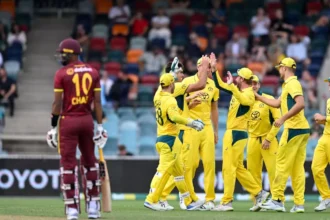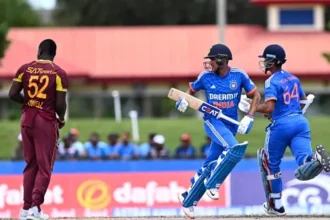
Cricket is a sport that constantly finds balance between aggression and skill, and the bouncer is one of-the most-aggressive weapons available for fast bowlers. A bouncer is a short-pitched ball and it makes the ball rise steeply to shoulder, chest or heading height after it has bounced on the pitch.
The art of fast bowling includes the variation to bowl bouncers and throughout the history of cricket, legendary fast bowlers have unleashed bouncers with the objective not only to intimidate batters but to break partnerships and change the direction of matches. But since too many short-pitched deliveries can pose safety issues and make the game uneven the International Cricket Council (ICC) has set a well-defined limit on how many bouncers a bowler is allowed to bowl in an over.
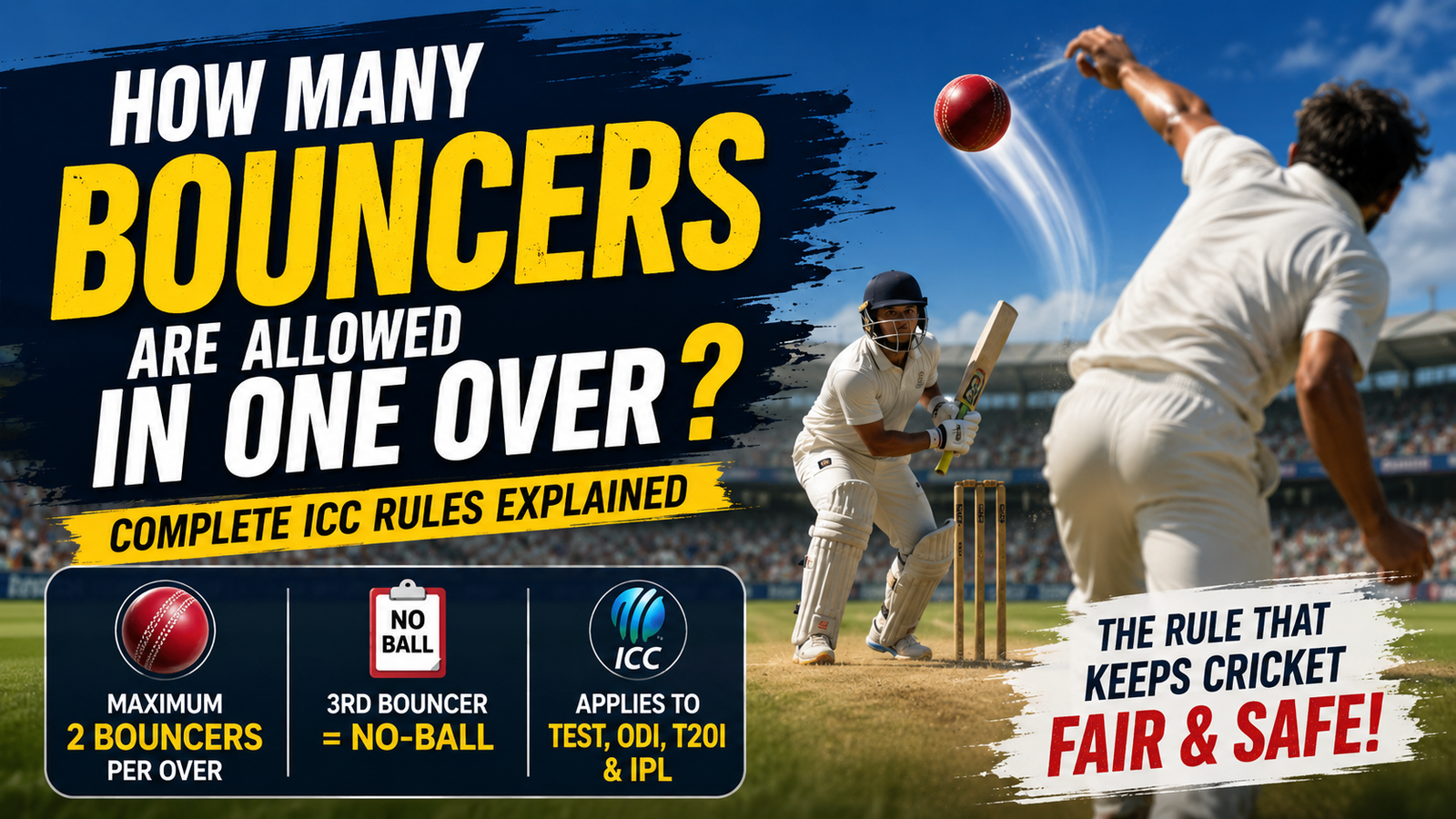
This is a common question many cricket fans especially those who are new to the game have asked several times “How many bouncers in one over? The answer is simple, at least up until this point: the current ICC playing conditions feature a maximum of two bouncers allowed per over for a bowler in all international formats (including Test matches, One Day Internationals, T20 Internationals) as well as most major franchise leagues like the IPL. The umpire then calls a no-ball for any extra bouncer above this upper limit by giving the batting side an additional benefit.
How Many Bouncers Are Allowed in One Over, Format-Wise Rules
| Cricket Format | Maximum Bouncers Allowed Per Over | Penalty for Extra Bouncer | Governing Rules |
| Test Cricket | 2 | No-Ball | ICC Playing Conditions |
| ODI Cricket | 2 | No-Ball + Extra Run | ICC Playing Conditions |
| T20 International | 2 | No-Ball + Free Hit | ICC Playing Conditions |
| IPL | 2 | No-Ball + Free Hit | IPL Playing Conditions |
| ICC World Cup | 2 | No-Ball + Applicable Penalties | ICC Tournament Rules |
| Champions Trophy | 2 | No-Ball + Applicable Penalties | ICC Tournament Rules |
Quick Summary of Bouncer Rules
| Rule | Details |
| What is a bouncer? | A short-pitched delivery that rises toward the batter’s upper body or head. |
| Maximum bouncers per over | 2 |
| Third bouncer in an over | Declared a no-ball |
| Purpose of the rule | Player safety and fair competition |
| Applies to | Tests, ODIs, T20Is, IPL, and ICC tournaments |
| Main advantage for bowlers | Creates pressure and wicket-taking opportunities |
| Common batting responses | Ducking, Swaying, Pull Shot, Hook Shot, Upper Cut |
| Introduced to improve | Safety, balance, and entertainment value |
What Is a Bouncer in Cricket
The Bumrah bouncer is one of the toughest deliveries for any batter because you have pace, bounce and surprise all in one. A bouncer, by contrast, is a deliberately short-pitched delivery which rises rapidly after bouncing on the pitch (as compared to a yorker which lands at or around the batter’s feet or other good-length ball set up for defensive shots).
Often the aim is to get the batter to do something rash — lose composure defending, mis-timing a pull shot, or even providing a catch to a greedy fielder waiting deep in the outfield. Bouncers are a part of the overall tactical plan used by Fast bowlers. If one bowler bowls a set of full-length deliveries and suddenly goes short, it throws the batter off-guard (to my surprise). Today, bouncers are still an integral part of fast bowling, yet with the restrictions imposed by ICC on their use.
A bouncer is a short-pitched delivery bowled by a fast or medium-fast bowler. The ball bounces on the pitch and rises steeply toward the batter’s chest, shoulders, or head.
The primary objectives of a bouncer include:
- Disrupting the batter’s rhythm
- Forcing defensive shots
- Creating catches for fielders
- Applying psychological pressure
- Setting up wicket-taking deliveries
Because of its aggressive nature, the ICC regulates the number of bouncers a bowler can bowl in an over.
How Many Bouncers Are Allowed in One Over
According to the existing ICC rules, a bowler is allowed two bouncers in an over. This applies across all formats of international cricket and has become the norm for professional competitions around the world. The umpire has no choice and is obliged to call a no-ball if the bowler bowls a third bouncer in the over. This can be especially expensive in limited-overs cricket such as ODIs and T20s, because it not only gives an additional run to the batting team, but may also trigger a free hit on the following delivery.
Consequently, bowlers and captains plan meticulously when to use the allowed bouncers. Instead of wasting them in the first half of an over, a lot of bowlers would keep one for later when they are looking to catch the batter off-guard and create chances to pick up their wicket.
The current ICC rule states that:
| Format | Allowed Bouncers Per Over |
| Test Cricket | 2 |
| One Day International (ODI) | 2 |
| T20 International | 2 |
| IPL | 2 |
Therefore, the answer to how many bouncers are allowed in one over in cricket is generally two bouncers per over in all major international formats and the IPL.
If a bowler exceeds this limit, the umpire signals a no-ball.
ICC Bouncer Rule Per Over
Restrictions Implemented For A Reason ICC has restricted short pitched bowling basically for 2 reasons. One is protect the player safety. Second is maintain integrity between bat and ball. For some periods in cricket’s history, and especially the 1970s and 1980s, fast-bowling attacks gained notoriety for their unshakeable dedication to short-pitched assault on batters.
These tactics were effective, but often at the cost of injuries and the general spectacle of the contest. The ICC has carefully capped the number of bouncers send down per over to prevent bowlers from purely utilising intimidation. Instead, they will have to rely on a mix of pace, swing and seam movement, vary their deliveries and sometimes try tactical acumen to dismiss the batters. It is to save cricket as a test of skill, rather than simply physical intimidation.
The ICC introduced restrictions on short-pitched bowling to protect batters from excessive intimidation and injury.
Under the current ICC playing conditions:
- Two short-pitched deliveries are permitted per over.
- Any additional bouncer is called a no-ball.
- The batter receives one extra run.
- The next delivery becomes a free hit in limited-overs cricket.
This rule applies to:
- International Test matches
- ODIs
- T20 Internationals
- ICC tournaments
The ICC bouncer rule per over helps maintain fairness while still allowing fast bowlers to use short-pitched tactics.
Why Are Bouncers Restricted
Many new fans wonder why bowlers cannot bowl unlimited bouncers.
The ICC introduced restrictions for several reasons:
Player Safety
Bouncers achieved speeds of over 140 km/h, and delivered at head or upper torso height. Although improvements to protective equipment have been made, the risk of injury remains from repeated short-pitched deliveries. Putting restrictions on bouncers helps in keeping the players safe and playing the game safely.
Fair Competition
All Fast bowlers should be allowed to bowl unlimited bouncers otherwise it will be injustice between fast bowlers and batter. This restriction allows for an even battle between bat and ball. It pushes both players to rely on strategy and skill instead of only intimidation.
Better Entertainment
Note: Cricket is a game that is best when bowlers and batters are relatively evenly matched. The excessive number of bouncers often makes it monotonous and one-dimensional for an admirer. This was a rule that gives matches an entertainment boost through several boundaries, deliveries, and battles of tactics.
Encouraging Skill
The bouncer cap compels the bowlers to switch to different deliveries like Yorkers, slower balls and swing bowling. Which enhances the standard of cricket as well as rewards bowlers who can change their strategy. This makes matches more competitive and skill based.
History of the Bouncer Rule
The rules regarding bouncers have changed multiple times throughout cricket history.
Early Cricket
Initially, there were virtually no restrictions on short-pitched bowling.
Rounding it off in the early years with minimal regulations about short-pitched bowling. The fast bowlers then had the freedom to test the batters with unlimited bouncers. It created fierce battles that sometimes came second to player safety.
1970s and 1980s
Fearsome fast-bowling attacks began to emerge during the 1970s and 1980s and dominated cricket, particularly from the West Indies. Bouncers were regularly used by bowlers who tended to believe doing so would run above opposition batters and bring them back into play psychologically. Their success revived discussions about playing safety and tighter regulations.
Teams such as the West Indies used fearsome pace attacks featuring:
- Michael Holding
- Joel Garner
- Malcolm Marshall
- Andy Roberts
These bowlers frequently used bouncers to dominate opponents.
1990s
However, in the 1990s cricket authorities started to limit short-pitched bowling. Unlimited bouncers would have given fast bowlers an undue hardship according to the ICC. To make the competition fairer and to limit injury hazards, new regulations were introduced progressively.
The ICC began introducing restrictions on excessive short-pitched bowling.
Modern Era
Today, the two-bouncer rule is standard across most international formats.
The ICC now permits at most two bouncers to be delivered per over in the majority of modern-day cricket. Every other bouncer is a no-ball by the umpire. It keeps players safe, and bouncers will continue to be an exciting tactic for fast bowlers.
Also read this: Which Cricketer Has More Fans in 2026 | IPL 2024 Winner | Jansen Height in Feet
How Does the Umpire Judge a Bouncer
Not every short ball counts as an official bouncer.
The umpire considers:
- Height of the ball after pitching
- Whether it passes above shoulder height
- Speed and trajectory
- Batter’s standing position
A delivery is generally counted as a bouncer when it rises sharply toward the batter’s upper body or head.
What Happens If a Bowler Bowls Too Many Bouncers?
A common question is:
What happens if a bowler bowls too many bouncers in one over?
If the bowler exceeds the allowed number:
In Test Cricket
- Umpire calls no-ball
- Batting side receives one run
In ODI Cricket
- No-ball is awarded
- One extra run added
In T20 Cricket
- No-ball is awarded
- Free hit on the next ball
This can significantly affect the game, especially during crucial moments.
Bouncer Rule in ODI Cricket Per Over
ODI cricket follows the same regulation.
Current ODI Rule
- Maximum 2 bouncers per over
- Third bouncer becomes a no-ball
The ODI format requires bowlers to carefully manage their short-pitched deliveries.
Fast bowlers often use bouncers:
- At the start of innings
- During middle overs
- At the death overs
Bouncer Limit Per Over in T20 Cricket
The bouncer limit per over in T20 cricket is also two.
This rule has made T20 bowling more strategic.
Because T20 batters attack aggressively, bowlers use bouncers:
- To prevent big shots
- To force mistimed pulls
- To create catching opportunities
Many death-over specialists rely heavily on well-directed bouncers.
How Many Bouncers Allowed in IPL One Over
Fans frequently ask:
How many bouncers are allowed in IPL one over?
The IPL follows ICC-style regulations.
IPL Bouncer Rule
- Two bouncers allowed per over
- Third short-pitched delivery becomes a no-ball
This rule applies throughout the tournament.
Several IPL fast bowlers use bouncers effectively, including:
- Jasprit Bumrah
- Pat Cummins
- Jofra Archer
- Kagiso Rabada
How Fast Bowlers Use Bouncers Strategically
A bouncer is not just a speedy ball directed at the batsman.
Elite bowlers use bouncers strategically.
Setting Up the Yorker
For example, a bowler can bowl bouncers and then yorkers.
Forcing Back-Foot Play
In bouncers, the batters are on a back foot.
Creating Catching Chances
Catching a hook that is mistimed?
Breaking Partnerships
Momentum can shift with a surprise bouncer.
Psychological Pressure
Short balls in succession are a confidence test for the batter.
Famous Bouncer Specialists in Cricket History
| Player | Country | Era | Why Famous for Bouncers |
| Jeff Thomson | Australia | 1970s | Known for extreme pace and intimidating short-pitched bowling that troubled batters worldwide. |
| Michael Holding | West Indies | 1970s–1980s | Combined speed, accuracy, and deadly bouncers to dominate international cricket. |
| Malcolm Marshall | West Indies | 1980s | Despite not being the tallest bowler, he generated steep bounce and bowled fearsome bouncers. |
| Joel Garner | West Indies | 1970s–1980s | Standing 6’8″, he used his height to produce awkward and dangerous bounce. |
| Brett Lee | Australia | 2000s | One of the fastest bowlers ever, famous for sharp and aggressive bouncers. |
| Shoaib Akhtar | Pakistan | 2000s | The “Rawalpindi Express” used raw pace and explosive bouncers to unsettle batters. |
| Dale Steyn | South Africa | 2000s–2010s | Mixed pace, swing, and surprise bouncers to become one of cricket’s greatest fast bowlers. |
| Mitchell Johnson | Australia | 2010s | His hostile short-pitched bowling played a key role in Australia’s Ashes dominance. |
| Jofra Archer | England | 2010s–2020s | Known for effortless pace and well-directed bouncers in all formats of the game. |
| Jasprit Bumrah | India | 2010s–Present | Uses surprise bouncers along with yorkers to trouble the world’s best batters. |
Challenges of Bowling Effective Bouncers
Although the bouncer looks simple, executing it consistently is difficult.
Challenges include:
- Maintaining accuracy
- Controlling pace
- Avoiding no-balls
- Managing over limits
- Reading batter reactions
Modern batters are highly skilled at handling short-pitched bowling.
How Batters Counter Bouncers
Top batters use several techniques against bouncers.
Ducking
Duck: One of the safest ways to counter a well-directed bouncer. The batter will drop their head and body underneath it — the ball goes over, untouched. This skill needs good ball height and speed judgement.
Swaying
Swaying is when the upper body goes towards the opposite side of where you are hitting the ball, and your feet do not move a lot. This is a technique used by experienced batters who want to stay in control of their movements at the crease while ducking bouncers. This helps make them ready for the next delivery avoiding unnecessary risks.
Pull Shot
The pull shot is a stroke that bowls to the batter who got a short-pitched delivery not rising much above his waist and has grown to be an attack response. The batter waits for the pace of the ball and smacks it hard towards the leg side. The pull shot, when performed well, can be the antidote to a bouncer that has proven headshaking.
Hook Shot
It is played off bouncers which are nearer shoulder or head high The batter turns and bat at the ball towards square leg or fine leg wall. The pull-shot is an attacking shot that can also be very successful, but is open to getting caught at mid-field.
Upper Cut
Uppercut Which modern cricket shot is in response to fast bouncers outside the off stump. The angled bat face allows a batter to direct the ball over the slips, or down towards the third-man fence. In T20 Cricket this shot is very much in demand as well because it brings fast runs against pace bowlers.
Players such as Virat Kohli, Rohit Sharma, and AB de Villiers have mastered playing bouncers.
Advantages of the Two-Bouncer Rule
The current rule benefits cricket in several ways.
Balanced Competition
Neither bowlers nor batters gain excessive advantage.
Greater Variety
Bowlers must use different deliveries.
Better Safety
Reduces risk of serious injuries.
More Tactical Cricket
Captains and bowlers must plan carefully.
Improved Entertainment
Fans enjoy a balanced contest.
Key Facts About Bouncer Rules
| Fact | Details |
| Maximum bouncers per over | 2 |
| Third bouncer | No-ball |
| ODI rule | 2 per over |
| T20 rule | 2 per over |
| IPL rule | 2 per over |
| Purpose | Safety and fairness |
| Free hit after no-ball in T20 | Yes |
| Applies to ICC events | Yes |
Common Myths About Bouncers
Myth 1: Unlimited Bouncers Are Allowed
False. Bowlers are limited to two bouncers per over.
Myth 2: Every Short Ball Is a Bouncer
False. Umpires determine whether the delivery qualifies as a bouncer.
Myth 3: Test Cricket Has No Restrictions
False. Test matches also follow bouncer limits.
Myth 4: IPL Uses Different Rules
False. IPL follows the same two-bouncer limit.
Conclusion
If you have ever wondered how many bouncers are allowed in one over, the answer is straightforward: two bouncers per over are permitted in Test cricket, ODI cricket, T20 Internationals, and the IPL. Any additional short-pitched delivery is called a no-ball by the umpire.
The bouncer is still one of the most thrilling and penetrating deliveries in cricket, offering speed and daring tactics to the game. Now, if you come to complain that how many bouncers one can bowl in a single over then the current ICC rule provides for only two bouncers including Test cricket, ODIs, T20 Internationals and IPL.
They are there to create equilibrium in bat and ball, but also for player safety. While no bowler can afford to bowl nothing but short-pitched deliveries, the bouncer remains one of cricket’s great weapons when used judiciously. The ICC bouncer limit per over is understood to enable fans to better appreciate the skill, planning, and strategy integral to fast bowlers of the modern game.
FAQs
1. How many bouncers are allowed in one over in international cricket?
According to current ICC rules, a bowler is allowed to bowl a maximum of two bouncers in one over in international cricket. Any additional bouncer is called a no-ball by the umpire.
2. How many bouncers can a bowler bowl in one over in T20 cricket?
In T20 Internationals and most domestic T20 leagues, including the IPL, bowlers can bowl two bouncers per over. A third short-pitched delivery results in a no-ball.
3. What is the ICC bouncer rule per over in ODI cricket?
The ICC bouncer rule for ODI cricket allows two bouncers per over. This regulation helps maintain a fair balance between aggressive fast bowling and batting.
4. How many bouncers are allowed in one over in the IPL?
The IPL follows ICC playing conditions, allowing bowlers to bowl a maximum of two bouncers per over. Exceeding this limit leads to a no-ball and additional penalties.
5. What happens if a bowler bowls more than the allowed number of bouncers in an over?
If a bowler delivers more than two bouncers in an over, the extra delivery is declared a no-ball. In limited-overs cricket, the batting team may also receive a free hit on the next ball.
6. Why does cricket have a limit on the number of bouncers per over?
The bouncer limit was introduced to improve player safety, prevent excessive intimidation, and ensure a balanced contest between batters and bowlers. It also encourages bowlers to use a variety of skills and tactics.