
DLS Method in Cricket used in cricket, an outdoor sport, played on grass fields with plenty of open sky to gaze into. Yet when the heavens open, sweeping across a golden day in a deluge and a hitherto leisurely contest as they are wont to do rain stops play at that point things can descend into anarchy unless there exists some kind of equitable mathematical system for determining the result of the game.
The system is the DLS method, short for the Duckworth-Lewis-Stern method, and it is now the universally accepted rain rule in cricket which all ICC teams use across ODIs, T20s and any limited-overs formats.
Be it a casual fan trying to figure out how or why on earth a team has been given an updated target, or a student of the game seeking details on the DLS method formula; this piece would explain in detail step-by-step with examples from its history and formula all the way to real-world application and controversies.
What Is the DLS Method in Cricket Match
The DLS in cricket refers to the mathematical formulation developed by Frank Duckworth and Tony Lewis to calculate a new target score for the side batting second in any limited-overs match interrupted by rain, bad light or other causes that reduce the number of overs played.
DLS is the shorts form of Duckworth-Lewis-Stern, a method with three mathematicians i.e. Frank Duckworth and Tony Lewis, also Steven Stern providing later updates for measuring scores in rain-affected matches. This method was used as the official rain rule for all International and most domestic limited-overs cricket matches by the ICC (International Cricket Council).
Cricket relied on much more crude and inconsistent methods for dealing with interruptions due to rain before DLS – A more contentious method was used that led to absurd results — the “highest scoring overs” rule was heavily panned for generating unrealistic asks. The DLS method was specifically created to address these shortcomings through a more principles-based, resource-driven approach.
History of the Duckworth-Lewis Method in Cricket
The Duckworth-Lewis Method itself stretches all the way back to the mid-1990s in ODI cricket. Frank Duckworth and Tony Lewis were independent when their minds were deeply troubled by the appearance of rain delays in limited-overs cricket. It was after the notoriety of the 1992 Cricket World Cup semi-final between England and South Africa – where a rain interruption meant that South Africa chasing 22 off 1 ball purportedly needed to score 22 runs off 1 ball, since their target had been reduced by only one run – that it became obvious the existing systems were broken.
As a result, Duckworth and Lewis started working on a resource-based approach. This method was first employed in international cricket on January 18, 1997 between England and Zimbabwe. This Duckworth-Lewis method was officially used by the ICC from 1999, and since then all previous methods have been replaced.
The maintenance of the system was passed to Australian statistician Steven Stern in 2014 after Frank Duckworth retired. This method was then renamed the Duckworth-Lewis-Stern (DLS) method in 2015 to recognize Stern’s continuing involvement.
How Does the Duckworth-Lewis-Stern Method Work
First, before understanding how DLS works, you need to understand a core concept: resources.
The Concept of Resources
The DLS method defines the “resources” of a batting team at any point in time by two things:
- Overs remaining
- Wickets in hand
For a team batting first, there are absolutely 100% resources available — all overs to go and all games (10 wickets) in hand. The resources become scarce when overs are bowled and wickets fall. The DLS technique uses a big lookup table that indicates the ratio of resources teams have at each combination of overs left and wickets lost.
At its core, the concept is: both sides get a chance to bat with a equal amount of resources. If rain denies Team 2 more overs, the DLS method manipulates their target to be a fair assessment of the comparison against Team 1 using an identical proportion of resources.
DLS Method Calculation: Step by Step
Here is how the DLS target is calculated in a cricket match:
Step 1: Calculate Team 1’s Resources Used
Team 1 bats their full allotment (say 50 overs in an ODI). Their resources used = 100% (full innings, 10 wickets available at start).
Step 2: Calculate Team 2’s Resources
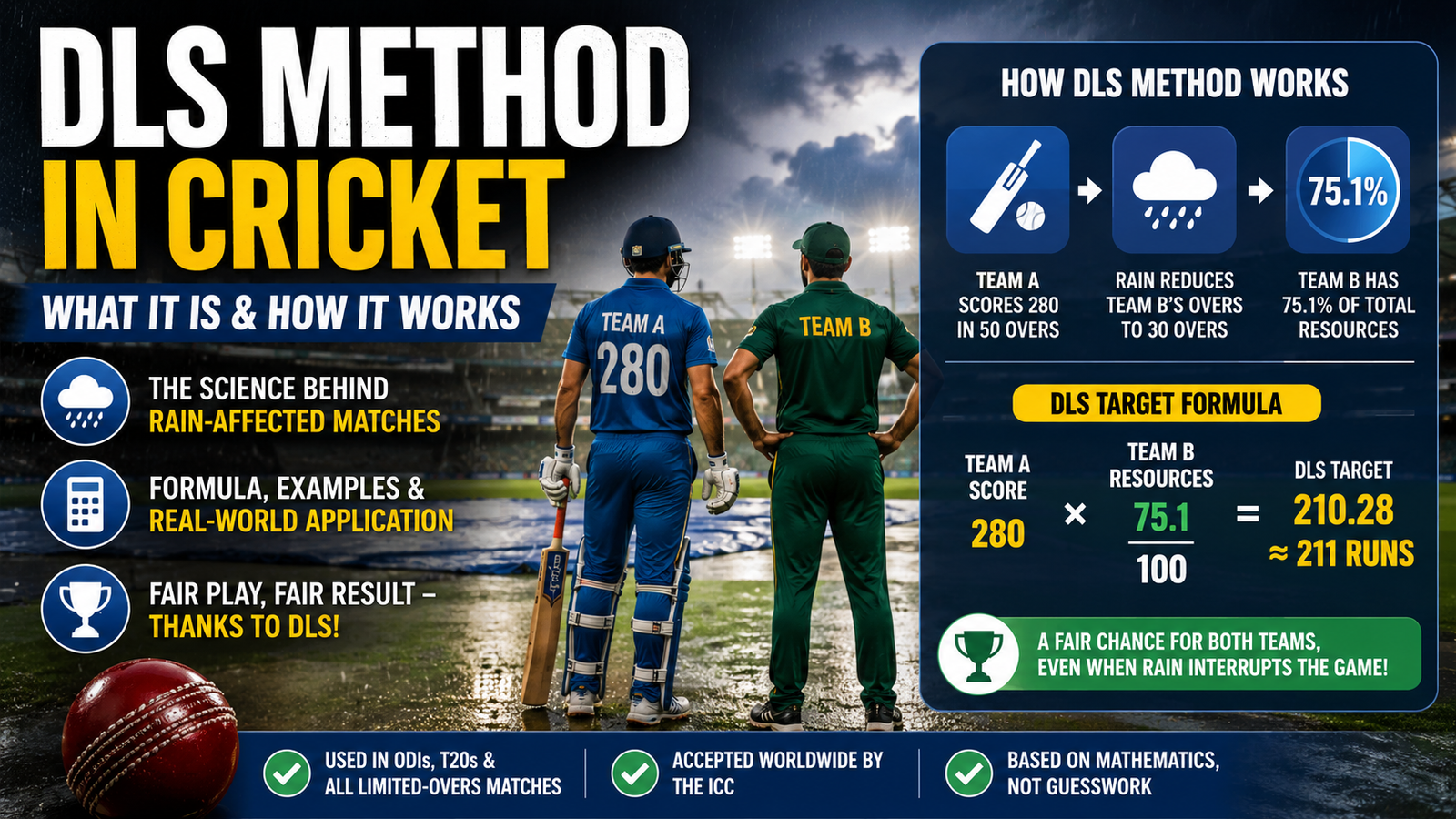
If rain reduces Team 2’s innings — say from 50 overs to 30 overs — their available resources are looked up from the DLS resource table. For example, 30 overs with all 10 wickets = approximately 75.1% of total resources.
Step 3: Apply the Formula
DLS Target = Team 1’s Score × (Team 2’s Resources / Team 1’s Resources)
So if Team 1 scored 280 in 50 overs, and Team 2 gets only 30 overs:
DLS Target = 280 × (75.1 / 100) = 210.28 ≈ 211 runs
Team 2 needs 211 runs to win in 30 overs — a fair revised target that reflects the resources available to each side.
Mid-Innings Rain Interruptions
The calculation becomes more complex when rain stops play mid-innings for Team 2. Suppose Team 2 is 100/2 after 20 overs and it rains, reducing their innings from 50 to 35 overs. The DLS method recalculates both what resources Team 2 has used and what they still have available, then adjusts the target accordingly. This is why the DLS par score updates dynamically throughout the match — it reflects what score Team 2 should be at given the exact overs and wickets used at every point.
DLS Method Formula Explained
The DLS method formula uses an exponential decay model. The resource percentage R(u, w) for u overs remaining and w wickets lost is modeled as:
R(u, w) = Z(w) × [1 − e^(−b(w) × u)]
Where:
- Z(w) is the asymptotic resource value (total resources when infinite overs remain, for w wickets lost)
- b(w) is a decay constant that controls how quickly resources diminish
- u is the number of overs remaining
- e is Euler’s number (~2.718)
In practice, these values are tabulated and teams, umpires, and match officials use the pre-computed DLS resource tables and software — not the raw formula in real time. The ICC provides certified DLS calculators to all match officials for this purpose.
DLS Method in ODI vs T20 Cricket
An important nuance is how different formats apply the DLS method.
DLS Method in ODI
The nature of the 50-over ODI gives the DLS method quite a bit more room to breathe. When more overs are played by each side, disruptions average out better and DLS targets a sound judgement. Hundreds of times it has been done in ODI cricket and is said to be a widely accepted method.
DLS Method in T20
The DLS method is criticized more with a T20 match. Given that T20 innings are already short (20 overs), shortening them is a big deal. If a team is chasing 180 in 20 overs and the game is reduced to 10 overs it would perhaps get DLS target of something like 110 — but the nature of run rate required, however, being entirely different.
T20 matches are often known for their fast nature of play, where one boundary changes the arithmetic dramatically, so many cricket experts say that the DLS method does not always echo this in a right frame.
These worries have been recognised by the ICC and in each one of a few amendments Steven Stern has made to the DLS tables through the years, attempting better methods for including specific T20 dynamics as games have developed.
Also read this: Most Beautiful Women Cricketers | MCA Pavilion Wankhede Stadium Ticket Price | IPL Ball Price
What Is the DLS Par Score
This DLS par score is the CB/1901 (Double Winning) Score that Team 2 has to match or better at [insert time of second Rain Interruption in 1] for this match to be a Repeat Tie/Win upon second rain interruption
If Team 2 is batting and rain prevents play at the end of 15 overs with a score of 90/3 runs, for instance, the umpires will look up what DLS par score was at that point in time. At that moment in time, if the par score is 88, Team 2 have crossed over DLS — which means that should the match be abandoned, Team 2 would win. Team 1 wins if they are below par.
That is why commentators often say “the DLS par score now is 95 in 15 overs” — it allows both teams and fans an instant reference throughout the match.
How ICC Applies DLS in World Cup Matches
DLS method is applied in every high profile tournament by the ICC such as the ICC Men’s Cricket World Cup, ICC T20 World Cup, ICC Women’s World Cup and Champions Trophy.
The ICC also reserves reserve days in knockout matches — semi-finals and finals specifically to try and avoid DLS-decided results if possible. But if bad weather continues into the reserve day and less than the requisite number of overs are bowled, then it will be down to DLS method, ending as the final ruling.
To ensure a match result is valid, a minimum number of overs must be bowled:
- ODIs: At least 20 overs per side must be bowled
- T20s: At least 5 overs per side must be bowled
If you can’t achieve even these minimums, then it’s deemed a No Result or a replay.
Difference Between DLS Method and VJD Method
Many cricket fans ask about the difference between the DLS method and the VJD method — an alternative developed by Indian mathematician V. Jayadevan.
| Feature | DLS Method | VJD Method |
| Developed by | Duckworth, Lewis, Stern | V. Jayadevan |
| ICC recognized | Yes | No (used in some domestic Indian cricket) |
| Resource model | Exponential decay | Two-curve model (normal + power play) |
| T20 suitability | Moderate | Claimed to be better for T20 |
| Global adoption | Universal | Limited |
While the VJD method’s proponents argue it better reflects T20 dynamics and Indian conditions, the ICC has continued to endorse the DLS method as the global standard. The VJD method has been used in some BCCI domestic tournaments but has not achieved international recognition.
DLS Method Criticism and Controversy
No system is free from criticism, and the DLS method has its critics as well.
Complexity for Casual Fans
The need to do something about this in the first place came primarily from one complaint; Most sports fans have been complaining that the DLS method is too complicated for even an average cricket fan to digest intuitively. The percentage of combined resources model is mathematically complicated and requires tables/software, meaning it is opaque to spectators at the ground — unlike a straightforward run-rate comparison.
T20 Suitability
As mentioned earlier, the DLS method in T20 cricket invariably ends up with ridiculous targets. T20 mode is a team hitting out from ball one, and this fundamental difference in batting philosophy compared to an ODI’s innings building is lost on the DLS tables, but that’s only a tiny part of the problem.
High-Scoring Modern Cricket
Now it is an everyday trend for Teams to tow along easily 350–400 runs in modern ODI cricket. The DLS approach was originally adjusted about scores (of around 225 in 50 overs) from a different time era. Steven Stern has rewritten the “Professional Edition” of the DLS tables to account for these inflated scores, but critics contend that the model continues to trail behind batting’s fast-changing landscape.
Famous Controversies
The DLS controversy has leaped into a few high-profile matches:
- 2003 World Cup — South Africa vs Sri Lanka: South Africa’s target was miscommunicated, leading to a tie when they needed to win to progress.
- 2019 World Cup — India vs Pakistan (reserve day): Rain threatened before sufficient overs were bowled, prompting debate about reserve days.
- Multiple T20 World Cup matches: Fans and analysts frequently question revised targets in knockout T20 games decided by DLS.
Why Is DLS Method Used in Cricket? Is There a Better Alternative
The DLS method is employed in cricket because, imperfect though it may be, it is the only mathematically robust and uniformly fair method currently available for dealing with rain-affected matches on a world stage. Its resource model captures the only two factors that could arguably tell us how much a batting team can score — overs left and wickets in hand. This is the most advanced and rigorously tested statistical method being endorsed for international cricket, and no other approach comes close.
Do you have a better alternative: probably but not yet demonstrated. The VJD method offers a useful approach for T20 cricket, while others have attempted machine-learning based models. But changing a de facto universal standard itself, one that has pervaded match regulations, software and umpire training, is hard evidence and ICC-wide approval.
Final Verdict
One of the few examples in cricket — the DLS method in cricket, or Duckworth-Lewis-Stern method — that comes to mind is more than just a math wonder. It is the bedrock of all rain-affected limited-overs crickets, in use at every ICC tournament and domestic league around the world.
Knowing how the DLS target is reached — via this concept of resources, overs left and wickets in hand — helps with demystifying what can sometimes look like a black-box call. Every number you see on TV as the DLS par score and then every number announced by the PA system when they announce the new DLS target has an exact, principled mathematical origin.
It is not flawless and has many real-world criticisms in the T20 age, but it has been refined over two decades now and still represents your gold standard for how you can deal with cricket’s oldest enemy – the weather. The DLS method will be the sport’s most reliable umpire when the rain begins to fall again as long as cricket continues in the open air.
FAQs
1. What is the full form of DLS Method in cricket?
DLS stands for Duckworth-Lewis-Stern Method. It is a mathematical formula used to revise targets in rain-affected limited-overs cricket matches.
2. How is the DLS target calculated in a rain-interrupted cricket match?
The DLS target is calculated using the resources available to both teams, including overs remaining and wickets in hand. The method ensures a fair revised target after interruptions.
3. Why is the DLS Method used instead of the old rain rule in cricket?
The DLS Method replaced older rain rules because it provides a more accurate and fair way to determine match results by considering both wickets and overs, rather than just run rates.
4. How does the DLS Method work in T20 cricket matches?
In T20 cricket, the DLS Method adjusts the target score when rain reduces the number of overs. It uses resource percentages to calculate a revised target for the chasing team.
5. What is the DLS par score and how does it decide the winner?
The DLS par score is the score a chasing team should have reached at a specific point in a rain-affected match. If the match is abandoned, the team above the par score wins.
6. Who invented the Duckworth-Lewis-Stern (DLS) Method in cricket?
The method was originally created by Frank Duckworth and Tony Lewis, and later updated by Steven Stern, which is why it is now called the Duckworth-Lewis-Stern (DLS) Method.