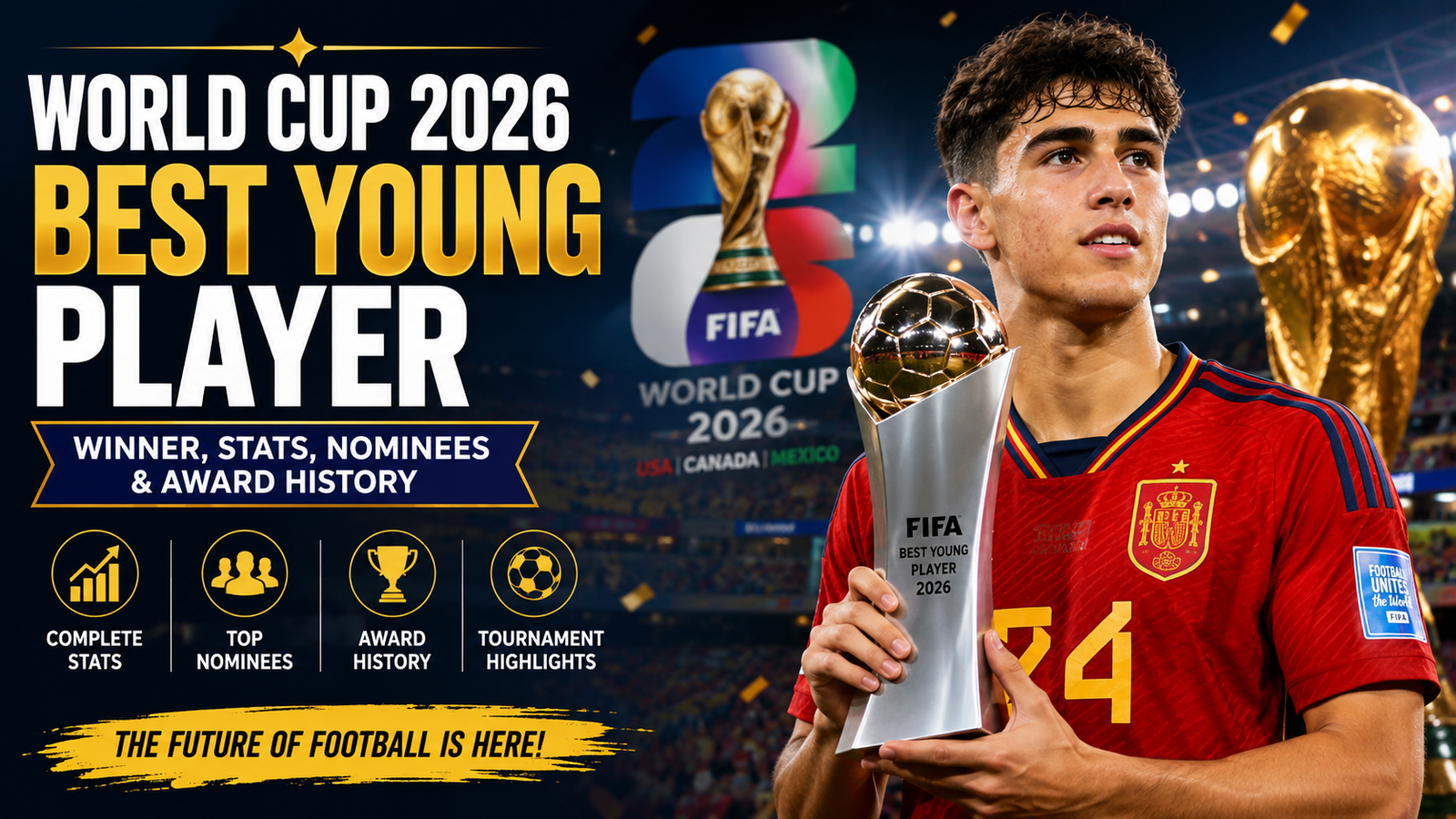
The FIFA World Cup 2026 didn’t just crown a new champion it also introduced the football world to the next generation of superstars. Among the dozens of teenagers and early-twenty-somethings who lit up stadiums across the USA, Canada, and Mexico, one name rose above the rest: Pau Cubarsí.
The 19-year-old Spanish center-back walked away with the FIFA Young Player Award, presented by Aramco (commonly known as the Best Young Player award), capping a remarkable tournament in which he barely put a foot wrong. In a competition stacked with electric attacking talent — Lamine Yamal, Désiré Doué, Arda Güler, and more — it was a defender who convinced FIFA’s Technical Study Group and the watching football world that composure, consistency, and leadership beyond his years mattered just as much as flair.
This article breaks down everything you need to know about the World Cup 2026 Best Young Player award: who won it, why he deserved it, his full tournament stats, his match-by-match journey to the trophy, how the award is decided, and how his win stacks up against past winners like Kylian Mbappé, Paul Pogba, and Enzo Fernández.
Who Won the World Cup 2026 Best Young Player Award?
Pau Cubarsí of Spain was named the FIFA Young Player Award winner at the 2026 World Cup, with FIFA confirming the honour after Spain’s 1-0 extra-time victory over Argentina in the final at New York New Jersey Stadium.
- Winner: Pau Cubarsí
- National team: Spain
- Club: FC Barcelona
- Age during the tournament: 19 years old (born January 22, 2007)
- Playing position: Centre-back
- Award announcement: Confirmed alongside the tournament’s other major individual honours following the final on July 19, 2026
- Why he was selected: Cubarsí started all eight of Spain’s matches at center-back, anchoring a defense that conceded just a single goal across the entire tournament one of the meanest defensive records in modern World Cup history. FIFA’s Technical Study Group pointed to his composure on the ball, his reading of the game, his aerial and dual numbers, and his ability to perform at the same level in a World Cup final as he did in the group stage. He also became the first defender ever to win the award since it was formalized in 2006, a distinction that set his campaign apart from the usual roll call of attacking winners.
Quick Facts About the World Cup 2026 Best Young Player
| Detail | Information |
| Award | FIFA Young Player Award, presented by Aramco (Best Young Player) |
| Winner | Pau Cubarsí |
| Country | Spain |
| Club | FC Barcelona |
| Age | 19 |
| Position | Centre-back |
| Tournament | FIFA World Cup 2026 |
| Host Nations | USA, Canada & Mexico |
| Result with Spain | World Cup champions (2nd title) |
| Notable feat | First defender to win the Best Young Player award |
Also read this:
Why Did the Winner Deserve the Award?
Outstanding Tournament Performances
Cubarsí was one of the few players at the World Cup who genuinely didn’t have an off day. From Spain’s opening group match to the final whistle in the final, he delivered the same calm, error-free performances that made him a fixture of Luis de la Fuente’s starting XI — never rotated, never rested, never dropped.
Defensive Contributions
Playing alongside Aymeric Laporte at the heart of Spain’s back line, Cubarsí was central to a defensive record that saw Spain concede just one goal in eight matches — a wonder strike in the quarter-final win over Belgium. His clearances, interceptions, and last-man tackles were a constant feature of Spain’s route to the trophy, and he repeatedly came out on top in aerial and ground duels against far more experienced strikers.
Consistency Throughout the Tournament
Cubarsí is the only player under 20 to play every single minute for his national team at the 2026 World Cup, and one of only three Spain players — alongside goalkeeper Unai Simón and full-back Marc Cucurella — to feature in every minute of the campaign. That level of durability and reliability, at a position that demands split-second decision-making, is rare for a teenager on the world’s biggest stage.
Impact in Knockout Matches
The knockout rounds are where reputations are made, and Cubarsí thrived under the increased pressure. In the semi-final win over France, he produced a decisive last-man tackle and a joint-match-high four clearances, snuffing out chance after chance created by Kylian Mbappé and Michael Olisé.
Performance in the Final
In the final against Argentina, Cubarsí played all 120 minutes and finished with the most passes (126), most accurate passes (121), and most clearances (6) of any player on the pitch, alongside a 96% pass completion rate. It was the performance of a player entirely unfazed by the occasion — helping Spain shut out a Messi-led Argentina side and lift the trophy for the second time in the country’s history.
World Cup 2026 Best Young Player Stats
| Stat | Total |
| Matches Played | 8 (all starts) |
| Minutes Played | 750 (every minute of the tournament) |
| Goals | 0 |
| Assists | 0 |
| Clean Sheets | 7 |
| Goals Conceded (with him on the pitch) | 1 |
| Pass Accuracy | 96% |
| Passes Completed | 432+ of roughly 450 attempted |
| Key Passes / Chances Created | 5 |
| Clearances | 30+ |
| Tackles Won | Majority of attempted tackles, including multiple last-man interventions |
| Aerial Duels Won | Over 60% |
| Man of the Match Awards | Multiple, including the semi-final |
| Yellow/Red Cards | 0 yellow, 0 red |
Note: Some in-tournament statistics were tracked cumulatively by different outlets and may vary slightly by source, but all confirm Cubarsí’s exceptional passing accuracy, zero-card discipline, and ever-present role in Spain’s defence.
Journey to Winning the Award
Group Stage Performance
Cubarsí started from matchday one, immediately forming a settled partnership with Laporte. Spain conceded nothing across their opening group games, with Cubarsí’s positioning and recovery pace repeatedly snuffing out counter-attacks before they developed.
Round of 32
With Spain topping their group, Cubarsí carried his clean-sheet run into the knockout stage, continuing to rack up clearances and ball recoveries while barely misplacing a pass.
Round of 16
Spain’s defensive discipline held firm, with Cubarsí again completing the full 90 minutes and contributing to another shutout, further cementing his status as one of the tournament’s most reliable performers.
Quarter-finals
Spain’s only goal conceded of the entire tournament came in the quarter-final win over Belgium — a stoppage-worthy strike that did little to dent Cubarsí’s overall numbers. Spain still advanced, with Cubarsí recording five clearances and continuing his ever-present run.
Semi-finals
Facing France and Mbappé in the last four, Cubarsí produced arguably his best game of the tournament: two tackles (including a vital last-man challenge), four clearances, two ball recoveries, and a perfect record in aerial duels, as Spain won 2-0 to reach the final.
Final
Cubarsí played all 120 minutes of the final against Argentina, leading all players in passes, accurate passes, and clearances as Spain won 1-0 after extra time to be crowned world champions for the second time — with Cubarsí becoming one of only five teenagers in history to win a World Cup.
Best Moments of the Tournament
- The Belgium quarter-final: Despite conceding Spain’s only goal of the tournament, Cubarsí’s overall defensive display kept Spain in control throughout.
- The France semi-final tackle: A crucial last-man challenge that stopped a dangerous French counter-attack in its tracks.
- The final performance: Leading every outfield player in passing output and clearances in the biggest match of his career, at just 19 years old.
- The clean-sheet streak: Seven clean sheets in eight matches, a defensive record matched by very few players in modern World Cup history.
- Matching — and beating — a legend’s record: Reaching six career World Cup clean sheets faster than Paolo Maldini did, one of the standout individual milestones of the tournament.
World Cup 2026 Best Young Player Nominees
| Player | Country | Position | Club | Age | Performance |
| Pau Cubarsí (Winner) | Spain | Centre-back | FC Barcelona | 19 | 7 clean sheets in 8 matches; ever-present in a title-winning defence |
| Lamine Yamal | Spain | Right Winger | FC Barcelona | 19 | Key creative outlet for Spain throughout their unbeaten run to the title |
| Désiré Doué | France | Forward/Winger | Paris Saint-Germain | 21 | Impactful displays for France en route to the semi-finals |
| Nico O’Reilly | England | Defender | Manchester City | 20 | Composed performances and strong passing numbers for England’s run |
| Ayyoub Bouaddi | Morocco | Midfielder | Lille | 19 | Controlled Morocco’s midfield throughout their quarter-final run |
| Arda Güler | Turkey | Midfielder | Real Madrid | 21 | Dictated Turkey’s attacking play in the group stage |
How FIFA Selects the Best Young Player
- Eligibility criteria: Any player born on or after January 1, 2005, was eligible for the 2026 award — meaning players had to be 21 years old or younger at the start of the tournament year.
- Age limit: 21 years old or under, calculated at the start of the calendar year of the tournament, not the player’s age on matchday.
- Shortlist process: FIFA narrows the field to a small group of candidates as the tournament progresses, spotlighting standout young performers after each knockout round.
- Voting process: The final decision blends fan input with expert analysis rather than being decided by fan vote alone.
- FIFA Technical Study Group: A panel of experienced coaches and football analysts who assess statistical performance, tactical impact, and consistency across the tournament.
- Selection factors: Match-winning contributions, defensive and attacking output, discipline, consistency across the full tournament, and performance in the biggest games (knockout rounds and the final) all weigh heavily in the decision.
Previous FIFA World Cup Best Young Player Winners
| Year | Winner | Country |
| 2006 | Lukas Podolski | Germany |
| 2010 | Thomas Müller | Germany |
| 2014 | Paul Pogba | France |
| 2018 | Kylian Mbappé | France |
| 2022 | Enzo Fernández | Argentina |
| 2026 | Pau Cubarsí | Spain |
Comparison With Previous Winners
Playing Style
Where Mbappé (2018) and Pogba (2014) won the award for explosive, game-changing attacking play, and Podolski and Müller combined finishing with all-around forward play, Cubarsí’s win marks a shift in recognition toward defensive excellence — the first time a purely defensive player has taken home the honour.
Statistics
Unlike goal-and-assist-driven winners such as Mbappé (four goals in 2018) or Müller (five goals and three assists in 2010), Cubarsí’s case rested almost entirely on defensive metrics: clean sheets, clearances, duels won, and elite passing accuracy out from the back.
Age Comparison
At 19, Cubarsí is tied with Mbappé as one of the youngest official winners of the award, and younger than Podolski (21), Pogba (21), and Fernández (21) were when they won.
Trophy Success
Cubarsí joins Mbappé (2018) and Fernández (2022) as one of only a handful of Best Young Player winners since 2006 to also lift the World Cup trophy in the same tournament — underlining just how central he was to a genuinely title-winning campaign, not simply a breakout individual run on an eliminated team.
Career Potential
Like Mbappé and Pogba before him, Cubarsí enters his early twenties with a World Cup winner’s medal already on his shelf, alongside back-to-back La Liga titles and an Olympic gold medal with Spain’s U23 side — a résumé that places him among the most complete young defenders in the game.
Expert Reactions
FIFA’s official recognition praised Cubarsí’s leadership and defensive authority “beyond his years,” highlighting his role in anchoring one of the tournament’s best defensive records. Spanish coaching staff and teammates have repeatedly pointed to his maturity and game-reading ability as reasons he was trusted to start every single match despite his age. Football analysts and pundits have widely framed his award as a deserved recognition of defensive craft in a tournament otherwise dominated by attacking headlines from players like Mbappé and Messi.
Fan Reactions on Social Media
Cubarsí’s rise became one of the most-discussed storylines of the tournament on social media, with fans and stat accounts regularly sharing his near-flawless passing numbers and clean-sheet streak. Barcelona supporters in particular celebrated his emergence as a worthy successor to the club’s long line of academy-produced defenders, while neutral fans praised the rare sight of a teenage centre-back outshining a field of attacking prodigies for the game’s top young-player honour.
What This Award Means for the Winner’s Career
- Market value: Cubarsí’s value has climbed sharply, with transfer valuations placing him among the most valuable young centre-backs in world football following his World Cup performances.
- Transfer interest: While he remains contracted to Barcelona, his tournament has only intensified reported interest from other elite clubs across Europe.
- Future prospects: With a World Cup winner’s medal, back-to-back league titles, and now this individual honour by age 19, Cubarsí is firmly positioned as one of the sport’s next great defenders.
- National team importance: He is now undroppable in Luis de la Fuente’s Spain side heading into future international tournaments.
- Club expectations: Barcelona will lean even more heavily on Cubarsí as the long-term cornerstone of their defence in the coming seasons.
Conclusion
Pau Cubarsí’s FIFA Young Player Award win at the 2026 World Cup wasn’t just a personal milestone — it was a statement about the value of defensive excellence on football’s biggest stage. In a tournament packed with electric young attackers, it was a 19-year-old centre-back’s composure, consistency, and near-flawless passing that ultimately won over FIFA’s Technical Study Group and the wider football world.
Having already won a World Cup, back-to-back La Liga titles, and an Olympic gold medal before turning 20, Cubarsí’s trajectory points toward a long run at the top of the game. As Spain and Barcelona both build their futures around him, all eyes will be on whether he can carry this form into the next major international tournaments — and cement his place among the finest defenders of his generation.
FAQs
1.Who won the World Cup 2026 Best Young Player award?
Pau Cubarsí of Spain won the award after helping his side to the World Cup title with a near-flawless defensive campaign.
2.How old was the winner?
Cubarsí was 19 years old during the tournament.
3.Who selects the Best Young Player?
The winner is determined through a combination of fan input and assessment from FIFA’s Technical Study Group, a panel of coaches and football analysts.
4.What are the eligibility rules?
Players must be born on or after January 1, 2005, to be eligible for the 2026 award — meaning they had to be 21 or under at the start of the tournament year.
5.Which country has produced the most Best Young Player winners?
Germany and France have both produced two official winners each since the award began in 2006 (Germany: Podolski, Müller; France: Pogba, Mbappé), with Spain now joining that group via Cubarsí in 2026.
6.Has a defender ever won the Best Young Player Award?
Yes — Pau Cubarsí in 2026 is the first defender to win the official award since it began in 2006.
7.What is the difference between the Golden Ball and Best Young Player Award?
The Golden Ball is awarded to the best overall player of the tournament regardless of age (won by Rodri in 2026), while the Best Young Player award is restricted to players 21 or under.
8.Can a player win both the Golden Ball and Best Young Player Award?
In theory, yes, since a young player can also be the tournament’s standout performer overall — though in practice it’s rare, and at the 2026 World Cup the two awards went to different Spain players, Rodri and Cubarsí respectively.