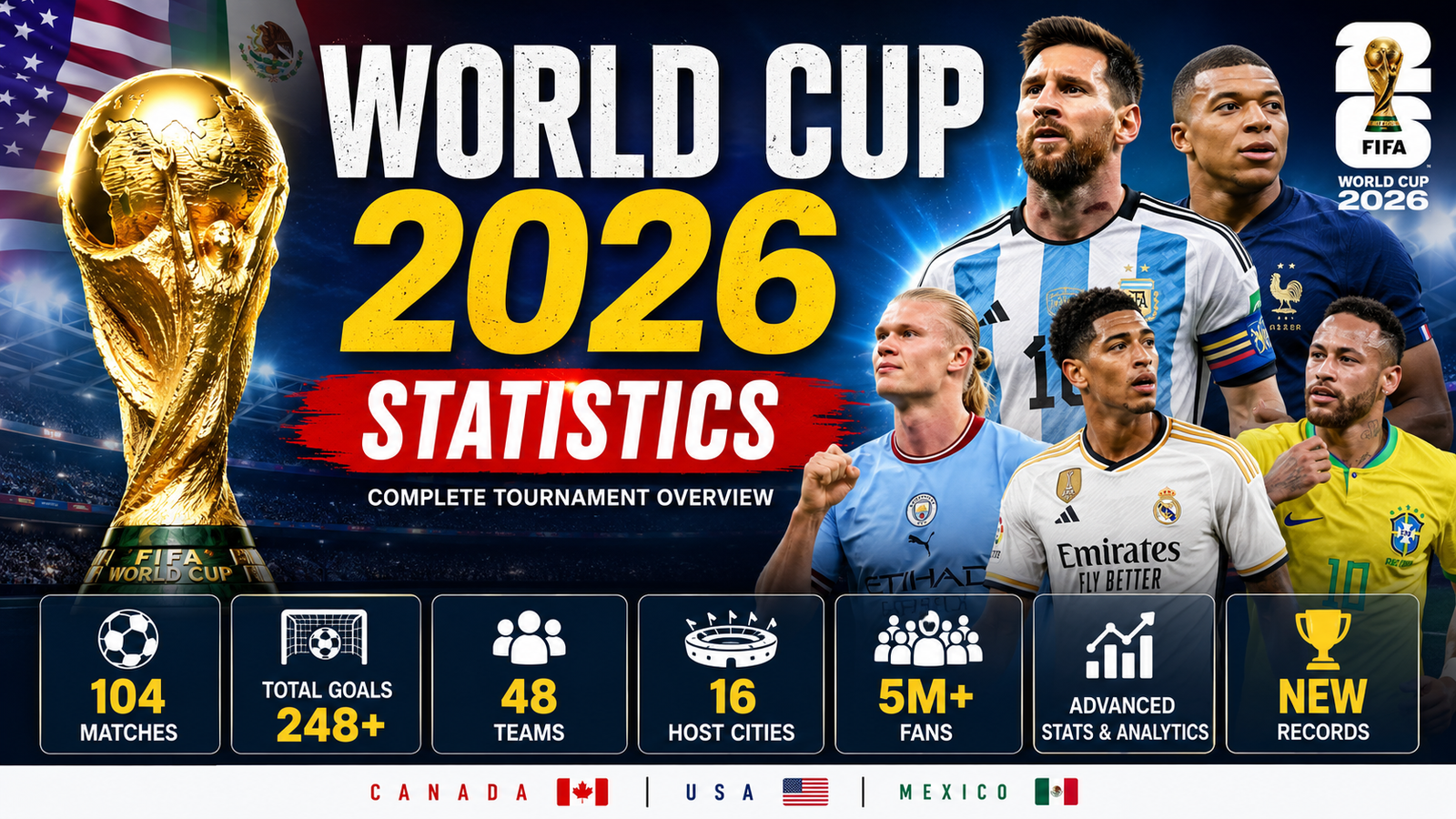
The World Cup 2026 Statistics, and the numbers it leaves behind are unlike anything the tournament has produced before. Played across the United States, Mexico, and Canada from June 11 to July 19, 2026, this was the first edition to feature 48 teams and 104 matches, up from the 32-team, 64-match format used since 1998. That expansion alone reshaped almost every record book in the sport, but the football itself did the rest — this was the highest-scoring World Cup since 1970 and the best-attended in history.
Statistics matter at a tournament like this because they’re the clearest way to separate genuine greatness from good stories. Anyone can remember that Spain won; the numbers tell you they did it while conceding a single goal in eight matches, something no previous champion had managed. This guide pulls together the full picture of World Cup 2026 statistics — tournament totals, team and player numbers, goalkeeper performance, records broken, award winners, and how this edition compares with Qatar 2022.
FIFA World Cup 2026 at a Glance
| Statistic | Value |
| Host Countries | United States, Mexico, Canada |
| Total Teams | 48 |
| Total Matches | 104 |
| Total Goals | 308 |
| Champion | Spain (2nd title) |
| Runner-up | Argentina |
| Third Place | England |
| Golden Boot Winner | Kylian Mbappe (France) — 10 goals |
| Golden Ball Winner | Rodri (Spain) |
| Golden Glove Winner | Unai Simon (Spain) |
| Young Player Award | Pau Cubarsi (Spain) |
| Fair Play Award | Netherlands |
World Cup 2026 Overall Tournament Statistics
The headline number is 308 goals in 104 matches, an average of 2.96 goals per game — the best scoring rate at a World Cup since Mexico 1970 (2.97) and comfortably above Qatar 2022’s 2.69. Of those 104 games, 57 finished with both teams scoring, and 54 of the 308 goals — 17.5% — came from set pieces, including 16 penalties.
Attendance was the other defining story of the tournament. FIFA recorded a cumulative 6,810,966 fans across the 104 matches, an average of roughly 65,490 per game at close to full occupancy, nearly double the previous record of about 3.59 million set when the United States last hosted in 1994. A single-day attendance record of 426,834 spectators was set on June 25.
A handful of milestones fell along the way that are worth noting outside a simple team-by-team breakdown:
- The tournament’s 173rd goal, scored by USA defender Auston Trusty against Turkiye, broke the all-time single-edition goals record previously held by Qatar 2022 — with more than 40 matches still to play.
- Argentina’s Enzo Fernandez scored the 3,000th goal in men’s World Cup history during a Round of 16 win over Egypt.
- Japan’s 4-0 win over Tunisia doubled as the 1,000th match in men’s World Cup history.
FIFA has not published a consolidated breakdown of VAR intervention counts, extra-time match totals, or penalty-shootout figures for the full 104-match tournament at the time of writing, so those specific counts are left out here rather than estimated — worth checking FIFA’s official statistics hub if a precise figure is needed for a given section.
Also read this:
Team Statistics
Team-level numbers tell a story of attacking football colliding with genuinely elite defending at the top of the bracket.
Best attack: France were the tournament’s most productive scoring side for long stretches of the group and knockout rounds, eventually finishing their run with a 6-4 shootout of a third-place match against England that was, on its own, the highest-scoring game of the tournament and the first World Cup match with 10+ goals since 1982.
Best defense: Spain’s was the standout defensive campaign of the tournament. The eventual champions conceded just one goal in eight matches — a record for a champion under the expanded format — while stretching an unbeaten run to 38 games across club and international convergence points in their squad’s recent history.
Team firsts worth flagging:
- Curacao, with a population near 150,000, became the smallest nation ever to play at a World Cup and the smallest to score a goal.
- Cape Verde became the smallest nation to reach the knockout stage.
- A record nine African teams advanced to the knockout rounds, more than four times the previous best of two.
- Senegal became the first African nation to score five goals in a single World Cup match (a 5-0 win over Iraq) and set an African group-stage record of eight goals.
- Mexico won four consecutive World Cup matches for the first time, a CONCACAF record.
- Japan’s 4-0 win over Tunisia was the biggest win by an Asian nation at a World Cup.
Granular team-by-team figures for possession percentage, passing accuracy, expected goals (xG), shots, corners, and disciplinary cards have not been consolidated into a single official source as of this writing. Rather than estimate those numbers, this guide sticks to the confirmed totals above; FIFA’s official post-tournament technical report, typically released some weeks after the final, is the best source once it’s published.
It’s also worth noting how differently “best attack” and “best defense” showed up on the scoreboard this year. France’s attacking numbers were built on volume and star power up front, with Mbappe and Olise doing much of the damage, yet that firepower couldn’t get them past Spain in the semi-final.
Spain’s route to the title, by contrast, was built on control long spells of possession, patient build-up through midfield anchored by Rodri, and a back line marshalled by teenage centre-back Pau Cubarsi that simply didn’t get broken down. That contrast, an entertaining but occasionally leaky France side against a nearly airtight Spain, is a large part of why the final itself was tense and low-scoring even though the tournament around it was the most prolific in over 50 years.
Player Statistics
Top Scorers (Golden Boot Race)
| Rank | Player | Nation | Goals |
| 1 | Kylian Mbappe | France | 10 |
| 2 | Lionel Messi | Argentina | 8 |
| 3 | Jude Bellingham | England | 7 |
| 3 | Erling Haaland | Norway | 7 |
Mbappe won the Golden Boot for the second straight tournament — the first player in history to do so — finishing two clear of Messi. It was also the first World Cup where four different players each scored seven or more goals in a single edition.
Most Assists
Lionel Messi set a new World Cup assists record with 12 career assists, passing Pele’s long-standing mark, in what he has described as his final World Cup appearance. Michael Olise (France) set the record for the most assists by a single player in one edition, with seven.
Goal Contributions (Goals + Assists)
| Player | Nation | Goal Contributions (single edition) |
| Kylian Mbappe | France | 14 |
| Lionel Messi | Argentina | 12 |
Mbappe’s combined tally is the highest for a single World Cup since Gerd Muller’s 13 in 1970.
Player Milestones
- Kylian Mbappe finished the tournament as the all-time leading World Cup goalscorer, with 22 career goals — one ahead of Messi — after a brace against England in the third-place match. He also passed Hugo Lloris to become France’s most-capped World Cup player.
- Lionel Messi played a record 34 World Cup matches and logged more World Cup minutes than any player in history. He scored in nine consecutive World Cup appearances spanning 2022 and 2026, another record, and became the first player to start three World Cup finals.
- Cristiano Ronaldo became the first player to score at six different World Cups and finished his World Cup career as Portugal’s all-time top scorer with 11 goals.
- Jude Bellingham scored seven goals, the most by an England player at a single World Cup.
- Harry Kane finished his World Cup career on 14 goals, England’s all-time record, passing Gary Lineker’s 10.
- Erling Haaland scored seven goals before Norway’s quarter-final exit, becoming his country’s all-time leading World Cup scorer on his tournament debut.
- Bukayo Saka scored a hat-trick in the third-place match against France, only the second England player to score one in a World Cup knockout match, after Geoff Hurst.
Detailed per-player passing, dribbling, distance-covered, and sprint-speed data from FIFA’s tracking systems has not been publicly consolidated at the individual level for this piece; where those figures matter for a specific player profile, they’re best sourced from FIFA’s official player statistics pages once released.
Goalkeeper Statistics
| Goalkeeper | Nation | Clean Sheets | Note |
| Unai Simon | Spain | 5+ | Record 650-minute shutout streak (all-time) |
| Mike Maignan | France | 4 | Eliminated at semi-final stage |
| Jordan Pickford | England | 2+ | Known for clutch saves in knockout rounds |
| Emiliano Martinez | Argentina | 2+ | Record 11 saves in the final |
Unai Simon won the Golden Glove and set the all-time World Cup record for the longest run without conceding — 650 consecutive minutes, spanning the 2022 and 2026 tournaments — passing Walter Zenga’s 517-minute mark from Italia ’90. Argentina’s Emiliano Martinez, the 2022 Golden Glove winner, made a record 11 saves in the 2026 final but could not deny Spain the title.
Match Statistics
- Highest-scoring match: England 6-4 France, third-place play-off — the first World Cup match with 10 or more goals since 1982.
- Biggest African-nation win: Senegal 5-0 Iraq.
- Biggest Asian-nation win: Japan 4-0 Tunisia.
- Final result: Spain 1-0 Argentina (after extra time), MetLife Stadium, July 19 — decided by Ferran Torres in the 106th minute, in front of 80,663 fans.
- Semi-finals: Spain 2-0 France; Argentina 2-1 England (Argentina came from behind with two goals in the final ten minutes).
- Third-place match: England 6-4 France.
Knockout Stage Statistics
The 2026 format introduced a Round of 32, a stage that didn’t exist in the 32-team era, adding an extra knockout round before the traditional Round of 16. Beyond the raw round-by-round scorelines, a few knockout-stage patterns stood out:
- Spain went through the entire knockout bracket — Round of 32, Round of 16, quarter-final, semi-final, and final — conceding only once, the tournament’s defining defensive achievement.
- The third-place match, traditionally a low-stakes fixture, produced the tournament’s most goals (10) and Mbappe’s decisive brace to claim the all-time scoring record.
- A record nine African teams made it out of the group stage into this expanded knockout bracket, reshaping what “giant-killing” looks like under the 48-team system.
Group Stage Statistics
With 12 groups of four teams in the new format (replacing the old eight groups of four), the group stage alone produced far more matches than any previous edition’s group phase — 72 in total, more than the entire 64-match tournament held in Qatar just four years earlier. Those 72 group games produced 215 goals on their own, an average of 2.98 per match, essentially setting the tone for the high-scoring tournament that followed rather than being an outlier against it.
The expanded format also changed what “surviving the group stage” means. With four third-placed teams advancing alongside the group winners and runners-up, several traditionally lower-ranked footballing nations including Cape Verde and a wave of African sides found a realistic path into the knockout rounds that wouldn’t have existed under the old 32-team system.
Specific per-group goal totals and the identities of the single highest- and lowest-scoring groups have not been consolidated into one official release at the time of writing, so exact group-by-group numbers are left out rather than approximated here; FIFA’s group-stage archive is the place to check once that breakdown is published.
World Cup 2026 Records Broken
| Record | 2026 Mark | Previous Record |
| Champions | Spain, 1-0 vs Argentina (2nd title) | Argentina, 2022 |
| Goals scored | 308 in 104 matches | 172, Qatar 2022 |
| Total attendance | 6,810,966 | ~3.59 million, USA 1994 |
| Teams | 48 | 32 |
| Matches | 104 | 64 |
| All-time top scorer | Kylian Mbappe, 22 goals | Lionel Messi, 21 (set earlier in 2026) |
| Golden Boot | Mbappe, 10 goals | Mbappe, 8 (Qatar 2022) |
| Longest goalkeeper shutout streak | Unai Simon, 650 minutes | Walter Zenga, 517 minutes (1990) |
| Most World Cup assists (career) | Messi, 12 | Pele |
| Most matches played (career) | Messi, 34 | — |
Spain’s win also made them the first European nation to win a World Cup staged in the Americas, ending a run of seven straight editions on the continent won by South American teams. No champion has retained the trophy since Brazil in 1962, and Argentina’s bid to do so in 2026 fell short.
Award Winners and Their Statistics
| Award | Winner | Nation | Key Stat |
| Golden Boot | Kylian Mbappe | France | 10 goals |
| Golden Ball | Rodri | Spain | Anchored Spain’s midfield through an 8-match, 1-goal-conceded run |
| Golden Glove | Unai Simon | Spain | 5 clean sheets, 650-minute record shutout streak |
| Young Player Award | Pau Cubarsi | Spain | 19 years old; key defensive figure in Spain’s title run |
| Fair Play Award | Netherlands | — | Best disciplinary record among qualifying teams |
Spain swept every major individual award except the Golden Boot, which Mbappe carried out of France’s semi-final exit — a rare split where the top scorer’s team didn’t reach the final at all.
Statistical Insights and Trends
- Scoring surge: At 2.96 goals per game, 2026 was the highest-scoring World Cup by average since 1970, reversing a run of relatively defensive tournaments from 1990 through 2022.
- Set pieces mattered: 54 of 308 goals (17.5%) came from set-piece situations, including 16 penalties — a reminder that dead-ball quality remained a differentiator even in an attack-heavy tournament.
- Long-range shooting: 43 goals (14.6% of the total) came from outside the penalty area, split between direct free kicks and long-range open play strikes.
- Elite defending still won the trophy: despite the tournament’s overall scoring explosion, the champion conceded a single goal across eight matches — proof that the highest-scoring World Cup in over 50 years was still won on the back of the meanest defense in the competition.
- Golden generation farewell: Messi’s final World Cup produced career-defining numbers (most matches played, most minutes, most assists, a nine-game scoring streak) even without a third title, while Mbappe’s tournament delivered the all-time scoring record and a second consecutive Golden Boot.
World Cup 2026 Statistics vs FIFA World Cup 2022
| Category | 2022 (Qatar) | 2026 (USA/Mexico/Canada) |
| Teams | 32 | 48 |
| Matches | 64 | 104 |
| Goals | 172 | 308 |
| Average goals per match | 2.69 | 2.96 |
| Attendance | ~3,404,252 | 6,810,966 |
| Champion | Argentina | Spain |
| Runner-up | France | Argentina |
| Golden Boot | Kylian Mbappe (8) | Kylian Mbappe (10) |
| Golden Ball | Lionel Messi | Rodri |
| Golden Glove | Emiliano Martinez | Unai Simon |
| Fair Play Award | England | Netherlands |
The jump from 64 to 104 matches explains much of the raw increase in goals and attendance, but the per-match scoring average climbed too — from 2.69 to 2.96 — showing the increase wasn’t purely a function of more games being played.
Conclusion
World Cup 2026 Statistics: World Cup 2026 will be remembered statistically as the tournament where scale and quality arrived together. The expanded 48-team, 104-match format was always going to inflate the raw numbers, but the 2.96 goals-per-game average the best in 56 years showed the football matched the occasion rather than being diluted by it. Spain’s title, built on conceding a single goal across eight matches, stands as a reminder that defensive excellence still decides finals even in the most attacking World Cup in decades.
Individually, this tournament closed one era and opened another: Messi’s farewell produced career-topping numbers in matches, minutes, and assists, while Mbappe left as the outright all-time leading scorer and a two-time Golden Boot winner. Several of these marks — the attendance record in particular, and Mbappe’s scoring record — are tied closely to the new format and a golden generation of forwards, and may stand for some time. The next opportunity to break them arrives at the 2030 World Cup in Spain, Portugal, and Morocco.
FAQs
1.How many goals were scored at World Cup 2026?
308 goals were scored across 104 matches, an average of 2.96 goals per game — the highest scoring rate at a World Cup since 1970.
2.Which team had the best defensive record?
Champions Spain conceded just one goal in eight matches, the best defensive campaign by any champion under the expanded format.
3.Who won the Golden Boot at World Cup 2026?
Kylian Mbappe, with 10 goals — his second consecutive Golden Boot after Qatar 2022, and the first player to achieve that feat.
4.Which goalkeeper had the most clean sheets?
Spain’s Unai Simon led all goalkeepers, winning the Golden Glove and setting an all-time record 650-minute shutout streak across the 2022 and 2026 tournaments.
5.Which player had the most assists?
Lionel Messi set the World Cup’s all-time career assists record with 12, passing Pele. Michael Olise set the single-edition assists record with seven.
6.What was the highest-scoring match of the tournament?
England’s 6-4 win over France in the third-place play-off, the first World Cup match with 10 or more goals since 1982.
7.Who is the all-time top scorer in World Cup history after 2026?
Kylian Mbappe, with 22 career World Cup goals, passing Lionel Messi’s 21 with a brace in the third-place match.
8.How many teams and matches were there at World Cup 2026?
48 teams and 104 matches — both records, up from 32 teams and 64 matches at every World Cup since 1998.
9.What was the total attendance at World Cup 2026?
6,810,966 fans across the tournament, a record, and nearly double the previous mark of roughly 3.59 million set at USA 1994.
10.Which records were broken at World Cup 2026?
Among the headline records: most goals in a tournament (308), highest attendance (6.81 million), most World Cup goals by a player (Mbappe, 22), and the longest goalkeeper shutout streak (Unai Simon, 650 minutes).