Test cricket is the longest and most traditional format of the game, known for its strategic battles and endurance. A standard day of Test cricket is divided into three sessions, allowing players to manage their performance while giving teams opportunities to adapt their tactics throughout the day. Understanding how many sessions are played in Test cricket is important for fans, bettors, and new followers of the sport, as session results can often influence the outcome of an entire match.
In this guide, we’ll explain How Many Sessions in Test Cricket, their timings, breaks, and why each session plays a crucial role in a five-day Test match.
How Many Sessions in Test Cricket
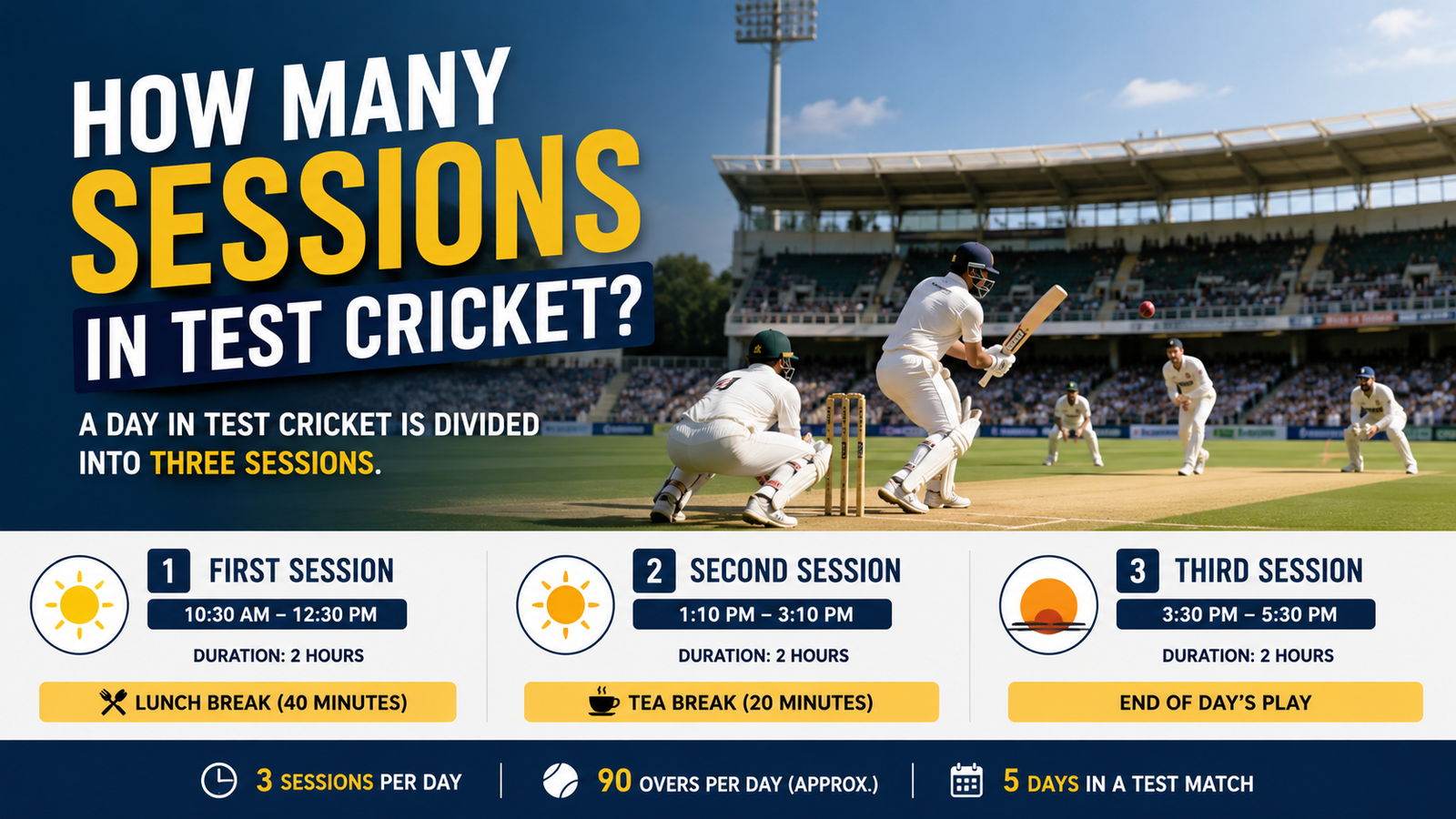
| Session | Typical Timing* | Duration | Break After Session |
| First Session | 10:30 AM – 12:30 PM | 2 Hours | Lunch Break (40 Minutes) |
| Second Session | 1:10 PM – 3:10 PM | 2 Hours | Tea Break (20 Minutes) |
| Third Session | 3:30 PM – 5:30 PM | 2 Hours | End of Day’s Play |
| Total Per Day | 3 Sessions | 6 Hours of Play | 2 Scheduled Breaks |
What Is a Session in Test Cricket
Before you start counting sessions, play a session which is relevant for the game context. In test cricket, a session is an uninterrupted unit of play between official breaks for lunch and tea. One of the tenets of a test match is that it has three playing sessions a day, with natural breaks to allow players to rest and teams to rethink.
The idea of the session lies at the heart of how test cricket is organized, timed and tactically shaped. While Twenty20 cricket is often over in a matter of hours, test cricket unfolds session by session, day by day, with a rhythm of pressure and release but above all one that renews its tension and obscures the endpoints.
How Many Sessions Are in a Test Cricket Match?
A test match can last up to five days. There are three sessions of play each day. This means there are 15 sessions in test cricket across a full five day test match.
Here is the basic breakdown:
- Day 1: Session 1, Session 2, Session 3
- Day 2: Day two is dedicated to all session 4,5 and session six
- Day 3: Session 7, Session 8, Session 9
- Day4: Session10, Session11, Session12
- Day 5: Session 13, session 14, session 15
This structure makes for three playing sessions per day in test cricket, totaling fifteen playing sessions across the five days of a standard test match. But it should be noted that not all Tests last a full five days. Most matches conclude in three or four days, reducing the sessions played.
How Many Sessions Per Day in Test Cricket
In a test match, Every day is divided into three sessions each separated by two official breaks. The timing is in accordance with the typical international setup as per ICC but may slightly differ based on the host nation and respective cricket board:
- Session 1 (Morning Session): This is the initial time of day when session starts, typically between 10:00 AM and 11:00 AM, local time. It takes about two hours before the lunch break. The conditions are fresh, the pitch behaves differently in morning air and both the batting side and bowling side look to make an early mark, hence this session is generally the most important of the day.
- Session 2 (Post-Lunch — Afternoon Session): After a break of 40 minutes, the second session is played. It is also about a two hour session. At this point of the day, when the sun is out there in its full glory, pitches become relatively standard and batters have an increased sense of belonging in their surroundings. But spinners can also get a little more assistance from afternoon conditions in some subcontinental venues
- Session 3 (Post Tea / Evening Session): Post the tea break of working 20 minutes, the third session of that day starts. The session continues until the day’s play is finished and could be around two hours long. The third session is probably the most dramatic. The ball is reverse swung in the dark or gathering darkness of day. Fielding sides really come hard for wickets perhaps just before the stumps, while batters will try their best to survive and take that total into the following day.
Also read this: DLS Method in Cricket | Most Beautiful Women Cricketers | MCA Pavilion Stadium Ticket Price
The Timings of Test Cricket Sessions
To understand the precise structure of test match sessions, let us examine the typical daily schedule of a test match:
Day’s play starts: 10:00 AM – 11:00 AM (varies by country and time zone)
- Morning Session: ~2 hours of play
- Lunch Break: 40 minutes
- Afternoon Session: ~2 hours of play
- Tea Break: 20 minutes
- Evening Session: ~2 hours of play
- Stumps (End of Day): Day’s play concludes
In total, on a normal day, approximately 6 hours of cricket are played across the three sessions. Over five days, this amounts to roughly 30 hours of live cricket, making it the most time-intensive sporting contest in the world.
How Many Overs Are Bowled in Test Cricket Sessions
The ICC stipulates that 90 overs must be bowled per day in test cricket. Now, while there are three sessions in a day that would ideally mean 30 overs per session. That said this number is a guideline, not a hard rule. Factors affecting the amount of overs per session –
- The speed at which the bowling team maintain its over-rate
- Wicket-taking delays and batsman changes
- Injury time-outs
- Weather interruptions
- DRS (Decision Review System) consultations
If a bowling side continues to use slow over-rates and repeatedly fails to achieve the 90-over target, then fines or other sanctions can be imposed on them by the match referee in accordance with ICC’s slow over-rate regulations. This allows for the right pace of play across all test cricket sessions.
Sessions Lost Due to Rain and Bad Light
As we know, weather is one of the most common factors that disrupt a test session. It could be rain, or bad light, or play being washed out as the outfield is unfit for cricket (like a wet soggy sponge). If play is lost then match referees have the power to extend the day in order to make up time. This is sometimes referred to as an “over-run” (or just “run”) of a session.
Under ICC guidelines, the umpires are allowed to add overs at the end of a day if more than 30 minutes of a session is lost due to weather. In some extreme cases a whole session may be rescheduled or merged with another one. Since its test cricket, playing with integrity requires ensuring that minimum 90 overs per day is as close to actual coverage as possible; this essentially means making these decisions.
Why Sessions Matter Strategically in Test Cricket
Knowing how many times the game is played in test cricket is more than a scheduling issue. Sessions are tactical units of the game for players, coaches and captains. And then it turns each session into a mini-battle in the larger war.
The Morning Session often favors fast bowlers. This is the best time to take wickets because of the new ball, dew and a relatively fresh pitch. When a team is batting and gets through the morning session without losing many wickets they already have one foot on the path to victory.
The Afternoon Session usually balances things out. The ball gets soft, the conditions get more good for batting and generally high scoring games well. This could be the most aggravating session for a bowling unit. There is the stereotype that captains bring spin on early and also more so in Asia and sub-continent.
The Evening Session is the decider. But the second new ball/early in the morning and with tail-enders walking out to bat, fast bowlers are back on their feet. Even if that bowling side takes them all for one cluster of wickets in the last session they can turn the momentum of a whole match.
This session by session examination is why commentators and analysts often say which team “won” a particular session. As a predictor of match result, winning the sessions in a 5-day test match is probably its single biggest component.
Sessions in Test Cricket vs. Other Formats
Given the evolution of formats in modern cricket, test sections can be juxtaposed on top of one another by more experienced spectators to show what is special and strange about tests themselves.
- One Day Internationals ODIs don’t have a session-based structure, as such. These tournaments consist of two innings totalling 50 overs, with a single innings break in-between.
- T20Is are even shorter in format, consisting of only two innings each with 20 overs as opposed to a single innings break.
- The Hundred, a relatively new form of cricket, consists of 100-ball innings with just one break in between.
None of these formats split play into the three-session, lunch-and-tea-break structure that characterises test cricket day sessions. The idea of a tri-session structure is only in existence for test matches and first-class cricket, which makes it unique – as well as its own character at a different pace.
Day-Night Test Matches and Session Timing
The last few years have seen the hosting of day-night test matches with pink balls and floodlights, which have been introduced in some parts by host boards and the ICC. We change session timings quite significantly with these matches. While day-night tests usually start in the late afternoon and run into the evening and night, this one starts in the late morning.
While that adjustment in timing means the answer will still be three sessions-per-day, fifteen sessions across the full five total days. What changes is when those sessions happen:
- Session 1: Late afternoon
- Session 2: Evening
- Session 3: Night (Usually ends up around local time midnight)
In some nations, day-night tests have brought significantly larger crowds and television audiences, but their core session structure is unchanged.
The Famous “Session-by-Session” Commentary in Test Cricket
What a lot of people love about test cricket culture is the session-by-session breakdown given to you by broadcasters and commentators. Experts condense it at the conclusion of every session to how the day has gone for which is the ‘superior’ team, how many wickets fell, how many runs were scored and what was done by the pitch in those two hours.
Expressions such as “India breezed through the morning session” or “three England wickets in a second-period collapse have completely transformed the test” are masticated words in everyday test cricket talk. The format has a narrative richness due to this granular, session-level analysis. A team could finish the morning session being thoroughly outplayed, only to turn around and win both the afternoon and evening sessions of play.
Total Sessions in Test Cricket History
Even though each individual Test match provides a maximum of 15 sessions spread over five days, the history of test cricket has thrown up some interesting deviations. Test matches were played for longer durations during the early years of the sport. Others, still-above, were timeless tests — the most celebrated of which is the Timeless Test between England and South Africa from 1939, which had no specified duration whatsoever and could have gone on until a result was achieved. The match was drawn after ten days of play as England needed to board a ship home.
The five-day, 15-session format is now standard under ICC regulations. That said, there are still some bilateral series that tinker with four-day test matches whereby a match would comprise just twelve sessions. The question of whether to play four-day contests instead of the traditional five day format has long divided cricket administrators, players and fans.
Conclusion: How Many Sessions is There in Test Cricket
To summarize cleanly:
- Number of sessions in Test Cricket per day: 3 Sessions
- No of sessions test match ( five days) : 15 sessions
- Average overs in each session: 30 overs
- Total Overage per Day: 90 Overs at Minimum
- Session breaks: Lunch (40 minutes) and Tea (20 minutes)
Test cricket, meanwhile, is not a mere structure of an administrative schedule broken into four sessions. The drama, strategy, and culture of the format is built on top of it. Every one of the fifteen sessions during which a test cricket match is played is a new chance for the balance to swing again, records to be set right here and in many ways careers can even thrive or even end at times whereas legends are born.
Understanding the session structure of test cricket is the first step to genuinely appreciating the depth and beauty of the longest format of the game whether you are a life long fan, or a newcomer.
Test cricket’s sessions are lived one over at a time, and history is written there.
FAQs
1. How many sessions are there in a Test cricket match?
A standard day of Test cricket is divided into three sessions: the morning session, afternoon session, and evening session. These sessions are separated by lunch and tea breaks.
2. How long is each session in Test cricket?
Each Test cricket session typically lasts for around two hours, making a total of six hours of scheduled play per day, excluding breaks.
3. What are the timings of the three sessions in Test cricket?
Test match session timings generally follow this schedule:
First Session: 10:30 AM – 12:30 PM
Second Session: 1:10 PM – 3:10 PM
Third Session: 3:30 PM – 5:30 PM
However, timings may vary depending on the venue and playing conditions.
4. How many overs are scheduled in each Test cricket session?
A full day of Test cricket is scheduled for 90 overs, which means each of the three sessions is expected to feature approximately 30 overs.
5. Why are Test cricket sessions important for match strategy?
Different sessions can favor either batters or bowlers due to changes in pitch conditions, weather, and ball behavior. Teams often plan their tactics around these session changes.
6. Can a Test cricket session be extended due to lost overs?
Yes, if overs are lost because of rain, bad light, or other interruptions, match officials may extend a session or the day’s play to help complete the scheduled overs.