Cricket is one of the most blessed game with rules, technical terms and match situations that leave fans, especially newbies to the cricket world scratching their heads. Hello, for example, one common word that confuses people is suspended meaning in cricket. Most people think that “shelved” means the same as “abandoned” or “delayed”, but it has a different meaning depending on the context.
In other words, in this era of cricket where IPL and ICC events along with domestic leagues are a part and parcel of it, there can be suspension due to heavy rain (not certain about it), slippery light conditions like June– July 2018 matches, delay due to fan breaching security or as the funniest reason for which the match suspended at Lord’s was disciplinary measures against what one could have visited up. Likewise, players can be suspended for violations of the rules.
This article explains all in depth, which includes What Does Suspended Mean In Cricket, Types of Suspension, Reasons for Suspension, Rules, Real Matches where suspended has happened and also more details about how it affects player teams and tournaments.
What Does “Suspended” Mean in Cricket
In cricket, “suspended” means the temporary stop of a match or a player’s participation, with the possibility of resumption later.
It is not a final decision like:
- Abandoned → Match is completely cancelled
- Postponed → Match shifted to another date
- Forfeited → One team gives up the match
Instead, suspended = paused or temporarily stopped
There are two major uses of the term:
1. Match Suspension
In cricket, a suspension of play means that the match has been halted for a period of time either because of weather and/or poor light conditions, or safety issues. The match can restart later the same day or on another appointed occasion as soon as conditions are appropriate.
2. Player Suspension
In cricket, a player suspension is when a cricketer is banned from playing any matches temporarily or permanently. It is generally suspended for disciplinary offences, such as violation of the code of conduct, doping or corruption.
Match Suspended Meaning in Cricket
Cricket match suspended: The game is temporarily stopped; however, the suspension arises from unavoidable conditions and not cancelled. The suspension can take place due to rain, bad light, unsafe ground conditions or other outside issues and the match is expected when the situation returns to normalcy. A suspension has the potential of continuation, an abandoned match does not.
Suspension is mainly in case the playing conditions are not fit for players or officials. Take heavy rainfall that makes the pitch unplayable or poor light in Test cricket which can mean it is not safe to continue to bat or bowl. It’s when players leave the field that umpires have their patience tested as they hold out for conditions to improve enough to get play back underway.
Officials are constantly assessing the weather, ground conditions and visibility when a match is interrupted. In the event of improved conditions, play will resume from whichever point the match was abandoned. But if the situation does not change for a long time, then this match can be reduced (using methods like DLS in limited overs cricket) or even abandoned as per the rules of the tournament.
Match suspension in cricket refers to a temporary halt of the game, wherein the match is suspended for the overall good or under circumstances where it can not be conducted fairly and without jeopardy.
Common Reasons for Match Suspension
In terms of cricket, matching suspension typically happens due to rain, poor weather or bad light producing unsafe or unfair play circumstances. A wet outfield, floodlight failure or an unfit pitch can also result in a game being abandoned. Perhaps, in a few instances, security concerns or any technical issues can stop the match temporarily.
1. Rain or Bad Weather
Rain is the most common reason for suspension.
- Pitch becomes unplayable
- Outfield becomes slippery
- Visibility becomes poor
Example:
A match may be suspended during a chase and resumed later using revised rules like the DLS method.
2. Bad Light Conditions
In Test matches or day-night games, poor light can force suspension.
- Umpires decide visibility is unsafe
- Players leave the field temporarily
This is common in longer formats like Tests.
3. Floodlight Failure
If stadium lights fail during a night match:
- Match is suspended immediately
- Resume once lighting is restored
4. Ground or Pitch Issues
Sometimes pitch conditions become unsafe:
- Wet pitch
- Damaged surface
- Outfield hazards
5. Security or Crowd Issues
Rare but serious cases:
- Crowd invasion
- Security threat
- Political or emergency situation
The match is suspended until safety is restored.
6. Equipment or Technical Issues
- Drone interference
- Sight screen problem
- Broadcasting failure (rare cause of delay)
Famous Players Suspended in Cricket
- Steve Smith – Suspended for 1 year in 2018 due to the ball-tampering scandal during the South Africa tour.
- David Warner – Also suspended for 1 year in 2018 for his role in the same ball-tampering incident.
- Cameron Bancroft – Received a suspension for his involvement in ball tampering in 2018.
- Shakib Al Hasan – Suspended in 2019 for failing to report corrupt approaches.
- Mohammad Amir – Faced suspension and a ban earlier in his career for spot-fixing in 2010.
- Hardik Pandya – Temporarily suspended by BCCI in 2019 due to controversial comments on a TV show (later lifted).
Also read this: Saachi Marwah Biography | Rajasthan vs Gujarat Qualifier 2 | Best Finishers in IPL
What Happens When a Match is Suspended
Suspended – when the cricket match is stopped (temporarily) due to such reasons like rain, bad light, ground problems & unsafe or unplayable circumstances. Players walk off the field straightaway and umpires indicate a halt in play But the contest is not over and even now at this point, it is yet to be determined.
Officials will monitor the situation after suspension to determine if play can resume. The pitch conditions improve, players retake the field and the match resumes from exactly where it stopped. In single innings formats like limited-overs cricket, if rain interrupts a match (such as in the case of One Day International cricket or Twenty20), revised targets could be calculated using the Duckworth-Lewis-Stern (DLS ← target) method.
If the suspension of play continues for an excessive time with no signs of improvement, match officials may accept that overs will be reduced or call the game off altogether. In such cases, the final call is made on tournament rules, weather predictions and the minimum overs that can yield a result.
When a match is suspended, officials follow ICC or tournament rules:
1. Temporary Stop
Players leave the field, but match is not cancelled.
2. Waiting Period
Officials assess conditions:
- Weather check
- Ground inspection
- Safety review
3. Resume or Reschedule Decision
- If conditions improve → match resumes
- If not → match may be shortened or moved
- If impossible → match may be abandoned
Difference Between Suspended, Abandoned, and Postponed
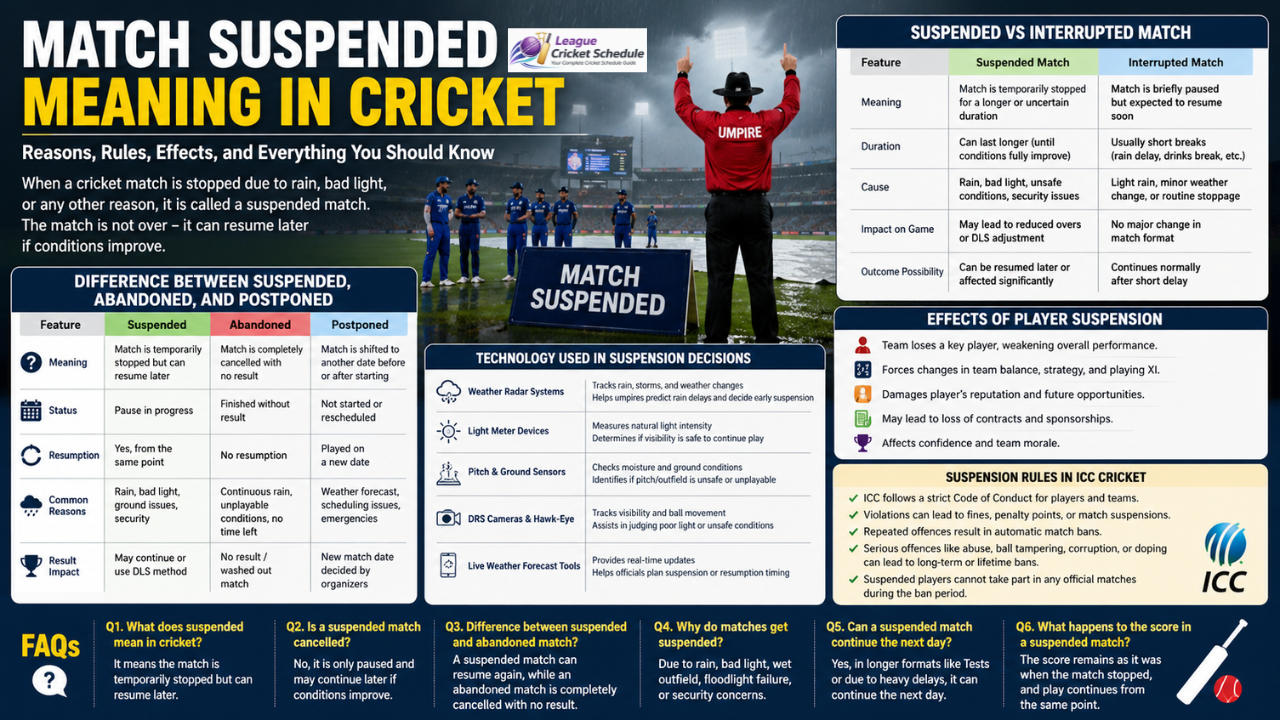
| Feature | Suspended | Abandoned | Postponed |
| Meaning | Match is temporarily stopped but can resume later | Match is completely cancelled with no result | Match is shifted to another date before or after starting |
| Status | Pause in progress | Finished without result | Not started or rescheduled |
| Resumption | Yes, from the same point | No resumption | Played on a new date |
| Common Reasons | Rain, bad light, ground issues, security | Continuous rain, unplayable conditions, no time left | Weather forecast, scheduling issues, emergencies |
| Result Impact | May continue or use DLS method | No result / washed out match | New match date decided by organizers |
This is very important for understanding cricket terminology.
1. Suspended
- Temporary stop
- Match can continue later
- Example: rain delay in IPL
2. Abandoned
- Match is completely cancelled
- No result possible
- Example: continuous rain throughout the day
3. Postponed
- Match moved to another date
- Happens before start or due to major issues
Player Suspended Meaning in Cricket
In cricket, player suspension denotes a temporary ban or disqualification in which a cricketer is suspended from participating in matches for having broken from the prescribed code of conduct. It is imposed by governing bodies of cricket such as the ICC, BCCI or tournament committees when a player does not abide by code of conduct. It is seen as an extreme measure that has a direct impact on one’s career and public persona.
A player can be banned for a number of offences; on-field roughness, verbal foul play towards umpires, ball tampering, doping or match-fixing. Heavy penalty: Even a team captain who repeats slow over-rate offense can be suspended. Offences can be punishable by fines, moderate bans or long-term suspension depending on the severity.
A player suspended is barred from participating in an official match for a specified period. They can shape a franchise, and change the way other teams think about their basketball during their absence. There have been instances when teams had to get in replacement players or reshuffle their playing XI and such adjustments have changed the course of tournaments or series.
Apart from matches, players can also be suspended.
This means:
A player is banned temporarily or permanently from participating in matches due to misconduct or rule violation.
Reasons for Player Suspension
1. Code of Conduct Violation
- Abusive language
- Aggressive behavior
- Umpire disrespect
2. Doping Violations
If a player tests positive for banned substances:
- Immediate suspension
- Investigation follows
3. Match-Fixing or Corruption
This is the most serious offense:
- Betting involvement
- Spot-fixing
- Illegal activities
Players can face long-term bans.
4. Over-Rate or Technical Penalties
Teams or captains may face suspension in extreme cases of repeated slow over-rate offenses.
5. On-field Misconduct
- Physical altercations
- Dangerous play
- Unsportsmanlike conduct
Effects of Player Suspension
Suspension of player from cricket both can influence the person as well as the group in general. If the team misses out on a crucial player, that crumbles either batting, bowling or leadership. It almost obliges the management to groom up a substitute, thus interrupting team balance. Suspension is damaging the reputation of player and it could also impact future selection of that player. In serious cases, it can even mean loss of contracts and sponsorships.
1. Team Impact
- Replacement player required
- Team balance disturbed
2. Career Damage
- Loss of reputation
- Sponsorship loss
- Future selection risk
3. Tournament Impact
- Team performance drops
- Leadership changes (if captain suspended)
Suspension Rules in ICC Cricket
The International Cricket Council (ICC) has strict rules:
Level of Offences:
- Level 1: Minor (warning or fine)
- Level 2: Moderate suspension points
- Level 3: Serious (match ban)
- Level 4: Extreme (long-term ban or lifetime ban)
Level 1: Minor (warning or fine)
The ICC (International Cricket Council) has strict suspension rules to ensure fair play and discipline in international cricket. Players and teams are expected to follow the ICC Code of Conduct, and any violation can result in penalties ranging from fines to match bans or suspensions.
Level 2: Moderate suspension points
Suspension levels depend on the seriousness of the offence. Minor violations may lead to warnings or penalty points, while serious misconduct like abuse, ball tampering, or violent behavior can result in immediate match suspension.
Level 3: Serious (match ban)
Repeated offences or accumulation of demerit points can also lead to automatic suspension from one or more matches. In extreme cases, such as corruption or doping violations, ICC can impose long-term or even lifetime bans.
Level 4: Extreme (long-term ban or lifetime ban)
Suspended players are not allowed to participate in any official matches during the ban period. This rule ensures discipline, protects the spirit of cricket, and maintains fairness in international and domestic competitions.
Suspended Meaning in IPL
In IPL, suspension can apply to:
- Matches (rain or technical issues)
- Players (disciplinary action)
Example situations:
- Rain interruptions → match suspended and shortened
- Player misconduct → one or more match bans
IPL also uses the DLS method for suspended or rain-affected matches.
Suspended Match vs Interrupted Match
| Feature | Suspended Match | Interrupted Match |
| Meaning | Match is temporarily stopped for a longer or uncertain duration | Match is briefly paused but expected to resume soon |
| Duration | Can last longer (until conditions fully improve) | Usually short breaks (rain delay, drinks break, etc.) |
| Cause | Rain, bad light, unsafe conditions, security issues | Light rain, minor weather change, or routine stoppage |
| Impact on Game | May lead to reduced overs or DLS adjustment | No major change in match format |
| Outcome Possibility | Can be resumed later or affected significantly | Continues normally after short delay |
Many people confuse these two.
Interrupted Match:
- Short break
- Game continues after delay
Suspended Match:
- Longer halt
- Requires official decision for resumption
Famous Real-Life Suspended Match Situations
1. Rain Suspensions in IPL
Many IPL matches have been suspended temporarily due to sudden rain showers and resumed later with revised targets.
2. Bad Light in Test Cricket
Test matches in England and India often get suspended due to fading light.
3. Security Suspensions
Some international matches have been suspended briefly due to crowd disturbances.
How Umpires Decide Suspension
Umpires consider:
- Player safety
- Ground conditions
- Visibility level
- Weather forecast
- ICC playing conditions
The final decision is taken jointly by match officials and the referee.
Technology Used in Suspension Decisions
| Technology | Purpose | How It Helps in Suspension Decisions |
| Weather Radar Systems | Tracks rain, storms, and weather changes | Helps umpires predict rain delays and decide early suspension |
| Light Meter Devices | Measures natural light intensity | Determines if visibility is safe to continue play or suspend match |
| Pitch & Ground Sensors | Checks moisture and ground conditions | Identifies if pitch/outfield is unsafe or unplayable |
| DRS Cameras & Hawk-Eye | Tracks visibility and ball movement | Assists in judging poor light or unsafe playing conditions |
| Live Weather Forecast Tools | Provides real-time updates | Helps officials plan suspension or resumption timing |
Modern cricket uses:
- Weather radar systems
- Ground sensors
- DRS cameras
- Light meters
These help ensure fair decisions.
Impact of Suspension on Fans and Broadcasting
For Fans:
- Match delays cause frustration
- Reduced excitement continuity
For Broadcasters:
- Schedule reshuffling
- Advertisement timing changes
- Financial adjustments
Psychological Impact on Players
Cricket is a game played in the mind of the players and suspension can have its greatest impact during crucial junctures in a match. Because the natural flow of play has now suddenly been disrupted, players (with the best will in the world) may lose momentum, focus and rhythm. The only flaw with this is that the retrained batter set at the crease or a bowler in good nick could find it very hard to get back to this level of intensity after the break.
Suspension further causes mental distress due to uncertainty. Players and teams stand to wait, never knowing when the contest will resume or if it gets better in conditions. Such waiting is a source of anxiety, overthinking and loss of match mindset — therefore detrimental to performance especially in the IPL playoffs or any international tournaments.
Once the game resumes, players need to refocus but have only a few moments to reset their mental state and adapt once again to match conditions. Teams usually take the opportunity to recalibrate, but not all players cope with that mental adjustment as well. Veteran players tend to have a better time coping with it, while younger players find that confidence and focus again as fast.
Suspension affects players mentally:
- Loss of momentum
- Pressure after restart
- Strategy reset required
Teams often use breaks to:
- Rebuild strategy
- Change batting order
- Adjust bowling plans
Conclusion
Suspended in cricket is an awesome word but its one that seems to be commonly misinterpreted. Depending on the context, it may refer to a temporary cessation of play or a disciplinary penalty imposed upon an athlete.
Suspension for matches typically occurs due to weather, poor light or safety issues. Suspension is a serious punishment for players for breaking rules or behaving badly.
This term guides the fans to follow the game with more clarity, especially between IPL, ICC tournaments and international games where these scenarios normally occur.
In simple words:
Suspended = Stopped temporarily, not finished.
FAQs
Q1. What does suspended mean in cricket?
Suspension in cricket means the match is temporarily stopped due to conditions like rain, bad light, or safety issues, but it can resume later.
Q2. Is a suspended match cancelled?
No, a suspended match is not cancelled. It is only paused and may continue later if conditions improve.
Q3. What is the difference between suspended and abandoned matches?
A suspended match can resume again, while an abandoned match is completely cancelled with no result.
Q4. Why do cricket matches get suspended?
Matches are usually suspended due to rain, bad light, wet outfield, floodlight failure, or security concerns.
Q5. Can a suspended cricket match continue the next day?
Yes, in longer formats like Tests or due to heavy delays, a suspended match can continue on the next day.
Q6. What happens to the score in a suspended match?
The score remains as it was when the match stopped, and play continues from the same point after resumption.