
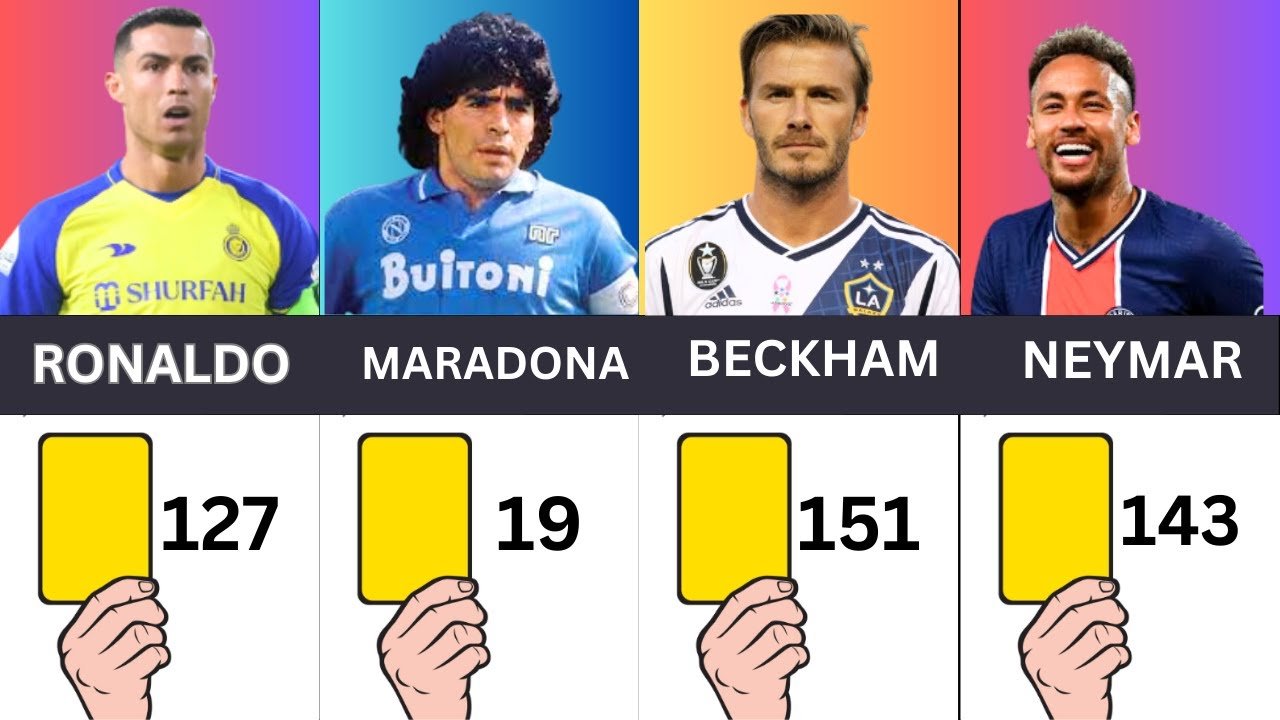
Football is often associated with goals, assists and trophies, but disciplinary statistics tell another important part of the game’s history. Some players have built long careers while regularly appearing in booking statistics, particularly defenders and defensive midfielders whose roles involve tackles, challenges and stopping dangerous attacks.
The Most Yellow Cards in Football History is therefore an interesting record category, but it is also one that needs careful interpretation. Unlike goals or appearances, historical card totals can differ between statistical databases because not every competition or older match has the same level of detailed data.
One name appears repeatedly when discussing major disciplinary records: Sergio Ramos. He holds several notable booking records, including major records for La Liga and Real Madrid. However, the exact number attached to a player’s career can vary depending on whether a database includes all competitions, second-yellow dismissals, or only specific competitions.
This article looks at the most-booked players, major league records, yellow-card rules and the reasons some footballers accumulate such high totals.
What Is a Yellow Card in Football?
A yellow card is a formal caution issued by the referee. Under the Laws of the Game, it communicates that a player or team official has committed a cautionable offence. A red card, by comparison, communicates a sending-off. Yellow cards can be shown for several different types of behaviour. These include reckless challenges, delaying the restart of play, dissent, unsporting behaviour and repeatedly breaking the Laws of the Game.
A player can also receive two yellow cards during the same match. When that happens, the second caution is followed by a red card and the player is sent off.
Common Reasons for a Yellow Card
A referee may show a yellow card for:
- Reckless tackles
- Unsporting behaviour
- Dissent by words or actions
- Delaying the restart of play
- Repeatedly committing fouls
- Stopping or interfering with a promising attack
- Simulation
- Failing to respect the required distance at a restart
- Entering or re-entering the field without permission
The exact circumstances matter. For example, IFAB’s Laws specifically identify simulation, dissent, delaying restarts and stopping promising attacks among situations that can lead to a caution.
Most Yellow Cards in Football History
Determining the single worldwide leader requires some caution because there is no universally standardized database covering every professional match in football history. Modern statistical databases have much better coverage than historical records, while different providers can classify second-yellow dismissals and competitions differently. One of the clearest documented examples is Sergio Ramos. Records compiled for La Liga list Ramos as the competition’s leading yellow-card recipient, while other databases report different totals depending on their methodology.
Notable Highly Booked Players
| Player | Position | Notable competition/club record | Why the player is notable |
| Sergio Ramos | Centre-back | Major La Liga and Real Madrid disciplinary records | Long career as an aggressive defender |
| Casemiro | Defensive midfielder | High booking totals across major competitions | Defensive midfield and tackling |
| Pepe | Centre-back | Extensive disciplinary record | Physical defensive style |
| Fernandinho | Defensive midfielder | Numerous domestic and European bookings | Tactical fouling and ball recovery |
| Arturo Vidal | Midfielder | Frequently booked during club career | Aggressive midfield role |
| Gary Medel | Defender/Midfielder | Strong disciplinary reputation | Physical defensive approach |
Also read this: Most Assists in a Football Season 2026 | Most Goals in a Football Season 2026 | Most Valuable Young Football Players 2026
Sergio Ramos and His Yellow-Card Records
Sergio Ramos is one of the most frequently cited names in discussions about football’s all-time disciplinary records. During his long career with Sevilla, Real Madrid, Paris Saint-Germain, Spain and later clubs, Ramos accumulated a substantial number of cautions. His position as a centre-back meant that he frequently had to defend against fast attackers, make tackles and stop dangerous situations.
La Liga’s records list Ramos as the competition’s most-booked player. One record compilation gives him 194 yellow cards in the competition when second-yellow cards are included in the disciplinary calculation. Another statistical database currently lists his La Liga total at 193 yellow cards, demonstrating why readers should always identify the source and methodology behind a historical record.
Ramos also holds significant Real Madrid disciplinary records. The club’s statistical record lists him with 252 yellow cards for Real Madrid and 22 yellow cards in the 2014–15 season, although the club’s methodology specifies which types of cards are included. His disciplinary record is therefore a useful example of why “most yellow cards” statistics should be separated into club, league, European and international categories.
Casemiro and His Disciplinary Record
Casemiro is another prominent name in discussions about highly booked midfielders. The Brazilian defensive midfielder spent much of his career playing in a position where tactical fouls, challenges and interceptions are common. His job often involves protecting the defence and breaking up opposition attacks before they reach dangerous areas.
His statistics demonstrate how a player’s position can influence booking numbers. For example, a statistical database records 13 yellow cards for Casemiro in the 2014–15 Liga Portugal season and four Champions League yellow cards during the 2020–21 campaign. His Premier League career has also included seasons with significant booking totals. In the 2025–26 Premier League season, Casemiro recorded 11 yellow cards for Manchester United according to StatMuse.
Dani Alves and Other Highly Booked Players
Dani Alves was primarily an attacking full-back, but his long career involved defending against some of the world’s best wingers. Full-backs can accumulate yellow cards because they frequently face one-on-one situations. A mistimed challenge can result in a caution, especially when a defender is attempting to stop an opponent from entering a dangerous attacking position.
Other well-known players with significant disciplinary records include:
- Pepe
- Fernandinho
- Arturo Vidal
- Gary Medel
- Xabi Alonso
- Sergio Busquets
- Javier Mascherano
The exact ranking among these players depends on the competitions and statistical database being used.
Most Yellow Cards by Position
A player’s position can have a major effect on how often they receive disciplinary action.
Defenders
Centre-backs frequently commit tactical or defensive fouls when an attacker has broken through the defensive line.
They may receive yellow cards for:
- Reckless tackles
- Holding attackers
- Stopping counterattacks
- Denying promising attacks
- Repeated fouls
Sergio Ramos is a prominent example of a defender with a very large disciplinary record.
Defensive Midfielders
Defensive midfielders often operate in the middle of the pitch and are responsible for stopping attacks before they develop. Players such as Casemiro and Fernandinho have therefore accumulated significant booking totals during their careers.
Full-Backs
Full-backs are regularly exposed in one-on-one defensive situations. A full-back may be forced to make a tactical foul when an opposing winger gets past them, particularly during a counterattack.
Forwards and Attacking Players
Attackers generally receive fewer yellow cards from tackles than defenders, but they can still be cautioned for:
- Dissent
- Simulation
- Delaying restarts
- Unsporting behaviour
- Excessive celebrations in certain circumstances
Most Yellow Cards in Premier League History
The Premier League has maintained detailed disciplinary statistics throughout its modern history, making it easier to compare players within the competition.
When analyzing Premier League yellow-card records, it is important to distinguish between:
- Career yellow cards
- Yellow cards in one season
- Yellow cards for one club
- Yellow cards per appearance
A player with 100 career yellow cards may simply have played far more matches than someone with 80.
Premier League Booking Comparison
| Player | Appearances | Yellow Cards | Position | Career Context |
| Highly booked defenders | High | High | Defender | Frequent defensive challenges |
| Defensive midfielders | High | High | Midfielder | Tactical fouls and interceptions |
| Full-backs | High | Moderate/High | Defender | One-on-one defending |
| Attackers | High | Usually lower | Forward | Dissent and other offences |
For a reliable current ranking, the competition’s official statistics should be checked because totals change as active players continue their careers.
Most Yellow Cards in La Liga History
- La Liga provides one of the strongest examples of a player dominating a competition’s disciplinary record.
- Sergio Ramos is listed as the competition’s most yellow-carded player. A La Liga records compilation gives him 194 yellow cards when its calculation includes 180 standard yellow cards plus 14 second-yellow cards.
- Another statistical source records 193 La Liga yellow cards for Ramos, illustrating the small but important differences that can appear between databases.
- This makes La Liga an excellent example of why articles about football records should identify the source used for the numbers.
Most Yellow Cards in Serie A
Serie A has traditionally featured many defenders and midfielders who play important roles in tactical defending.
When studying Serie A yellow-card records, researchers should consider:
- Number of appearances
- Position
- Number of seasons played
- Competition rules
- Yellow cards per match
- Whether second-yellow dismissals are counted separately
Comparing raw totals without considering appearances can give an incomplete picture of a player’s disciplinary frequency.
Most Yellow Cards in Bundesliga
- The Bundesliga also produces significant booking statistics among defensive players and midfielders.
- Players operating in central defensive areas often have more opportunities to commit tactical fouls because they are responsible for protecting the space in front of goal.
- Modern Bundesliga data can be compared using total yellow cards, cards per appearance and cards per 90 minutes.
Most Yellow Cards in Champions League History
The UEFA Champions League is another important category for disciplinary records.
Sergio Ramos has been one of the competition’s most frequently carded players. Different statistical databases report slightly different totals depending on how cards are classified. StatMuse, for example, currently lists 44 Champions League yellow cards for Ramos.
The Champions League record is particularly interesting because players can accumulate cards across many seasons, while knockout-stage rules can also affect suspensions.
Most Yellow Cards in International Football
International football presents another separate category. A player may have hundreds of club appearances but considerably fewer international matches, so comparing club and international yellow-card totals directly is not always useful. For Spain, Sergio Ramos and Sergio Busquets are listed with 25 yellow cards each in one compilation of Spain national-team records. International tournament records should also be separated from total national-team records because a player may receive cards in qualifiers, friendlies, Nations League matches and major tournaments.
Most Yellow Cards in a Single Football Season
A single-season record is different from an all-time career record.
A player can accumulate a large number of yellow cards in one campaign because of:
- A high number of appearances
- A defensive position
- Tactical fouling
- A team’s playing style
- Competition-specific refereeing
- A particularly long season
Real Madrid’s records list Sergio Ramos with 22 yellow cards during the 2014–15 season, according to the club’s statistical methodology.
Single-Season Record Categories
| Record Type | What It Measures |
| League season | Yellow cards in one domestic league campaign |
| All competitions | Cards across league and cup competitions |
| European season | Cards in UEFA competitions |
| International tournament | Cards during one national-team tournament |
| Per 90 minutes | Booking frequency relative to playing time |
Most Yellow Cards in One Football Match
A single match can produce several yellow cards when the game contains repeated fouls, confrontations, tactical interruptions or disagreements with officials.
High-card matches are particularly common when:
- The game is physically intense
- Both teams commit repeated fouls
- Counterattacks are stopped frequently
- Players show dissent
- There are confrontations between opponents
- The match has high competitive importance
It is important to distinguish the most yellow cards received by one player from the total number of yellow cards shown in one match. They are completely different records.
Countries and Leagues With High Yellow-Card Numbers
Yellow-card totals can vary considerably between competitions.
Important factors include:
Refereeing Standards
Officials may interpret certain challenges differently within the framework of the Laws.
Playing Style
A league with frequent physical challenges can naturally generate more disciplinary incidents.
Tactical Approach
Teams that frequently stop counterattacks through tactical fouls can accumulate more bookings.
Competition Rules
Suspension and accumulation systems vary between competitions.
Statistical Methodology
One database may classify a second yellow separately while another may combine disciplinary events differently. For this reason, comparing raw yellow-card totals between leagues should always be done carefully.
Why Do Some Football Players Get So Many Yellow Cards?
Defensive Playing Style
Defenders frequently find themselves making last-second challenges against attackers.
Tactical Fouls
A tactical foul can stop a dangerous attack before it becomes a scoring opportunity.
Aggressive Tackling
Players who regularly challenge for the ball can receive cautions when tackles are judged reckless.
Stopping Counterattacks
A defender may deliberately stop an opponent’s progress when the team is vulnerable.
Dissent Toward Referees
Players can be cautioned for showing dissent through words or actions.
Repeated Fouls
A player who repeatedly infringes the Laws can eventually receive a yellow card even when individual fouls might not initially warrant a caution.
High Number of Career Appearances
Longevity matters enormously. A player who plays 700 or 800 matches has considerably more opportunities to accumulate yellow cards than a player whose career lasts only a few seasons.
Yellow Card Records vs Red Card Records
Yellow and red cards represent different disciplinary outcomes.
| Record Type | Meaning |
| Yellow Card | A caution issued by the referee |
| Second Yellow | A second caution in the same match, followed by a red card |
| Straight Red | Direct sending-off |
| Career Bookings | Total yellow cards accumulated across a player’s career |
Under the current Laws, a second caution in the same match results in the player being sent off.
How Yellow Card Accumulation Works
Yellow-card accumulation is separate from receiving two yellow cards in one match. A player can receive one yellow card in several different matches and eventually reach a competition’s suspension threshold.
However, accumulation rules are not identical across every competition.
They can depend on:
- Competition regulations
- Number of accumulated cards
- Stage of the competition
- Whether cards are carried forward
- Specific suspension rules
This is why a player may be suspended in one competition after reaching a particular number of cards while remaining available in another.
Famous Footballers Known for Disciplinary Records
Sergio Ramos
Ramos is one of the most documented examples of a highly carded elite defender. He holds major disciplinary records for Real Madrid and La Liga.
Casemiro
Casemiro’s role as a defensive midfielder has resulted in substantial booking numbers across different leagues and competitions.
Pepe
Pepe’s centre-back role and physical defensive style made him another frequently discussed player when examining football’s disciplinary records.
Fernandinho
The Brazilian midfielder was often responsible for protecting his team’s defence and stopping opposition attacks, making disciplinary statistics an important part of his career profile.
Arturo Vidal
Vidal’s energetic midfield style involved frequent defensive work, challenges and physical contests.
Gary Medel
Medel has played both midfield and defensive roles and has been known for a combative approach throughout his career.
Why Yellow-Card Statistics Matter in Football
Yellow cards are more than just numbers on a statistics page.
They can influence:
- Player availability
- Tactical decisions
- Defensive strategy
- Substitutions
- Suspension risk
- Team selection
- Match dynamics
A defender playing with a yellow card may have to be more cautious when challenging an opponent, while a midfielder on a caution may change the way they press or tackle.
This is why booking statistics can provide additional context when analyzing a player’s career.
Final Thoughts
The Most Yellow Cards in Football History is a fascinating category because it combines longevity, playing position, tactical responsibility and disciplinary statistics. Sergio Ramos stands out in major documented records, particularly in La Liga and Real Madrid statistics. Casemiro and other defensive midfielders also demonstrate how demanding defensive roles can lead to substantial booking totals.
However, there is an important distinction between career yellow cards, league records, single-season records, Champions League bookings and international cards. These categories should not be mixed together.
Historical statistics can also differ between databases. Differences may result from competition coverage, the treatment of second-yellow dismissals and the availability of historical match data. For that reason, the most useful way to understand football’s booking records is to look at the specific competition, time period and statistical methodology behind each number.
FAQs
1.Who has the most yellow cards in football history?
There is no single universally standardized worldwide database covering every professional match in football history. Sergio Ramos is one of the most frequently cited players in major disciplinary-record compilations, including prominent records in La Liga and at Real Madrid.
2.Which football player has the most career yellow cards?
Sergio Ramos is widely associated with exceptionally high career booking totals, but the exact number depends on the competitions and database methodology being used.
3.Who has the most yellow cards in Premier League history?
Premier League records should be checked using the competition’s official statistical database when publishing a definitive current ranking because active players can continue adding cards.
4.Which defender has the most yellow cards?
Sergio Ramos is one of the most prominent defenders associated with all-time yellow-card records, particularly because of his La Liga and Real Madrid records.
5.Which midfielder has the most yellow cards?
There is no single universally accepted worldwide answer because historical coverage differs between databases. Players such as Casemiro, Fernandinho and Arturo Vidal have accumulated substantial booking totals during long careers.
6.What causes a player to receive a yellow card?
Common cautionable offences include unsporting behaviour, dissent, delaying the restart, repeated offences, simulation and stopping promising attacks.