FIFA World Cup 2026 Qualifiers: It was a long, dramatic road to what was the biggest FIFA World Cup in history and one so different to any other that had ever been played. Spread over six continents, with six million fans turning out across nearly three years of competition involving more than 200 nations — this was the cycle that determined 45 teams to join hosts Canada, Mexico and The USA at the expanded 48-team FIFA World Cup 2026.
From Japan being the first nation to qualify this March 2025, to the final precious two spots being decided in the inter-confederation playoff this March 2026, qualification threw up heartbreak and history moments we will be speaking about for generations.
FIFA World Cup 2026 Qualifiers Overview
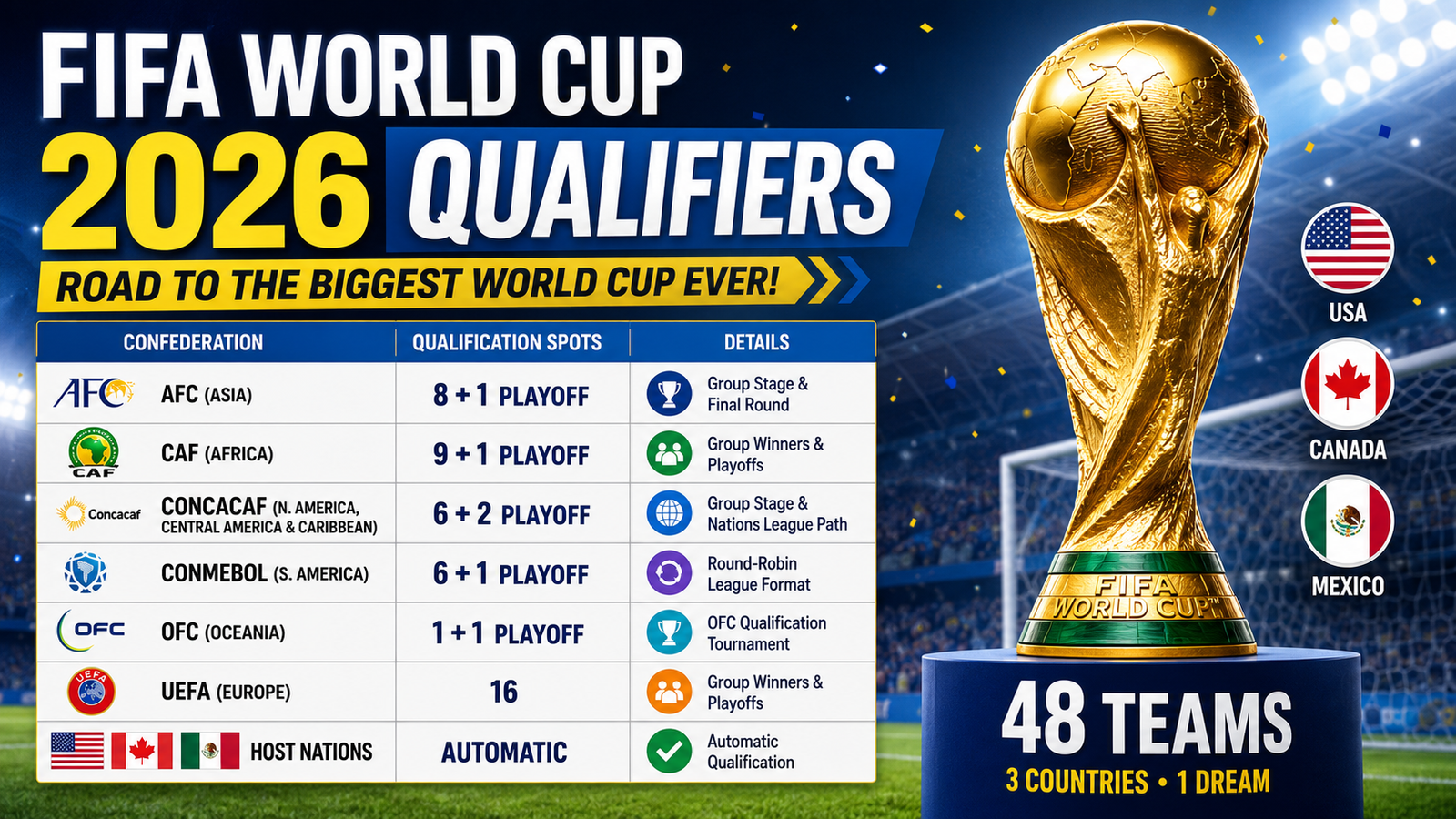
| Confederation | Qualification Spots | Qualified Teams (Examples) | Qualification Method |
| AFC (Asia) | 8 + 1 Playoff | Japan, South Korea, Iran, Australia | Group Stage & Final Round |
| CAF (Africa) | 9 + 1 Playoff | Ongoing Qualification | Group Winners & Playoffs |
| CONCACAF | 6 + 2 Playoff | USA, Canada, Mexico (Hosts) | Group Stage & Nations League Path |
| CONMEBOL | 6 + 1 Playoff | Argentina, Brazil, Ecuador | Round-Robin League Format |
| OFC (Oceania) | 1 + 1 Playoff | New Zealand | OFC Qualification Tournament |
| UEFA (Europe) | 16 | England, France, Germany, Spain | Group Winners & Playoffs |
| Host Nations | Automatic | USA, Canada, Mexico | Automatic Qualification |
FIFA World Cup 2026 Qualification Summary
| Item | Details |
| Tournament | FIFA World Cup 2026 |
| Host Countries | USA, Canada, Mexico |
| Total Teams | 48 |
| Total Qualification Spots | 45 (plus 3 hosts) |
| Confederations Involved | AFC, CAF, CONCACAF, CONMEBOL, OFC, UEFA |
| Intercontinental Playoff Spots | 6 Teams Compete for Final 2 Spots |
| Qualification Period | 2023–2026 |
| World Cup Start Date | June 2026 |
| Expanded Format | First-ever 48-team FIFA World Cup |
Why the 2026 Qualifiers Were Unlike Any Before
What qualifying meant was changed fundamentally when the FIFA World Cup expanded from 32 to 48 teams. This gave more nations a sensible opportunity at the tournament, as there were more slots available across every confederation. However, an increased number of teams demanded a more complicated qualification system — one which required scheduling, multi-round qualifications, and at certain times even new playoff systems completely.
This was the first World Cup to be contested with more than 32 teams. FIFA allocated the available spots to its six confederations: UEFA (Europe) got 16 allotments, CAF: 9 slots and one inter-confederation playoff slot; AFC: eight direct and one playoff as well as CONMEBOL (south America): six and two playoff place CONCACAF(North & central America and Caribbean):six plus two playoff places however OFC(Oceania) sent their first guaranteed Berth at a world cup with. It is the first World Cup where all six confederations are assured at least one guaranteed spot in the tournament.
It began with three CONMEBOL matches on 7 September 2023 when Colombian forward Rafael Santos Borré netted the first goal of the entire global campaign against Venezuela. It took around two years and seven months for the qualification process to fill up, with the final spot being made available on March 31 2026. Added to that timeline, and the breadth of matches played around the world over four years, this became the longest World Cup qualification campaign in history.
UEFA Qualifiers 2026: Europe’s Dramatic Road to the World Cup
The European path to WC 2026 was the most viewed and deffinitetly the toughest qualification campaign of all confederations. A group-stage format ran from March 2025, where 54 nations played home-and-away round-robin matches across eight groups, headed up by UEFA. Twelve group winners gained automatic and direct qualification to the tournament, while other qualifying places were settled by the UEFA playoff system.
The 12 group runners-up (four will qualify, and will be the ones ranked 1–4) together with the four best-ranked group winners not to qualify through their groups from the UEFA Nations League were placed into playoffs for World Cup qualification. These 16 teams were placed into 4 paths of 4, with single-leg semis then a one-legged final! A single team from each path appeared at the World Cup.
The results were stunning. Bosnia and Herzegovina eliminated Italy on penalties in the Path A final, pushing out the four-time champion for a third straight World Cup — becoming the first former champion to miss three consecutive World Cups. Sweden secured their ticket from Path B by edging a tense final 3–2 against Poland. Türkiye scraped through following a nail biting tussle which saw them win out of Path C, while Czechia booked their place via Path D after defeating Denmark.
Scotland qualified, too (their first World Cup since 1998), providing national party on the other side of the border. The Federal Republic of Yugoslavia and Norway were also back in the finals stage for the first time since 1998 in Austria.
The last 16 were completed with qualifiers from Europe, England, France, Croatia, Norway, Portugal, Germany, Netherlands. Switzerland as well as Scotland (technically they played a playoff but are included here), Spain and Austria also came through followed by Belgium with Bosnia and Herzegovina making up the rest of the quartet along with Sweden literally sneaking in then Türkiye followed them before rounding off by Czechia Even though Italy were ranked 12th by FIFA when they failed to prepare for the finals, there was no bigger story of the whole European qualifying campaign than their absence.
Also read this: How Many Sessions in Test Cricket | DLS Method in Cricket | Most Beautiful Women Cricketers
CONMEBOL Qualification Standings: South America’s Round-Robin Battle
Once again the South American qualification format stayed unchanged from previous cycles — all 10 CONMEBOL member nations played each other home-and-away in a full round-robin league table. World Cup qualification describes the process that a national team must go through to participate in the FIFA World Cup, soccer’s (football) world championship.
Such format made it one of the tightest tournaments in the whole qualification series. The six automatic berths were won by Colombia, Argentina, Uruguay, Ecuador, Brazil and Paraguay. They came seventh in Bolivia, and they competed at the inter-confederation play-offs but missed out.
The one main headline from CONMEBOL qualification was that Ecuador were deducted three points before the campaign even began due to an investigation into falsified documents of birth for Byron Castillo from the last cycle. With that handicap notwithstanding, and proof of their resilience across the campaign, Ecuador qualified.
AFC Qualifiers 2026: Asia’s Expanded Road to the World Cup
While the expanded tournament gave Asian football its biggest allocation with eight automatic know-how and a playoff berth, this amount rewritten an area hung in the balance. The AFC qualification format consisted of three rounds, commencing in October 2023.
Two-legged, home-and-away knockouts amongst 20 lower AFC nations were held in the first round. Joining the 26 higher-ranked nations in Round Two were the ten winners, with 36 teams split into nine groups of four to play full home-and-away round-robin matches. The third round featured the 18 group winners and runner-ups.
Round three saw 18 teams split into three groups of six, with the top two from each group qualifying automatically — serving up six of the eight AFC slots. The top three third-placed teams then went into a different round, with the winners of that mini-league taking the last two automatic places. The third-place finisher in each confederation’s qualification path (except for Oceania) earned a place in the inter-confederation playoffs, alongside the two best second-placed teams.
They were joined by the nine Asian qualifying nations: Australia, Iran, Japan, Jordan, Uzbekistan and Qatar; while Saudi Arabia grabbed one of the four remaining slots beating out South Korea and Iraq (the latter through an inter-confederation playoff). Of course, Japan was the first nation in the world to qualify for the 2026 World Cup it happened on March 14.
The extent of Iraq’s campaign was one viewed as both drawn-out and remarkable in qualification history; it took 28 months and 21 matches to complete the job. It was also the first time for Jordan and Uzbekistan, who became the first country from Central Asia to ever make an appearance at a FIFA World Cup.
CAF World Cup Qualifiers: Africa’s Best-Ever Showing
There was plenty to celebrate for African football from the 2026 qualification campaign. The new format saw nine African teams qualify automatically, plus another via an inter-confederation playoff. It was an unprecedented number for a single World Cup: 10 African nations.
It is a two phase CAF qualification. A total of fifty-four CAF member nations were drawn into nine groups of six in the first round, playing home-and-away round-robin matches. The nine group winners qualified directly for the World Cup. The next best four group runners-up then entered a CAF playoff to decide which teams would go through to the inter-confederation play-offs.
Nigeria defeated Gabon 4–1 in the playoff semifinals and DR Congo defeated Cameroon 1–0. Nigeria and DR Congo drew 1–1 across two legs of the final playoff but managed to convert four penalties successfully compared with Nigeria’s three to clinch the confederation spot in inter-confederation playoffs.
Several teams qualified automatically from the continent of Africa, including Algeria, Cape Verde, Côte d’Ivoire (Ivory Coast), Egypt, Ghana, Morocco, Senegal, South Africa and Tunisia. Africa wraps up their 10 with DR Congo having been victorious in their inter-confederation playoff match. One of the biggest stories of the entire campaign was Cape Verde qualifying for their first World Cup — a nation with a population of around 600,000.
It was also a significant return for South Africa, who qualified on merit for their first finals since hosting the tournament in 2010. After so many near-misses at World Cups, Egypt’s qualification offering Mohamed Salah a chance to dazzle on the biggest stage once again.
CONCACAF Qualifiers 2026: North and Central America Beyond the Hosts
Three places were automatically qualified for Canada, Mexico and the United States as host nations leaving CONCACAF to fill six other spots from eligible nations along with two inter-confederation play-off spaces. The CONCACAF qualifying structure was revealed in February 2023, set up to create as many competitive matches throughout the region’s qualification process as possible.
It was quite a dramatic qualification for CONCACAF! That means Haiti is back at the World Cup for the first time since 1974, while micro-Caribbean island nation Curaçao became the smallest country ever to qualify for a FIFA World Cup with just a population of 158,000. The scale of what they had done was truly historic: no other qualifying nation has come close to qualifying with a population base so small.
The INTER-CONFEDERATION PLAY-OFF sought to qualify 2 additional nations, represented by CONCACAF and Jamaica, Suriname respectively. The two finalists faltered at the last barrier — Jamaica losing to DR Congo and Suriname falling to Bolivia — but merely advancing to the playoff stood as a sign of real progress for Caribbean football.
Inter-Confederation Playoff: The Final Two Spots
The Intercontinental play-off matches were held on March 26 and 31, 2026 in Mexico: Estadio Akron in Guadalajara, and Estadio BBVA in Monterrey. Six teams DR Congo, Iraq, Jamaica, Bolivia, Suriname and New Caledonia pursued the other two World Cup spots.
Direct entry into the finals of each pathway went to top two-ranked teams among the six, DR Congo and Iraq. New Caledonia faced Suriname in one semifinal, while Bolivia met Jamaica in the other. Post semifinals, the final stands read:
Pathway 1 Final: DR Congo 1–0 Jamaica — a sensational last-minute strike by Axel Tuanzebe clinched a first World Cup for DR Congo since the inaugural tournament in 1974. The celebrations in Kinshasa were extraordinary, they are described.
Pathway 2 Final: Iraq 2–1 Bolivia — A game that had monumental logistical challenges behind the showpiece, since a regional conflict had shut down much of the Iraqi squad when travelling through diplomatic clearance forced away from competition Airspace. Over the course of qualifying more than 60% of Iraq’s domestic-based players were out-of-action waiting in Baghdad at one point or another but they negotiated those unprecedented conditions to qualify. This was Iraq’s first World Cup since 1986.
Notable Absences and Surprise Stories
No qualification campaign of this scale is without its heartbreak. Among the notable nations that were not involved in Qatar include: Italy, Denmark, Cameroon, Poland, Serbia, Wales and Costa Rica. The world champion is out of the World Cup for a third straight time; never before has history had it so for a former winner. Denmark were eliminated in the UEFA playoff stage, despite having one of the best organized teams among European countries.
Conversely, the countries entering their first World Cup brought tremendous vibrancy to the tale of qualification. Others like Cape Verde, Curaçao, Jordan and Uzbekistan qualified for the first time. A World Cup campaign that saw tiny Curaçao become the smallest-ever qualifier, Jordan finally qualify and Uzbekistan flying the flag for Central Asian football made 2026’s qualifying story one of globalisation.
All 48 Qualified Teams: How Each Confederation’s Spots Were Filled
The complete picture was clear as qualification closed on 31 March 2026. Europe had 16 representatives, Africa contributed 10 teams, Asia had 9, South America provided 6 teams, North and Central America and the Caribbean sent in a total of 6 representatives (New Zealand qualified through its confederation) and there was only one from Oceania. Twenty-six of the 48 qualified nations had also contested the 2022 World Cup in Qatar — leaving 22 either making their debut or returning after long absences from the big stage.
The reigning titleholder at the Fifa World Cup from CONMEBOL qualified with Brazil, Colombia, Uruguay, Ecuador and Paraguay. Portugal’s Cristiano Ronaldo, meanwhile, was slapped with a three-match ban during qualifying for violent conduct after being sent off in an altercation with the Republic of Ireland and handed a two-match suspension but successfully appealed part of the punishment with the final two matches suspended to be eligible for selection.
Conclusion: A Qualification Campaign That Changed Football History
The FIFA World Cup 2026 qualifiers were an indicator of not only who you are going to see in Qatar, but a sign that world football is changing. More countries had a plausible look in than ever before. This year, more debutantes progressed than ever before. The best kind of world tournament, too, expanded on a 48-team scale.
From Japan securing qualification early in March 2025 to Iraq’s incredible last-minute excitement of emotions inside the inter-confederation playoff, the road from WC 2026 was everything followers of football could have dreamed of. Now it is time for the United States, Canada and Mexico to embark on an ambitious journey towards what could be the biggest, most competitive and most celebratory World Cup of all-time.
FAQs
1. How many teams will qualify for the FIFA World Cup 2026?
The FIFA World Cup 2026 will feature 48 teams, with 45 teams qualifying through continental competitions and 3 host nations (USA, Canada, and Mexico) receiving automatic qualification.
2. Which countries have already qualified for the FIFA World Cup 2026?
The host nations—USA, Canada, and Mexico—qualified automatically. Several teams from different confederations have also secured qualification through their regional qualifying campaigns.
3. What is the qualification process for the FIFA World Cup 2026 in Asia?
The AFC qualification process includes multiple rounds, with teams competing in group stages and final qualification rounds to earn direct World Cup spots and playoff opportunities.
4. How do European teams qualify for the FIFA World Cup 2026?
UEFA teams compete in qualifying groups, with group winners earning direct qualification and additional teams entering playoffs for the remaining spots.
5. When will the FIFA World Cup 2026 qualifiers officially end?
Most FIFA World Cup 2026 qualifying matches are scheduled to conclude in early 2026, followed by intercontinental playoffs to determine the final qualified teams.
6. Which confederation gets the most qualification spots for the FIFA World Cup 2026?
UEFA receives the highest allocation with 16 qualification spots, followed by AFC with 8 direct spots and CAF with 9 direct spots for the expanded 48-team tournament.