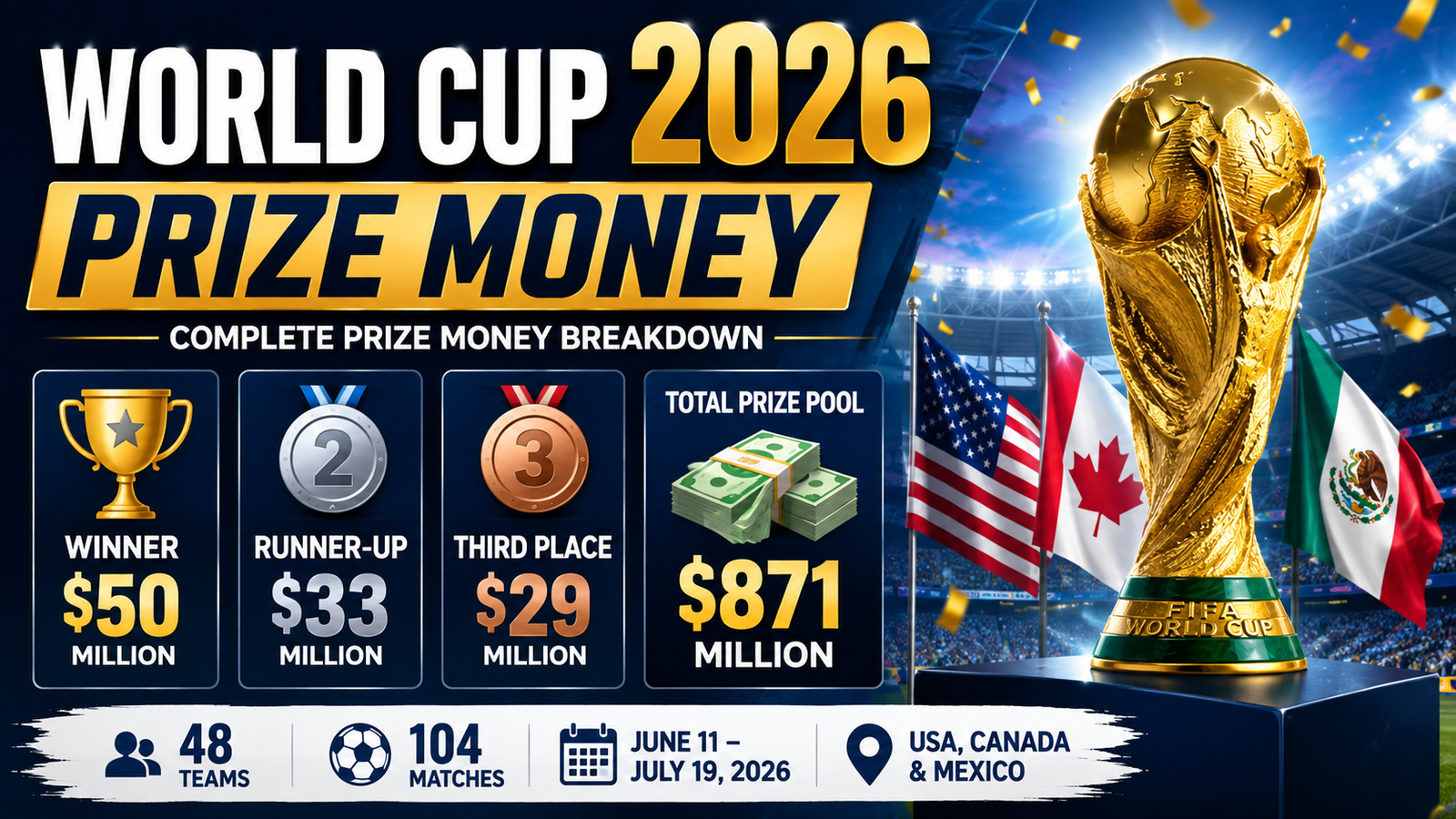
The 2026 FIFA World Cup didn’t just make history on the pitch — it rewrote the record books off it too. With Spain lifting the trophy at MetLife Stadium after beating Argentina in the final, football’s biggest prize also came with football’s biggest paycheck. The World Cup 2026 prize money pool reached a staggering $871 million in total financial distribution; the largest sum FIFA has ever handed out in the tournament’s 96-year history.
The jump wasn’t a small bump either. Thanks to the expansion to a 48-team format, played across the United States, Canada, and Mexico, FIFA increased the overall pot by around 50% compared to Qatar 2022. That meant every single participating federation, win or lose, walked away richer than any World Cup squad before them.
In this guide, you’ll get a complete breakdown of how the World Cup 2026 prize money was distributed — from the guaranteed payments every qualified nation banked before a ball was even kicked, to the record-setting $50 million check that Spain collected as champions. We’ll also cover how this year’s numbers stack up against 2022, which federations profited most, and where all that money actually goes once it lands in a national association’s bank account.
Quick Facts: World Cup 2026 Prize Money
| Category | Details |
|---|---|
| Tournament | FIFA World Cup 2026 |
| Hosts | United States, Canada & Mexico |
| Dates | June 11 – July 19, 2026 |
| Participating Teams | 48 |
| Total Prize Pool | US$871 million |
| Performance Prize Fund | US$655 million |
| Winner’s Prize | US$50 million |
| Runner-up Prize | US$33 million |
| Third Place Prize | US$29 million |
| Fourth Place Prize | US$27 million |
| Guaranteed Qualification Payment | US$10 million per team |
| Preparation Funding | US$2.5 million per team |
| Minimum Guaranteed Earnings | US$12.5 million per qualified team |
| Prize Money Currency | United States Dollar (USD) |
| Organizing Body | FIFA |
| Previous World Cup Prize Pool (2022) | US$440 million |
| Increase from 2022 | Nearly 98% higher |
| Biggest Winner’s Prize in History | Yes |
| Total Matches | 104 |
| Official Tournament | FIFA World Cup 2026 |
World Cup 2026 Prize Money Overview
Before diving into the round-by-round figures, here’s the big picture of how FIFA structured its World Cup 2026 prize money system:
- Total prize pool: $871 million in overall financial distribution, with $655 million tied directly to on-field performance
- Number of participating teams: 48, the largest field in World Cup history, up from 32 in 2022
- Performance-based rewards: Payouts increased at every stage, from group-stage elimination through to the final, rewarding teams for each round they survived
- Qualification and preparation payments: Every federation received guaranteed funding before the tournament began, covering travel, training camps, and delegation costs
- Key highlight: The champion’s prize alone jumped to $50 million — up from $42 million in 2022 and more than 20 times what Italy earned for winning in 1982
The structure reflects a simple philosophy FIFA has leaned into for years: reward performance heavily at the top, but make sure no federation leaves the tournament empty-handed.
FIFA World Cup 2026 Total Prize Pool
Total Financial Distribution
FIFA confirmed a record $871 million total financial distribution for the 2026 World Cup, a figure that includes both performance-based prize money and guaranteed payments to every qualified nation. That’s a substantial jump from the $440 million pool at Qatar 2022 and nearly 40 times what was on offer in 1982.
The bulk of that figure, $655 million, was earmarked purely for performance-based prize money — the amount teams earned based purely on how far they advanced. The rest went toward qualification funding, preparation grants, and additional team contributions covering delegation and logistics costs.
Performance-Based Prize Money
This is where the real money separated the contenders from the rest of the field. Every team, regardless of how it exited the tournament, was locked into a payout tier based on its final finishing position — group stage exit, Round of 32, Round of 16, quarterfinals, and so on, all the way up to the champion’s $50 million.
Qualification Payment
Simply qualifying for the 2026 World Cup was worth real money. FIFA guaranteed a qualification-linked payment to each of the 48 federations that punched their ticket to the tournament, regardless of what happened once the group stage kicked off.
Preparation Fee
On top of qualification money, FIFA handed every participating nation a preparation grant — reported at $1.5 million per team — specifically intended to cover pre-tournament costs like training camps, travel, and accommodation in the lead-up to the opening match.
Why FIFA Increased the Prize Pool
FIFA’s decision to boost the pool wasn’t made in isolation. It came down to a mix of factors: the expanded 48-team format meant more matches and more broadcast windows, commercial and sponsorship revenue for the tournament climbed significantly, and FIFA wanted the World Cup prize money to keep pace with the eye-watering numbers set by the FIFA Club World Cup earlier in 2025. More on this later in the guide.
Also read this:
World Cup 2026 Prize Money Breakdown (Table)
| Final Position | Teams | Prize Money (USD) |
| Champions | 1 | $50 million |
| Runner-up | 1 | $33 million |
| Third Place | 1 | $29 million |
| Fourth Place | 1 | $27 million |
| Quarter-finalists (5th–8th) | 4 | $19 million |
| Round of 16 (9th–16th) | 8 | $15 million |
| Round of 32 (17th–32nd) | 16 | $11 million |
| Group Stage Exit (33rd–48th) | 16 | $9 million |
This tiered structure meant that even the 16 teams eliminated after the group stage still collected a guaranteed $9 million each in performance money alone, before qualification and preparation payments are factored in.
How Much Will the World Cup 2026 Winner Earn?
Champion’s Reward
Spain’s triumph over Argentina in the final earned the Spanish federation a record $50 million in pure performance-based prize money — the single largest payout ever awarded to a World Cup-winning nation.
Total Earnings Including Qualification Payments
Once you stack the champion’s $50 million on top of the qualification funding and preparation grant every team received before the tournament, Spain’s total World Cup 2026 windfall climbed well past $50 million once all guaranteed payments are included — the richest overall return any World Cup winner has taken home.
Comparison With Previous Editions
The growth here has been dramatic. Argentina pocketed $42 million for winning in Qatar in 2022. France earned $38 million for lifting the trophy in Russia in 2018. Go back far enough, and Italy’s 1982 championship squad received just $2.2 million. Spain’s $50 million in 2026 represents more than a 20-fold increase over four decades.
Runner-Up Prize Money
Runner-Up Earnings
Argentina, chasing a second straight title after winning in 2022, fell short in the final but still walked away with $33 million in performance-based prize money for finishing runner-up.
Difference Between Champion and Runner-Up Rewards
The gap between first and second place sits at $17 million — a reminder of just how much value FIFA places on winning the final itself, rather than simply reaching it. That gap has widened compared to 2022, when the difference between Argentina’s champion payout and France’s runner-up prize was smaller in both absolute and percentage terms.
Prize Money for Every Knockout Round
Third Place
England claimed the tournament’s third-place playoff, beating France to secure $29 million in prize money.
Fourth Place
France’s third-place playoff loss still came with a significant consolation: $27 million for finishing fourth overall.
Quarter-finals
The four teams eliminated at the quarterfinal stage each collected $19 million.
Round of 16
Eight nations that exited in the Round of 16 including the United States, which fell to Belgium each earned $15 million.
Round of 32
With the expanded 48-team format introducing a brand-new knockout round, the 16 teams eliminated in the Round of 32 each received $11 million, a payday that didn’t exist in previous World Cup formats.
Group Stage Exit
Even the 16 teams that failed to advance past the group stage left with $9 million each — more than double what many group-stage exits earned just two editions ago.
Guaranteed Money for Every Qualified Team
Qualification Payment
Every one of the 48 federations that qualified for the 2026 World Cup received a guaranteed qualification payment simply for making the tournament, separate from anything earned on the pitch.
Preparation Grant
Layered on top of that, FIFA distributed a $1.5 million preparation grant per nation to help cover pre-tournament logistics, training camps, and travel.
Minimum Guaranteed Earnings
Combine the qualification payment, preparation grant, and the guaranteed $9 million for a group-stage finish, and even the tournament’s least successful teams walked away with a multi-million-dollar payday — by far the highest guaranteed floor in World Cup history.
World Cup 2026 Prize Money vs World Cup 2022
Total Prize Pool Comparison
The 2026 tournament’s $871 million total financial distribution dwarfs the $440 million pool at Qatar 2022 — more than double in just four years.
Winner’s Prize Comparison
Spain’s $50 million champion prize outpaces Argentina’s $42 million from 2022 by $8 million, continuing a steady upward trend in what winning nations take home.
Number of Teams
The field expanded from 32 teams in 2022 to 48 teams in 2026, adding an entirely new Round of 32 knockout stage and 16 more federations sharing in the prize pool.
Biggest Financial Changes
Beyond the headline totals, the biggest structural shift was at the bottom of the payout table. Group-stage exits in 2026 earned considerably more than their 2022 counterparts, reflecting FIFA’s push to spread more of the increased revenue across the entire field, not just the teams that go deep into the knockout rounds.
Why FIFA Increased the Prize Money
Expansion to 48 Teams
More teams meant more matches — 104 in total, up from 64 in 2022 — which translated directly into more broadcast inventory, more matchday revenue, and a bigger overall commercial footprint for FIFA to work with.
Increased Broadcasting Revenue
Hosting across three countries with strong existing football and sports media markets significantly boosted the value of FIFA’s broadcast rights deals heading into the tournament.
Sponsorship Growth
The expanded format and North American hosts attracted a wider pool of global and regional sponsors, adding to FIFA’s overall commercial revenue for the cycle.
Commercial Success
Ticketing, hospitality packages, and licensing all scaled up alongside the larger tournament footprint, contributing to FIFA’s ability to raise the total pool by roughly 50% compared to 2022’s projections.
FIFA Revenue Model
FIFA’s prize money isn’t drawn from a fixed budget — it’s tied to the revenue the World Cup generates across that four-year cycle. As broadcasting, sponsorship, and commercial income climbed for the 2026 tournament, FIFA passed a larger share of that windfall on to participating federations.
Which Countries Could Earn the Most?
Top Title Contenders
Heading into the knockout stages, the deepest-pocketed run belonged to the two finalists. Spain and Argentina both banked significant sums simply by advancing through every knockout round before the final decided who took home the extra $17 million that separates champion from runner-up.
Estimated Earnings for Finalists
Between performance-based prize money and guaranteed qualification and preparation payments, both the Spanish and Argentine federations ended the tournament with total windfalls far exceeding any previous World Cup run for either nation.
Financial Impact on National Football Associations
For smaller footballing nations that qualified for the first time or made deep unexpected runs, the financial jump was proportionally even bigger — a group-stage $9 million payday alone can represent a transformative injection into a federation’s annual budget.
How FIFA Distributes World Cup Prize Money
Distribution Process
FIFA pays out prize money directly to each participating national football federation, not to individual players, based on the team’s final finishing position once the tournament concludes.
Payments to Football Federations
Federations receive their performance-based prize money, qualification payment, and preparation grant as separate line items, which they’re then responsible for allocating according to their own internal agreements.
Player Bonuses
How much of that prize money reaches the players themselves depends entirely on bonus structures individual federations negotiate with their squads and players’ unions ahead of the tournament — these vary widely from country to country.
Team Agreements
Some federations have long-standing bonus formulas tied to World Cup performance, while others negotiate fresh agreements each cycle. FIFA has no direct involvement in how a federation splits its prize money with players and staff.
Financial Impact on National Teams
Investment in Football Development
For many federations, World Cup prize money represents one of the single largest revenue events in a four-year cycle, often reinvested directly into the sport’s domestic infrastructure.
Youth Academies
A share of prize money frequently flows toward youth development programs and academy systems, aimed at building the next generation of talent.
Infrastructure
Stadiums, training facilities, and federation offices are common long-term beneficiaries of World Cup windfalls, particularly for smaller footballing nations.
Women’s Football Funding
Several federations have publicly committed a portion of their men’s World Cup earnings toward growing women’s football programs domestically, a trend that’s grown alongside FIFA’s own push to close the funding gap between the men’s and women’s game.
Interesting Facts About World Cup 2026 Prize Money
- Highest prize pool in World Cup history — $871 million in total financial distribution, easily surpassing every previous edition
- First 48-team tournament — the expanded format added an entirely new Round of 32 knockout round and prize tier
- Record champion payout — Spain’s $50 million champion prize is the largest ever awarded to a World Cup winner
- Largest guaranteed payment for qualified teams — every one of the 48 federations received a guaranteed multi-million-dollar payout regardless of on-field results
Conclusion
The 2026 FIFA World Cup didn’t just deliver a record-breaking tournament on the pitch — it delivered a record-breaking payday off it. From Spain’s historic $50 million champion’s prize down to the guaranteed millions collected by every team that made the 48-nation field, this was the richest World Cup FIFA has ever staged, with a total financial distribution of $871 million. So we discussed World Cup 2026 prize money.
What stands out most isn’t just the size of the numbers at the top — it’s how far FIFA spread the wealth across the entire field. Group-stage exits, Round of 32 debutants, and quarterfinalists alike all cashed in more than any of their predecessors at previous tournaments. As the World Cup continues to grow in scale and commercial value, expect the prize pool to keep climbing at future editions, with federations increasingly reinvesting these windfalls into youth development, infrastructure, and the broader growth of the game — including the women’s side of the sport.
FAQs
1.What is the total World Cup 2026 prize money?
FIFA’s total financial distribution for the 2026 World Cup reached $871 million, with $655 million of that tied directly to performance-based prize money.
2.How much will the World Cup 2026 winner receive?
Champions Spain earned $50 million in performance-based prize money, the largest champion’s payout in World Cup history.
3.Does every qualified team receive prize money?
Yes. All 48 qualified federations received guaranteed qualification and preparation payments in addition to at least $9 million in performance-based prize money for reaching the group stage.
4.How much does the runner-up earn?
Runner-up Argentina received $33 million in performance-based prize money.
5.What is the minimum guaranteed payment?
Every team that exited in the group stage still earned $9 million in performance-based prize money, on top of separate qualification and preparation payments.
6.How is FIFA World Cup prize money distributed?
FIFA pays prize money directly to national football federations based on final tournament position; how much individual players receive depends on bonus agreements each federation negotiates separately.
7.Why did FIFA increase the prize pool?
The expansion to 48 teams, higher broadcasting revenue, stronger sponsorship deals, and overall commercial growth around the tournament allowed FIFA to raise the total pool by roughly 50% compared to 2022.
8.Is World Cup 2026 the richest FIFA World Cup ever?
Yes. At $871 million in total financial distribution, 2026 is the richest World Cup FIFA has ever staged, surpassing the $440 million pool at Qatar 2022.