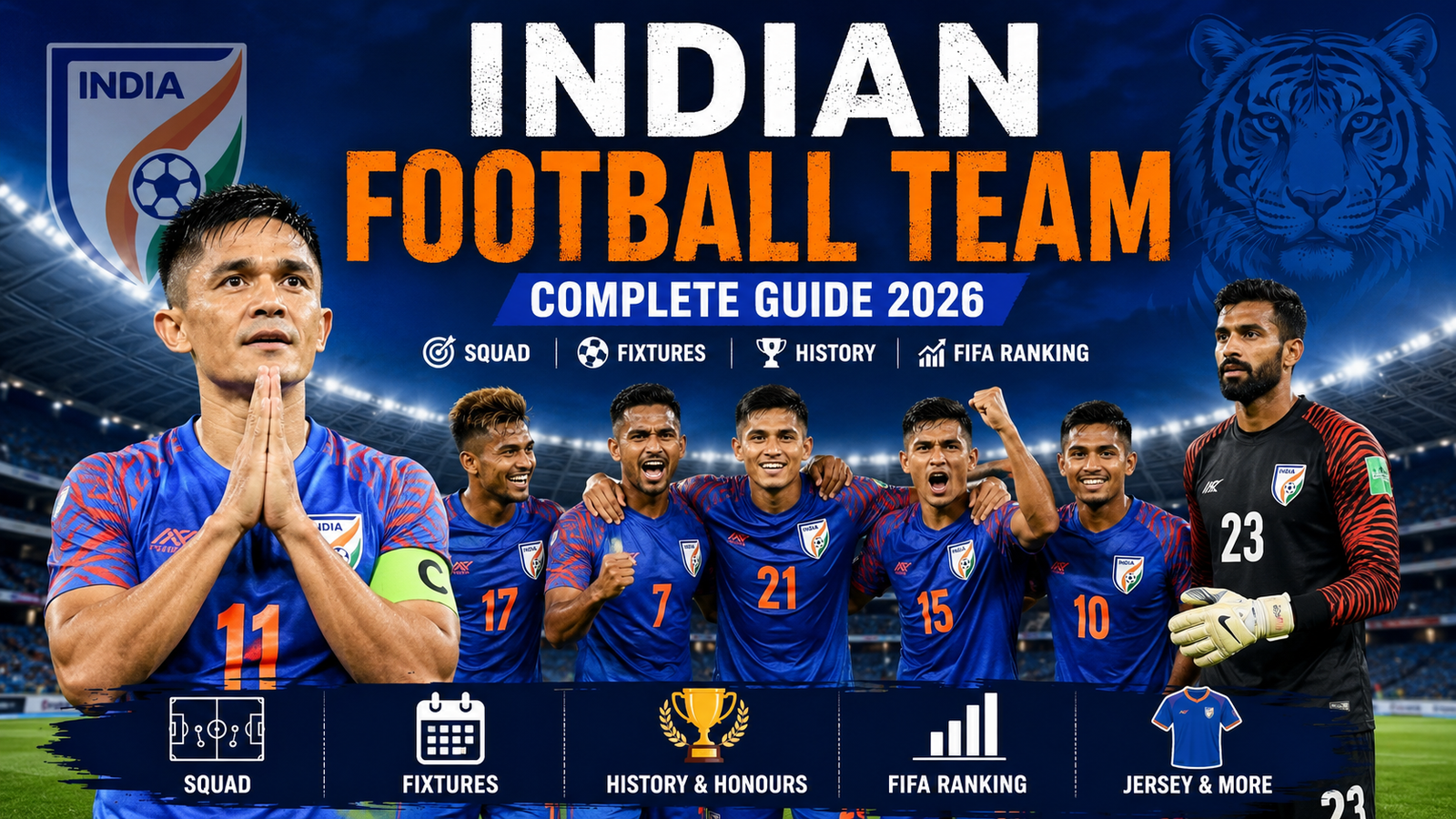
The Indian Football Team, popularly known as the Blue Tigers, represents India in international men’s football and is governed by the All India Football Federation (AIFF). Over the decades, India has experienced historic highs, including Asian Games gold medals and regional dominance in the SAFF Championship, while also facing major challenges on the Asian and global stage.
In 2026, Indian football is entering another important transition period under head coach Khalid Jamil. The squad combines experienced internationals such as Gurpreet Singh Sandhu, Sandesh Jhingan, Rahul Bheke and Brandon Fernandes with younger players looking to establish themselves at international level. The team’s immediate priorities include improving consistency, climbing the FIFA world ranking, developing the next generation of players and building toward the 2030 FIFA World Cup qualification campaign.
India’s football story is much bigger than its World Cup record. The Blue Tigers have won the SAFF Championship nine times, claimed Asian Games gold in 1951 and 1962, finished runners-up at the 1964 AFC Asian Cup, and produced legendary players such as Sunil Chhetri, Bhaichung Bhutia and IM Vijayan.
This complete guide to the Indian Football Team 2026 covers the latest squad, players and positions, head coach, captain, FIFA ranking, schedule, major achievements, Asian Cup record, World Cup qualification history, famous players, records, rivalries and the road toward 2030. Whether you want to check the India football team squad 2026, understand its history or follow its upcoming fixtures, this guide brings the key information together in one place.
Indian Football Team 2026: Quick Facts
| Category | Details |
|---|---|
| Team | Indian Football Team |
| Nickname | Blue Tigers |
| Governing Body | All India Football Federation (AIFF) |
| FIFA Code | IND |
| Confederation | AFC |
| Regional Federation | SAFF |
| Head Coach | Khalid Jamil |
| Captain | Gurpreet Singh Sandhu |
| FIFA Ranking | Around 133rd (June 2026) |
| Highest FIFA Ranking | 94th |
| SAFF Championship Titles | 9 |
| AFC Asian Cup Appearances | 5 |
| FIFA World Cup Appearances | 0 |
| All-Time Top Scorer | Sunil Chhetri |
| Home Venue | Salt Lake Stadium, Kolkata |
| Long-Term Target | 2030 FIFA World Cup |
Indian Football Team 2026: Overview
| Category | Details |
|---|---|
| Team Name | Indian Football Team (Blue Tigers) |
| Governing Body | All India Football Federation (AIFF) |
| FIFA Code | IND |
| Nickname | Blue Tigers |
| Confederation | Asian Football Confederation (AFC) |
| Regional Federation | South Asian Football Federation (SAFF) |
| Head Coach | Khalid Jamil |
| Team Captain | Gurpreet Singh Sandhu |
| Home Stadium | Vivekananda Yuba Bharati Krirangan (Salt Lake Stadium), Kolkata |
| Stadium Capacity | 85,000+ spectators |
| FIFA Ranking (June 2026) | Around 133rd |
| Highest FIFA Ranking | 94 (February 1996) |
| Lowest FIFA Ranking | 173 (March 2015) |
| FIFA World Cup Appearances | 0 |
| AFC Asian Cup Appearances | 5 |
| SAFF Championship Titles | 9 (Record) |
| First International Match | India 1–2 Australia (1938) |
| Biggest Victory | India 7–1 Pakistan (1956) |
| Most Goals in One Match | 7 Goals (vs Pakistan, 1956) |
| Team Colors | Blue Jersey, Blue Shorts, Blue Socks |
| Home Supporters | Blue Pilgrims |
| Most Capped Player | Sunil Chhetri |
| All-Time Top Scorer | Sunil Chhetri (94 International Goals) |
| Current Formation | 4-2-3-1 / 4-3-3 (varies by opponent & coach) |
| Squad Market Value (Approx.) | €4–6 Million (combined estimate, varies by squad selection) |
| Official Website | AIFF – https://www.the-aiff.com |
| Current Goal | Qualify for the 2030 FIFA World Cup and strengthen India’s position in Asian football |
Also read this: Premier League Player Stats 2026 | Champions League Records 2026 | Jude Bellingham Assists 2026
Indian Football Team 2026 Players by Position
| Position | Players |
|---|---|
| Goalkeepers | Gurpreet Singh Sandhu, Vishal Kaith, Amrinder Singh |
| Centre-Backs | Sandesh Jhingan, Anwar Ali, Mehtab Singh |
| Full-Backs | Rahul Bheke, Roshan Singh, Akash Mishra, Asish Rai |
| Defensive Midfielders | Jeakson Singh, Apuia Ralte |
| Midfielders | Suresh Singh Wangjam, Brandon Fernandes, Sahal Abdul Samad, Ayush Chhetri |
| Wingers | Liston Colaco, Lallianzuala Chhangte |
| Forwards | Manvir Singh, Irfan Yadwad, Farukh Choudhary |
| Striker | Sunil Chhetri |
Indian Football Team 2026 Squad & Coach
Coach: Khalid Jamil
Captain: Gurpreet Singh Sandhu
Nickname: Blue Tigers
Governing Body: All India Football Federation (AIFF)
The Indian Football Team is entering a new phase under head coach Khalid Jamil, who became the first Indian to lead the senior men’s national team in over a decade. His appointment marked the beginning of a rebuilding process focused on disciplined defending, quick transitions, and giving opportunities to young domestic talents.
Leading the squad is captain Gurpreet Singh Sandhu, one of India’s most experienced goalkeepers and a key figure in the Blue Tigers’ dressing room. The 2026 squad blends experienced internationals such as Sandesh Jhingan, Rahul Bheke, Lallianzuala Chhangte, and Brandon Fernandes with emerging players who have impressed in the Indian Super League (ISL). The aim is to build a competitive team capable of climbing the FIFA rankings and preparing for the 2030 FIFA World Cup qualification campaign.
| Player | Position | Club (2026) |
|---|---|---|
| Gurpreet Singh Sandhu | Goalkeeper | Bengaluru FC |
| Vishal Kaith | Goalkeeper | Mohun Bagan Super Giant |
| Amrinder Singh | Goalkeeper | Odisha FC |
| Rahul Bheke | Defender | Bengaluru FC |
| Sandesh Jhingan | Centre-Back | FC Goa |
| Anwar Ali | Centre-Back | East Bengal FC |
| Mehtab Singh | Centre-Back | Mumbai City FC |
| Roshan Singh Naorem | Left-Back | Bengaluru FC |
| Akash Mishra | Left-Back | Mumbai City FC |
| Asish Rai | Right-Back | Mohun Bagan Super Giant |
| Jeakson Singh | Defensive Midfielder | East Bengal FC |
| Lalengmawia “Apuia” Ralte | Midfielder | Mohun Bagan Super Giant |
| Suresh Singh Wangjam | Midfielder | Bengaluru FC |
| Brandon Fernandes | Attacking Midfielder | FC Goa |
| Sahal Abdul Samad | Midfielder | Mohun Bagan Super Giant |
| Ayush Chhetri | Midfielder | FC Goa |
| Liston Colaco | Winger | Mohun Bagan Super Giant |
| Lallianzuala Chhangte | Winger | Mumbai City FC |
| Manvir Singh | Forward | Mohun Bagan Super Giant |
| Irfan Yadwad | Forward | Chennaiyin FC |
| Sunil Chhetri | Striker | Bengaluru FC |
| Farukh Choudhary | Forward | Chennaiyin FC |
Coaching Staff
| Role | Name |
|---|---|
| Head Coach | Khalid Jamil |
| Team Captain | Gurpreet Singh Sandhu |
| Nickname | Blue Tigers |
| Governing Body | All India Football Federation (AIFF) |
The majority of the current squad comes from leading ISL clubs such as Mohun Bagan Super Giant, Bengaluru FC, Mumbai City FC, FC Goa, and East Bengal FC, highlighting the league’s growing role in developing players for the national team. Under Khalid Jamil, the Blue Tigers are expected to continue building a younger, more competitive squad while maintaining experienced leaders to guide the next generation.
Indian Football Team Recent Results
India has shown mixed performances in recent international matches. While the Blue Tigers have produced encouraging displays against regional rivals, consistency remains the team’s biggest challenge. The coaching staff continues to focus on improving defensive organization, ball possession, and attacking efficiency.
| Opponent | Competition | Result |
|---|---|---|
| Thailand | Friendly | Win |
| Hong Kong | AFC Qualifier | Draw |
| Bangladesh | Friendly | Win |
| Singapore | AFC Qualifier | Loss |
Indian Football Team Honours
Despite limited success at the global level, the Indian Football Team has enjoyed several memorable achievements in Asian football.
| Competition | Titles |
|---|---|
| SAFF Championship | 9 |
| Asian Games Gold Medal | 2 |
| Nehru Cup | 3 |
| AFC Challenge Cup | 1 |
| Intercontinental Cup | 2 |
These achievements highlight India’s rich football history and its dominance in South Asian football.
India’s Major Football Achievements
| Achievement | Year/Count |
|---|---|
| Asian Games Gold | 1951, 1962 |
| Asian Games Fourth Place | 1956 |
| AFC Asian Cup Runner-up | 1964 |
| SAFF Championship Titles | 9 |
| Nehru Cup Titles | 3 |
| AFC Challenge Cup | 2008 |
| Intercontinental Cup | 2 |
| Highest FIFA Ranking | 94th |
| Biggest Listed Victory | India 7–1 Pakistan, 1956 |
Indian Football Team FIFA Ranking Timeline
| Year | FIFA Ranking |
|---|---|
| 1996 | 94 |
| 2015 | 173 |
| 2017 | 96 |
| 2020 | 104 |
| 2023 | 99 |
| 2026 | Around 133 |
Indian Football Team FIFA Ranking History
India’s FIFA ranking has fluctuated significantly over the years, reflecting changes in performance and international competition.
| Year | FIFA Ranking |
|---|---|
| 1996 | 94 (Highest) |
| 2015 | 173 |
| 2017 | 96 |
| 2020 | 104 |
| 2023 | 99 |
| 2026 | Around 133 |
Improving the FIFA ranking remains one of the key objectives for the Indian Football Team.
Indian Football Team World Cup Qualification Record
The Indian Football Team has never qualified for the FIFA World Cup. However, the team regularly competes in the AFC qualification rounds and continues working toward its long-term goal of reaching football’s biggest tournament.
| Tournament | Qualified |
|---|---|
| FIFA World Cup 1950 | Qualified but withdrew |
| FIFA World Cup 1954–2026 | Did Not Qualify |
The Golden Era: When India Ruled Asia
For the knowhow on the Indian football team, you need to chart back to the 1950s and early portion of the 1960s period that can be identified as the golden era of Indian football.
Coached by the legendary Syed Abdul Rahim, India became one of the most feared sides in Asia. You won gold at the 1951 Asian Games in New Delhi, beating Iran 1–0 final, a defining moment that heralded India as an emerging continental power. His dreams were again made a reality eleven years later in Jakarta at the 1962 Asian Games where they triumphed yet again establishing Rahim as the father of modern Indian football.
The only other significant Indian achievement at the Games remains a fourth place finish at the 1956 Melbourne Olympics. The side had an almost carefree technical quality that invited comparisons with some of Europe’s finest club sides of the age.
It also resulted in one of the sport’s more bizarre historical footnotes. India were given a technical qualification for the 1950 FIFA World Cup after several teams in their group withdrew. However, the team withdrew before the start of the tournament — officially due to travelling costs, although it has been speculated ever since that more than mere funding was at play. This is still as close India has got to the biggest stage of cricket.
Also read this: Brazil National Football Team | Spain National Football Team | Argentina National Football Team
The Long Decline and the Road Back
Indian football fell into a long period of decline after the end of this golden era following Rahim’s death in 1963. With no real domestic league to speak of, little investment in the sport and administrative roadblocks, India lagged further and further behind their Asian rivals.
India’s FIFA ranking fell to an all-time low of 173 in March 2015. It was at a low point for the sport, not a prayer of an England team capturing a football crazy nation with nowhere credible to put their passion.
This revival was sparked under the second stint of head coach Stephen Constantine. India registered a stunning unbeaten streak of 22 matches (11 wins and 2 draws) from June 2016 to March 2018 under his steady course. That run helped India qualify for the 2019 AFC Asian Cup, their first appearance at Asia’s top tournament in eight years – and propelled the FIFA ranking to a modern-day high of 96th in July 2017.
2014 was also the year that saw the Indian Super League come into effect in a bigger structural form. It drew foreign recruitment and offered young Indian footballers a professional contest to thrive in, and, as a result, raised the bar of Indian soccer significantly.
Sunil Chhetri: The Man Who Carried Indian Football
And no piece on the India national football team is truly complete without a lengthy homage to Sunil Chhetri, India’s greatest-ever player (the argument for this could go long) and one of the most prolific international goalscorers in history.
Chhetri was born on 3 August 1984 in Secunderabad and made his senior international debut against Pakistan in June 2005, with Chhetri netting a goal on his full appearance. That was followed by 19 years of greatness, leadership and goals.
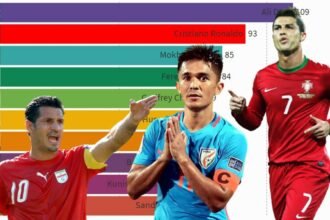
Chhetri had scored 94 goals in 151 appearances in his career, which at its peak made him the fourth highest international goal scorer behind only Cristiano Ronaldo, Lionel Messi and Ali Daei. His 64-goal effort stood (for a minute or an eternity, as might fit) shoulder to shoulder with Messi’s at the time in June of 2018 and sent headlines flying across the planet while global football audiences had little choice but to take notice of what Indians fans have known for years.
His trophy collection with the national team was no less glorious. Chhetri was pivotal in helping India to SAFF Championship titles, during 2011, 2015, 2021 and 2023 along with the Nehru Cup crowns of [2007], [2009] and [2012] and finally a victory at the AFC Challenge Cup of just before the turn of the new millennium where they were also then rewarded qualification for their first AFC Asian Cup in [27 years].
He won a record seven AIFF Player of the Year awards, and got the Khel Ratna in 2021, thus becoming the first footballer to win India’s highest sporting honour.
Chhetri had announced his retirement from international football after India’s World Cup qualifier against Kuwait in Kolkata in June 2024. In early 2025, at the request of coach Manolo Márquez, he came out of retirement in order to play again and scored in his comeback match against the Maldives. However, in confirming his final international retirement following India’s failure to qualify for the 2027 AFC Asian Cup, those appearances and goals ended as benchmarks which will remain beyond reach in Indian football for generations.
Also read this: Spain national football team games | Netherlands national football team games | France football team
SAFF Championship: India’s Regional Dominance
Although reaching FIFA World Cups and AFC Asian Cups has been an elusive target, the Indian football team has dominated South Asia. The SAFF Championship has been won a record nine times by India, whose most recent victory came in 2023 after triumphing on penalties against Kuwait.
That 2023 edition saw Chhetri as the top-scorer for the Indian team with five goals including a sensational hat-trick versus Pakistan. The SAFF Championship continues to be the only reliable indicator of India’s footballing identity at a regional level, aspiring to punch above their weight at continental and global level.
India’s Current FIFA Ranking and the 2026 Situation
Today we present a sobering overview. As of June 2026, the India football team FIFA ranking is approximately 133rd; a drop to more than two modern-era highs (96 since 2017), and to near-the-lowest in nine years.
The reasons are well-documented. India bowed out of 2026 FIFA World Cup qualification. In the second round, India were yanked into group A with Afghanistan, Kuwait and Qatar, managing just one win in the first leg against Kuwait (1–0). The losses continued a 0–3 loss and 1–2 loss against Qatar, followed by a shocking 1–2 loss to Afghanistan before the campaign ended with goalless draws. India came third in the group and did not qualify for the knockout stage.
In October 2025, a second blow came when India were eliminated from qualifying for the 2027 AFC Asian Cup after losing 2–1 to Singapore marking the first time since 2015 that no South Asian team qualified for the tournament. The combined failures in just twelve months’ timeframe emphasized the size of the reconstruction needed.
The 2026 Squad and Coach Khalid Jamil
After the World Cup qualifier, Manolo Márquez stepped down from his post as head coach of the Indian national football team, following the appointment of Khalid Jamil in 2025. Jamil is a well-known face in Indian club football, having previously coached Mumbai City FC and Northeast United, with a philosophy prioritising organisation in defence and quickly going on the attack; at least until his team goes ahead.
The India 2026 squad of the football team is a transitional unit. India will need a new leader at the head of attack with Chhetri’s eventual retirement and the AIFF have been doing well to source players from U-20 and U-23 setups to strengthen depth. The current pool features Mohun Bagan SG, East Bengal FC and players from Bengaluru FC.
India took part in the Unity Cup held in June 2026 with players from clubs such as Mohun Bagan SG being called up to the team. But the experience of competitive international meetings even in friendly and minor tournaments is vital for benefiting a future generation of Indian players.
Indian Football Team AFC Asian Cup Record
India has participated in the AFC Asian Cup on multiple occasions and achieved its best-ever result by finishing as runners-up in 1964.
| Year | Result |
|---|---|
| 1964 | Runner-up |
| 1984 | Group Stage |
| 2011 | Group Stage |
| 2019 | Group Stage |
| 2023 | Group Stage |
The team aims to become a regular participant in future AFC Asian Cups.
Indian Football Team Coaching History
Several respected coaches have guided the Blue Tigers over the years, helping shape Indian football.
| Coach | Period |
|---|---|
| Syed Abdul Rahim | 1950s–1963 |
| Stephen Constantine | 2015–2019 |
| Igor Štimac | 2019–2024 |
| Manolo Márquez | 2024–2025 |
| Khalid Jamil | 2025–Present |
Each coach has contributed to the development of Indian football in different ways.
Indian Football Team Records
The Indian Football Team has produced several remarkable records throughout its history.
| Record | Achievement |
|---|---|
| Most International Goals | Sunil Chhetri (94) |
| Most International Appearances | Sunil Chhetri |
| Biggest Victory | India 7–1 Pakistan (1956) |
| Highest FIFA Ranking | 94 |
| Most SAFF Championship Titles | 9 |
These milestones underline the contributions of legendary Indian footballers.
Indian Football Team Rivalries
The Blue Tigers have developed exciting rivalries over the years, particularly within South Asia.
- Pakistan – One of the oldest and most passionate football rivalries in the region.
- Bangladesh – Competitive SAFF Championship clashes.
- Nepal – Frequent encounters in regional tournaments.
- Maldives – Close contests in SAFF competitions.
These matches often attract significant fan interest and create memorable moments.
Indian Football Team Jersey
The Indian Football Team jersey is traditionally blue, reflecting the nickname Blue Tigers. Home kits usually feature royal blue, while away kits are commonly white. The design changes periodically with new official kit suppliers, but the team’s iconic blue identity remains unchanged.
Indian Football Team Schedule 2026
The Indian Football Team Schedule 2026 includes AFC Asian Cup qualifiers, FIFA international windows, and friendly matches. The schedule may change throughout the year based on FIFA and AFC calendars.
| Month | Competition |
|---|---|
| March | FIFA International Window |
| June | AFC Asian Cup Qualifiers |
| September | International Friendlies |
| October | AFC Asian Cup Qualifiers |
| November | FIFA International Window |
The Indian Super League: Foundation of the National Team
The role of the Indian Super League is and will always be there in discussions about development of the Indian football team, and rightly so. But the ISL is an ever-maturing entity- purpose prefixed in a bedrock sense of football and business ethics, now serving as the main pipeline for national team players since its inception in 2014.
An administrative dispute between the league operator and its governing body, AIFF, marred the 2025–26 ISL season as the supreme court stepped in. The format of the season was shortened and took place from February to May 2026, with East Bengal FC winning their first ISL title. In spite of the turmoil, the standard of football on show especially from the Indian youngsters gave real cause for hope.
The ISL 2026–27 season would feature a quirk-free full-length format with the season running from September 1, 2026, to April 11, 2027. The domestic season needs to be stable and competitive for the national team. Form in ISL directly correlates to the levels of performance for the national team since when India’s best is match-sharp while playing regularly in a professional environment, it makes the Blue Tigers less easy to tackle internationally.
July 2026 might see the impending Durand Cup, while the Indian Football League (IFL) will fill up from October to March 2027 and completes this already-tight domestic schedule intended to keep players ticking throughout the year.
India AFC Asian Cup Record
| Edition | India’s Result |
|---|---|
| 1964 | Runner-up |
| 1984 | Group Stage |
| 2011 | Group Stage |
| 2019 | Group Stage |
| 2023 | Group Stage |
India’s World Cup Qualification Record
| World Cup Cycle | Result |
|---|---|
| 1950 | Qualified but withdrew |
| 1954 | Did not qualify |
| 1958 | Did not qualify |
| 1962 | Did not qualify |
| 1966 | Did not qualify |
| 1970 | Did not qualify |
| 1974 | Did not qualify |
| 1978 | Did not qualify |
| 1982 | Did not qualify |
| 1986 | Did not qualify |
| 1990 | Did not qualify |
| 1994 | Did not qualify |
| 1998 | Did not qualify |
| 2002 | Did not qualify |
| 2006 | Did not qualify |
| 2010 | Did not qualify |
| 2014 | Did not qualify |
| 2018 | Did not qualify |
| 2022 | Did not qualify |
| 2026 | Did not qualify |
Indian Football Team: Key Records
| Record | Player/Result |
|---|---|
| Most International Goals | Sunil Chhetri |
| International Goals | 94 |
| Most International Appearances | Sunil Chhetri |
| Highest FIFA Ranking | 94 |
| Lowest FIFA Ranking | 173 |
| Most SAFF Championship Titles | India – 9 |
| Biggest Listed Win | India 7–1 Pakistan |
| Best AFC Asian Cup Finish | Runner-up, 1964 |
| Asian Games Gold Medals | 2 |
Best Indian Football Players: Past and Present
Indian football has given us many memorable players from different generations and not just Chhetri. Bhaichung Bhutia Bury FC Bhaichung’s ‘Sikkimese Sniper’ became one of the first Indian footballers to play abroad, having represented English club Bury FC. The electric dribbler, who could see the back of the net from an age when most Indian kids never even saw the net to aim at, M. I. M. Vijayan was a crowd favourite throughout the 90s Peter Thangaraj is widely regarded as the greatest goalkeeper of all time in India.
Fast-forward to the present day and Brandon Fernandes has now seemed to establish himself as one of Indian football’s most creative midfielders while Liston Colaco has come on leaps and bounds as a dynamic wide forward who shouldered much of the goal-scoring load in that transition post-Chhetri. Gurpreet Singh Sandhu, another first in Indian football but this time as the country’s first custodian to play a UEFA competition game while lining up for Norwegian side Stabæk in the Europa League continues to occupy a key position between the sticks.
India Football: The Road to 2030
The 2030 FIFA WC qualifying campaign is just around the corner for Indian football. The format of the qualifiers would resemble that for 2026, with India playing from the second round group stage. The message is simple: Finish in the top two of their group. That is the bounce they failed to make in 2026, and it needs to be made into clearance by 2030.
In another, Khalid Jamil would like to see it clearly just get as many points on every outing possible, since India are gearing up for the next qualifying draw for FIFA rankings. Higher seeds kinder draws better qualification chances. The rebuild lacks glamour but is systematic and necessary.
Some of the AIFF’s longer-term initiatives in youth football, such as the AIFF Elite Academy, developmental Indian Arrows set-up that feeds to I-League and tie-ups with state football associations are starting to pay off. The players of this generation in their early twenties are arguably the best-prepared we have ever produced in Indian football.
A high of 94th, set more than 25 years ago in 1996, still lingers as a symbolic milestone on the all-time FIFA ranking list for India. Yet, in a hotchpotch sport where the closest competitors for neighboring nations such as Japan, South Korea and Australia have shot ahead, literally through the roof and up against the sky within measurement of stature alone and by miles academically. The Blue Tigers need more than just symbolism. They require results from the top order on a regular basis against Asia’s elite.
Also read this: Argentina national football team | Norway national football team | Italy national football team
Key Takeaways
- The Indian Football Team, popularly known as the Blue Tigers, is governed by the All India Football Federation (AIFF).
- Khalid Jamil is the head coach of the Indian Football Team in 2026, while Gurpreet Singh Sandhu serves as the captain.
- India has won the SAFF Championship nine times, making it the most successful team in the tournament’s history.
- The Indian Football Team has never qualified for the FIFA World Cup, but it continues to compete in AFC qualification campaigns.
- Sunil Chhetri is India’s all-time leading goal scorer and one of the country’s greatest football legends.
- The team plays its home matches at venues such as Salt Lake Stadium and other major stadiums across India.
- The Indian Football Team Schedule 2026 includes AFC Asian Cup qualifiers, FIFA international windows, and friendly matches.
- Improving the FIFA ranking, developing young talent, and preparing for the 2030 FIFA World Cup qualifiers remain the team’s primary goals.
Conclusion
The Indian Football Team stands at an important point in its history in 2026. The Blue Tigers have a proud legacy that includes Asian Games gold medals, a runners-up finish at the 1964 AFC Asian Cup and a record nine SAFF Championship titles. At the same time, the team continues to face the difficult challenge of becoming more competitive against Asia’s strongest football nations.
The current rebuilding phase under Khalid Jamil is focused on creating a stronger and more balanced squad. Experienced players such as Gurpreet Singh Sandhu, Sandesh Jhingan and Brandon Fernandes can provide leadership, while younger talents from India’s domestic football system will be increasingly important for the team’s future.
The biggest targets remain clear: improve the FIFA ranking, develop greater squad depth, perform more consistently in international matches and prepare effectively for the 2030 FIFA World Cup qualification campaign. The growth of the Indian Super League, youth development programmes and India’s expanding football culture provide important foundations for that journey.
India’s World Cup dream has remained unfulfilled so far, but the history of the Blue Tigers shows that Indian football is capable of producing memorable moments. With stronger domestic development, better international preparation and a clear long-term strategy, the Indian Football Team can aim to establish itself as a more competitive force in Asian football and take another step toward its ultimate goal of reaching the FIFA World Cup.
FAQs
1. Who is the current head coach of the Indian Football Team in 2026?
The current head coach of the Indian Football Team is Khalid Jamil, who took charge after Manolo Márquez and is leading the Blue Tigers into a new era.
2. Who is the captain of the Indian Football Team in 2026?
Gurpreet Singh Sandhu is the captain of the Indian Football Team and remains one of the country’s most experienced goalkeepers.
3. What is India’s current FIFA ranking in 2026?
As of June 2026, the Indian Football Team is ranked around 133rd in the FIFA Men’s World Rankings.
4. Has the Indian Football Team ever qualified for the FIFA World Cup?
No, the Indian Football Team has never qualified for the FIFA World Cup finals. However, the team is working toward qualifying for the 2030 FIFA World Cup.
5. Who is the all-time top scorer for the Indian Football Team?
Sunil Chhetri is India’s all-time leading goal scorer with 94 international goals, making him one of the highest-scoring international footballers in history.
6. Which players are key members of the Indian Football Team in 2026?
Some of the key players in the Indian Football Team’s 2026 squad include Gurpreet Singh Sandhu, Sandesh Jhingan, Rahul Bheke, Brandon Fernandes, Lallianzuala Chhangte, Liston Colaco, Manvir Singh, and Sunil Chhetri.
Q7. What is the Indian Football Team schedule for 2026?
The Indian Football Team schedule for 2026 includes AFC Asian Cup qualifiers, FIFA international windows, and friendly matches. The fixture list is updated regularly by the AIFF and FIFA based on the international football calendar.
Q8. What are the biggest achievements of the Indian Football Team?
The Indian Football Team has won the SAFF Championship nine times, secured Asian Games gold medals in 1951 and 1962, won the AFC Challenge Cup in 2008, and finished as runners-up in the 1964 AFC Asian Cup.
Q9. What is the home stadium of the Indian Football Team?
The Indian Football Team plays home matches at several venues across India, with Vivekananda Yuba Bharati Krirangan (Salt Lake Stadium), Kolkata, being one of its primary home stadiums. Other venues are also used depending on the competition and hosting arrangements.
Q10. Why is the Indian Football Team called the Blue Tigers?
The Indian Football Team is popularly known as the Blue Tigers because of its iconic blue home jersey and the tiger, which symbolizes strength, courage, and determination in Indian sports.
Q11. Which club contributes the most players to the Indian Football Team?
Several Indian Super League (ISL) clubs regularly contribute players to the national team. In recent years, Mohun Bagan Super Giant, Bengaluru FC, Mumbai City FC, FC Goa, and East Bengal FC have provided many key players for the Indian Football Team.
Q12. Where can I watch Indian Football Team matches live?
Fans can watch Indian Football Team matches live on the official broadcasters announced by the AIFF and through selected sports TV channels and OTT streaming platforms. Match schedules and broadcast details are usually released before each fixture.