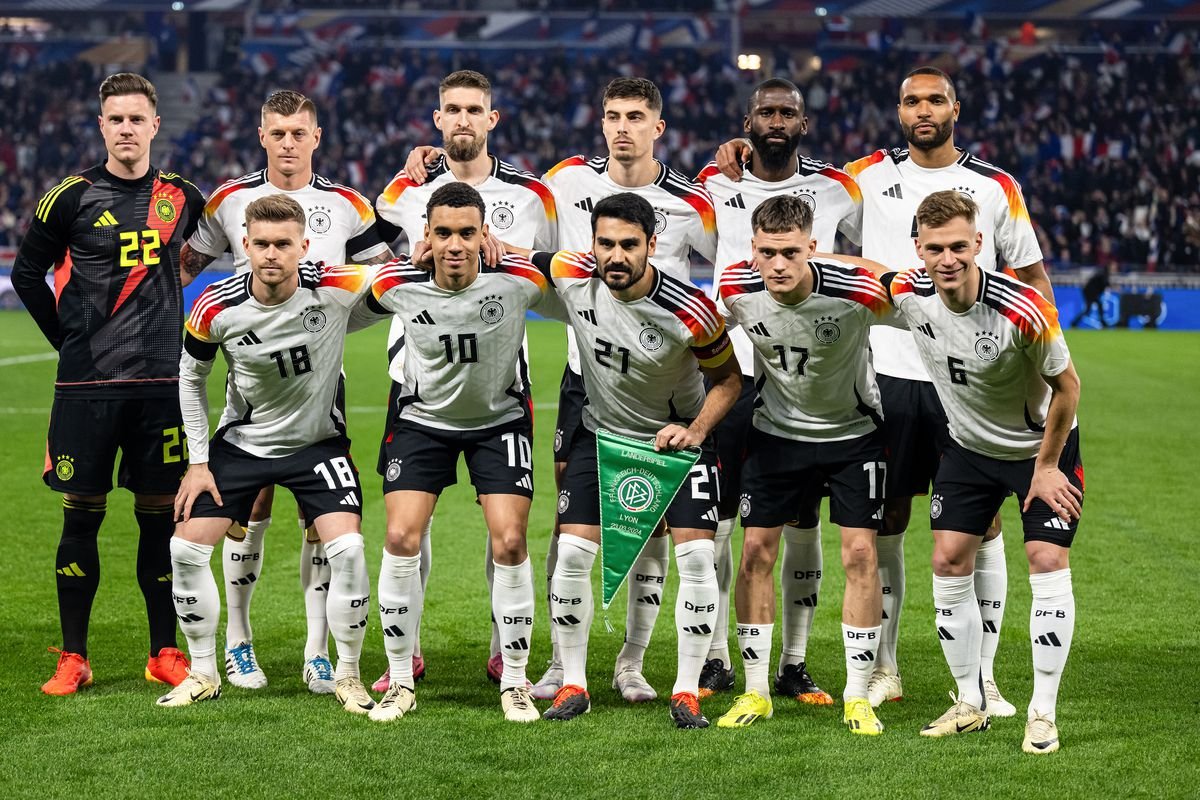
After four years in the football wilderness, a nation desperate to see the Germany Football Squad add a fifth star to their jersey applauded Germany as they arrived at the 2026 FIFA World Cup with hopes sky high. With the DFB (Deutscher Fußball-Bund) in charge, Germany is still one of football’s most successful programs with their four World Cups to boot. The 2026 version of the tournament.
However, it ended in a combination of promising outings, nailbiting near-misses and crushing heartbreak on the way to a coaching change that has entirely reframed the conversation about its long-term trajectory.
This piece will walk you through everything going on with Germany right now, from their 2026 World Cup roster and group-stage match-ups to crashing out in the round of 32, the abrupt exit of their manager; all the way down to what comes next for the program.
Germany World Cup 2026 Squad Information
| Category | Details |
| Team | Germany National Football Team |
| Nickname | Die Mannschaft |
| Football Association | Deutscher Fußball-Bund (DFB) |
| Head Coach | Julian Nagelsmann (Resigned after FIFA World Cup 2026) |
| Captain | Joshua Kimmich |
| Tournament | FIFA World Cup 2026 |
| Group | Group E |
| Best Finish | Champions (1954, 1974, 1990, 2014) |
| 2026 Finish | Round of 32 |
| Eliminated By | Paraguay (Penalty Shootout) |
Germany World Cup 2026 Group Stage Results
| Match | Opponent | Result | Score |
| Match 1 | Curaçao | Won | Germany 7-1 Curaçao |
| Match 2 | Côte d’Ivoire | Won | Germany 2-1 Côte d’Ivoire |
| Match 3 | Ecuador | Lost | Germany 1-2 Ecuador |
Germany World Cup 2026 Squad Highlights
| Position | Key Players |
| Goalkeepers | Manuel Neuer, Oliver Baumann, Alexander Nübel |
| Defenders | Joshua Kimmich, Nico Schlotterbeck, Jonathan Tah, David Raum |
| Midfielders | Jamal Musiala, Florian Wirtz, Leon Goretzka, Aleksandar Pavlović, Angelo Stiller, Felix Nmecha, Nadiem Amiri |
| Forwards | Nick Woltemade, Deniz Undav, Leroy Sané, Jamie Leweling |
Germany World Cup 2026 Statistics
| Category | Record |
| World Cup Appearances | 21 |
| FIFA World Cup Titles | 4 |
| Group Stage Finish | 1st (Group E) |
| Group Stage Record | 2 Wins, 1 Loss |
| Goals Scored | 10 |
| Goals Conceded | 4 |
| Knockout Finish | Round of 32 |
| Eliminated By | Paraguay (Penalty Shootout) |
Germany Football Squad Key Players
| Player | Position | Role |
| Manuel Neuer | Goalkeeper | Veteran Leader |
| Jamal Musiala | Midfielder | Creative Playmaker |
| Florian Wirtz | Attacking Midfielder | Chance Creator |
| Joshua Kimmich | Midfielder | Captain & Leader |
| Nick Woltemade | Forward | Target Striker |
| Deniz Undav | Forward | Super Substitute |
| Leroy Sané | Winger | Pace & Width |
Germany World Cup 2026 Fixtures & Results
| Date | Opponent | Stage | Result |
| Group Match 1 | Curaçao | Group E | Won 7-1 |
| Group Match 2 | Côte d’Ivoire | Group E | Won 2-1 |
| Group Match 3 | Ecuador | Group E | Lost 1-2 |
| Round of 32 | Paraguay | Knockout | Lost on Penalties |
Germany FIFA World Cup Titles
| Year | Host Country | Final Opponent | Result |
| 1954 | Switzerland | Hungary | Champions |
| 1974 | West Germany | Netherlands | Champions |
| 1990 | Italy | Argentina | Champions |
| 2014 | Brazil | Argentina | Champions |
Germany World Cup 2026 Squad
Germany World Cup 2026 squad: Julian Nagelsmann names 26-man roster on May 21, 2026 featuring one of the biggest surprises of the entire tournament: veteran goalkeeper Manuel Neuer. Neuer, who had stepped back from international football following Euro 2024, took the ‘one last dance’ approach alongside captaincy of the sticks at what is likely to be his fifth and final World Cup. His recall, age 40, was the most talked about aspect of the whole squad announcement; it saw Oliver Baumann who had been No.1 in recent months pushed back to second choice along with Alexander Nübel.
Germany Football Squad World Cup 2026 Squad
| Position | Players |
| Head Coach | Julian Nagelsmann (stepped down after the tournament) |
| Captain | Joshua Kimmich |
| Goalkeepers | Manuel Neuer, Oliver Baumann, Alexander Nübel |
| Defenders | Joshua Kimmich, Jonathan Tah, Nico Schlotterbeck, David Raum, Waldemar Anton, Robin Koch, Benjamin Henrichs, Yann Aurel Bisseck |
| Midfielders | Jamal Musiala, Florian Wirtz, Leon Goretzka, Aleksandar Pavlović, Angelo Stiller, Felix Nmecha, Nadiem Amiri, Assan Ouédraogo |
| Forwards | Nick Woltemade, Deniz Undav, Leroy Sané, Jamie Leweling, Karim Adeyemi, Maximilian Beier |
As for the midfield and attack, Germany’s squad was made up of a mix of established quality and returning players. A member of Germany World Cup-winning squad in 2022, forced his way into the final selection after overcoming an injury sustained during the 2025 Club World Cup. As for availability, Nagelsmann wasn’t worried only to the extent concerning sharpness and he noted that even at 95-percent full capacity Musiala would still be one of the deadliest players on planet earth.
Florian Wirtz, who had been ruled out of the 2022 World Cup with injury, finally made it to a World Cup alongside him. Wirtz of course already has the reputation as one of the very best attacking midfielders in world football since his move from Bayer Leverkusen to Liverpool, also around October 2023 he was viewed as a good fit alongside Musiala in the advanced areas.
And up front was towering striker Nick Woltemade a 1.98 m answer to a complete modern number nine, himself making his senior debut just a year earlier in Germany’s Adeyemi Richarlison-prototype at the four top levels of German football. Deniz Undav had formed a little niche as an impact sub, one he performed to great effect across the group stage. With Serge Gnabry pulling up injured, Leroy Sané stayed wide on the right and provided speed and width, with Stuttgart’s Jamie Leweling also trying to start in that position.
There was plenty of competition for those central-midfield spots. Leon Goretzka, Aleksandar Pavlović, Felix Nmecha, Nadiem Amiri and Angelo Stiller were all added to Nagelsmann’s selection framework each furnishing him with varying profile options based on the opponent. Nmecha ended up starting all the group games next to Pavlović with Amiri and Goretzka coming off the bench as impact subs.
Captain Joshua Kimmich, a veteran of over 100 caps and often the fulcrum in central-midfield (or on occasion even at right-back) provided tactical flexibility to the side. Injuries also had a say in team selection with Lennart Karl being forced to withdraw only days before the tournament began and Assan Ouédraogo called up as his replacement, while further prodding to the backline coming on the eve of the knockout rounds after Nico Schlotterbeck picked up a knock.
Also read this: Brazil national football team | Spain national football team | Argentina national football team
Germany’s Group E Fixtures and Results
Germany would then find themselves drawn in Group E with World Cup debutants Curaçao, three-time AFCON winners Côte d’Ivoire, and South American qualifiers Ecuador. So on paper, it appeared to be a very generous draw for the team with four World Cup titles in its history, and indeed the gap in class largely bore out in the results from group stage action — albeit not without some late-gaming drama.
It was the perfect start for Germany, thrashing Curaçao 7-1 in their opening game of the tournament as Manuel Neuer finally appeared in goal to set aside his injury woes and Deniz Undav dazzled from the bench with a goal and two assists as soon as super sub. The result helped set an early tone of confidence for Nagelsmann’s side.
In terms of difficulty, their second match against Côte d’Ivoire was a completely different proposition. Germany needed to recover and perhaps fittingly once more it was Undav who did, scoring twice late from the bench for a 2-1 win. Nadiem Amiri was another of those introduced at the hour mark that contributed to turning this game around, playing a part in Undav’s leveller.
Germany’s only defeat of the group stage came at the hands of Ecuador with a 2-1 loss despite goals in the attacking unit including one from Jamie Leweling. Germany still qualified top of Group E ahead of Côte d’Ivoire, Ecuador, and Curaçao on the strength of its earlier results in spite of the loss.
The Round of 32: Germany vs Paraguay
Germany’s tournament ended with heavy heartbreak at the hands of Paraguay in a round-of-32 exit. The 22-year-old, who is in a great run of form scoring last-minute winners for Borussia Dortmund this season, came off the bench against Peru to score his first international goal, and ended up seeing Julian Nagelsmann’s side finish top of Group E ahead of Côte d’Ivoire, Ecuador and Curaçao before elimination on penalties at the hands of Paraguay in the round of 32.
The loss extended a difficult major tournament spell for a country many assumed was back to genuine title-contender status under Nagelsmann.
The manner of Germany’s World Cup exit was cruel, given the genuine anticipation building around this squad ahead of the tournament. Germany have struggled at major international tournaments since their 2014 win where they infamously thrashed Brazil 7-1 in the semi-finals before defeating Argentina in the final, suffering humbling defeats at the Group Stage of both their following World Cups (2018 & 2022).
The attitude going into 2026 was markedly different; fans and pundits alike felt that Nagelsmann had returned the team to a level of genuine belief and identity which made the penalty shootout exit to Paraguay all the lonelier.
Germany are now level with Italy on four World Cup titles, making them the joint-most successful European side in history, and have played more World Cup finals than any other nation. Their legends never really go away Lothar Matthäus holds the record for most Germany caps, Miroslav Klose is still the nation’s all-time World Cup top scorer. Germany’s greatest World Cup achievements to date remain its title-winning efforts in 1954, 1974, 1990 and most recently 2014 a golden high bar that the new generation continues striving for.
Julian Nagelsmann Steps Down
One of the biggest news was just after the tournament finished as Germany head coach Julian Nagelsmann resigned after his side were knocked out of the FIFA World Cup by Paraguay in round 32. Nagelsmann, who came in to manage the national team after being appointed in September 2023, had the Netherlands reach an at-home Euro 2024 quarter-final exit against Spain, the eventual winners.
His exit gives a finality to a period many German fans were hoping would end in redemption. Nagelsmann was seen as a bridge to restoring faith and tactical identity after the 2018 and 2022 shambles in the group stage. His risk-taking coaxing Manuel Neuer to come back from his international retirement, among other things stole the spotlight in the lead-up and spoke to a manager willing to make decisions atypical for their potential payoff.
Now that Nagelsmann has been shown the door, it is up to the DFB to find their next head coach as Germany enters a new World Cup cycle. Finding the man to succeed him is bound to be top of the agenda in German football circles over the coming months, as the federation will want to keep a good foundation already laid by all that youthful talent among players such as Musiala | Wirtz | Woltemade and Pavlović while surely seeking someone at-the-helm who can finally get them back over this hump they have been battling up at major tournaments.
Key Players to Watch Going Forward
Several individual displays at the 2026 World Cup show Germany’s next generation is finally primed to carry the program forward — even in defeat
- Florian Wirtz earned his long-awaited World Cup debut after missing 2022 through injury and turned up with one of the best attacking midfielders in the world title after joining Liverpool. He and Musiala had better chemistry in the final third, giving fans a long-term view of an attacking partnership in Germany’s future.
- One of the main players to watch was Jamal Musiala despite his wellness after a long-term injury. That Nagelsmann continues to insist that Musiala even at 95 percent is still top tier only speaks volumes as to the heights this talent will reach by just getting back in top shape.
- Nick Woltemade looks like a long-term striker solution, the size/index = “”13333 “line up how to create images one””, of which Germany-esque number nine considering the lack thereof in tournaments.
- Deniz Undav established himself as the competition’s most productive impact substitute and was Germany’s top marksman in the Bundesliga and across Europe (19 goals) during the 2025/26 season — a tally that will only make it harder for any future coach to ignore him, either from the team’s first XI or off of it.
- Joshua Kimmich still remains the team’s heart as both a captain and as an elite multi-position player. He has won over 100 appearances already, and remains the obvious captain for whoever will succeed him next.
Germany World Cup History in Context
But the last 10 years have become one of the most turbulent stretches in program history. The group-stage exits in 2018 and 2022 were shocking for a footballing nation that was so often playing deep into tournaments, and while Nagelsmann’s appointment in 2023 felt like the first step toward stabilising the program albeit with a disappointing Euro 2024 quarterfinal exit on home soil as an association-wide highlight the round of 32 exit to Paraguay at the hands of Webb in 2026 shows things are still very much unfinished.
What’s Next for Die Mannschaft
With Nagelsmann gone for good, all attention is now on the DFB: What comes next? The federation has an ever-trickier balance to maintain: some continuity but also change, so that the work done during qualifying in establishing and solidifying high-performing team culture and identity isn’t undone for a coach able to take talent long needed on this stage and convert it finally into good performance in tournament play.
And the heart of this group Wirtz, Musiala, Woltemade, Kimmich and Pavlović are all squarely in their prime years, providing German football with a real foundation to build from going into another big tournament cycle no matter who is in charge.
Until then German football enters an offseason characterized by introspection not a victory parade, but the quality within this group at least gives hope that they may not have to wait as long for their fifth star as recent tournament results would indicate.
Conclusion
Germany at 2026 FIFA World Cup: A journey of hope and despair. Die Mannschaft topped Group E with comfortable victories and then their tournament was over in the Round of 32 where they lost on penalties to Paraguay. The tournament also served as a coming-out party for the young generation led by Jamal Musiala, Florian Wirtz, Nick Woltemade and Aleksandar Pavlović while in the background did veteran voices like Manuel Neuer and Joshua Kimmich maintain their important presence.
Julian Nagelsmann’s resignation after the tournament marks a new era for the Germany National Football Team. Now it’s up to the German Football Association (DFB) to identify its next head coach who can transform this talented group into serious title challengers again.
Four FIFA World Cup titles, a proud footballing tradition and a generation of talented young players maturing into their prime means Germany has plenty of hope that its bid for a fifth World Cup shield is far from finished.
FAQs
1. Who was included in Germany’s FIFA World Cup 2026 squad?
Germany’s FIFA World Cup 2026 squad featured experienced stars such as Manuel Neuer, Joshua Kimmich, Jamal Musiala, Florian Wirtz, Leroy Sané, Deniz Undav, and Nick Woltemade, along with several emerging young talents.
2. Who was the head coach of the Germany National Football Squad at the 2026 FIFA World Cup?
Julian Nagelsmann served as Germany’s head coach during the 2026 FIFA World Cup. However, he resigned following Germany’s elimination in the Round of 32.
3. How did Germany perform at the FIFA World Cup 2026?
Germany finished first in Group E, winning two of their three group-stage matches. Their campaign ended in the Round of 32, where they lost to Paraguay in a penalty shootout.
4. Who was Germany’s captain during the 2026 FIFA World Cup?
Joshua Kimmich captained the Germany National Football Team at the 2026 FIFA World Cup, providing leadership and versatility throughout the tournament.
5. Which young players impressed for Germany at the 2026 FIFA World Cup?
Several young players stood out, including Jamal Musiala, Florian Wirtz, Nick Woltemade, Aleksandar Pavlović, and Jamie Leweling, all of whom are expected to play key roles in Germany’s future.
6. What is next for the Germany National Football Team after the 2026 FIFA World Cup?
Following Julian Nagelsmann’s resignation, the German Football Association (DFB) is expected to appoint a new head coach. Germany will now focus on rebuilding around its talented young core as it prepares for future international tournaments, including UEFA Euro 2028 and the next FIFA World Cup.