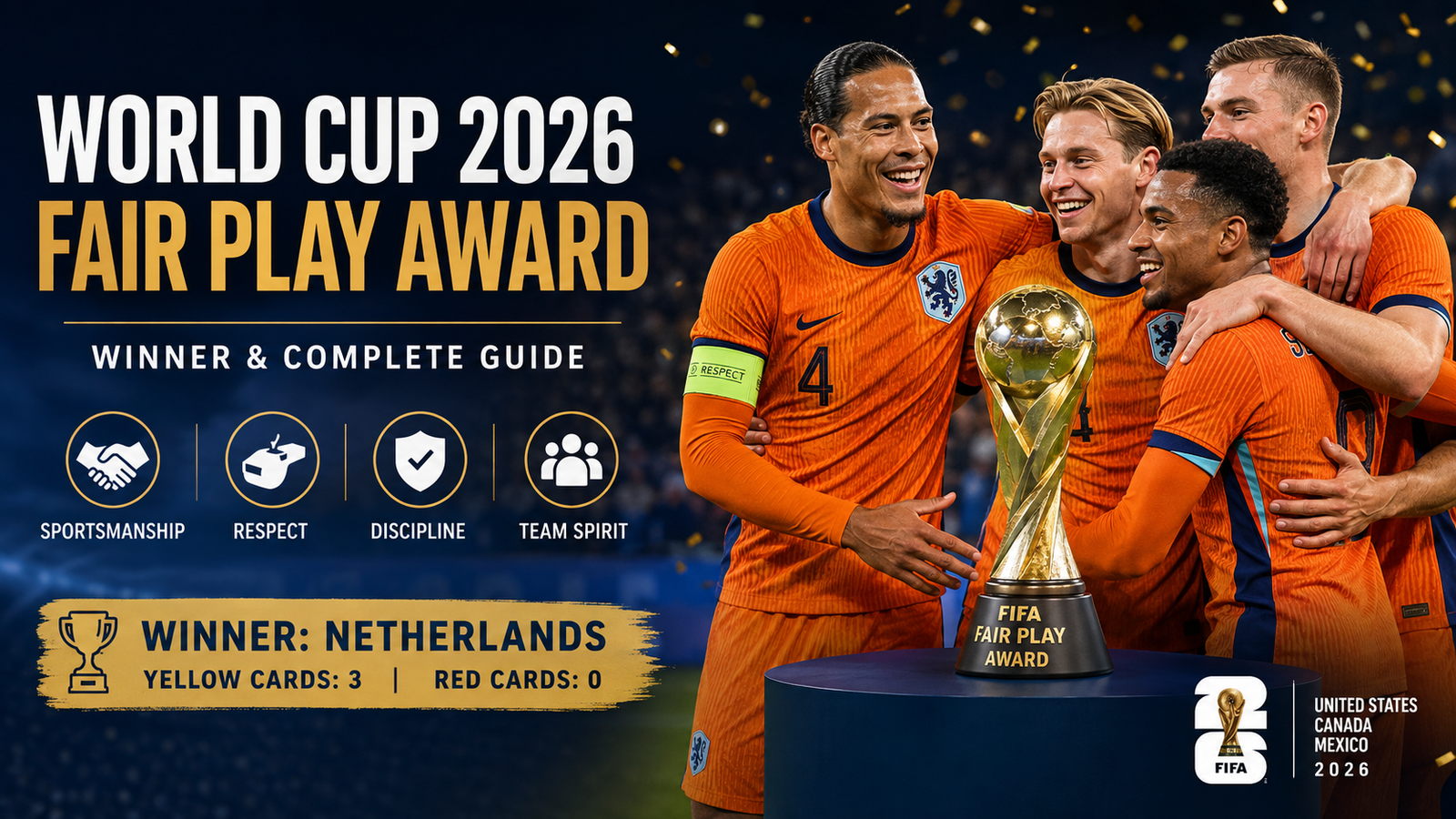
No FIFA World Cup is ever just a champion. In addition to the Golden Ball, Golden Boot, and Golden Glove Award, FIFA also gives out one of the more understated yet otherwise total-notable-little-prizes that comes together with the tournament: The Fair Play Award. It does not reward the best dribbler, the deadliest finisher or a dependable goalie. It rewards discipline, respect, and restraint, things that rarely go viral, but are vitally important to the spirit of the game.
At the World Cup 2026 Fair Play Award, shared by the United States, Canada and Mexico, that honor belonged to a team whose tournament came to an abrupt conclusion on the scoreboard but never even slightly compromised in spirit. So this guide will tell you who won the World Cup 2026 Fair Play Award, why they won it, how FIFA’s scoring system actually works and where the award ranks alongside football’s other major individual & team accolades (hint: its not very high) and how it compares to every Fair Play winner since 1970.
Quick Facts
| Category | Details |
| Award Name | FIFA World Cup Fair Play Award |
| Tournament | FIFA World Cup 2026 |
| Winner | Netherlands |
| Yellow Cards | 3 |
| Red Cards | 0 |
| Matches Played | 4 |
| Introduced | 1970 |
| Presented By | FIFA |
What Is the World Cup 2026 Fair Play Award?
The FIFA Fair Play Award is awarded at the conclusion of each World Cup to the national team deemed to be playing with the best disciplinary record and most sporting behaviour throughout the tournament. It’s not performance-related — a team can get knocked out in the first knock-out round and still return home with this trophy, like the Netherlands did in 2026.
Purpose of the award
FIFA created the award to emphasize a simple notion: football is about more than goals and trophies; on-pitch movements matter too. Reckless challenges, dissenting against officials and gamesmanship aimed to waste the clock all erode tournament beauty. The opposite — teams that play hard but don’t cross the line — is what the Fair Play Award seeks to highlight.
Why sportsmanship and discipline matter
Tempers always flare in the highest stakes of tournaments. Players are one bad tackle away from a ban; coaching staff, one outburst away from a touchline suspension. The fact that a team can use that pressure to play with intensity and poise says everything about its culture and coaching.
How FIFA Fosters Fair Play During the Tournament
FIFA compiles disciplinary data, match per match — yellow cards, red cards, fouls and incidents involving referees — then combines that with assessments taken by its own delegates observing team behaviour on the pitch and off it; how teams react to decisions from the officials, as well as their conduct in tunnels and in technical areas.
Also read this: Pau Cubarsi World Cup 2026 | Shivam Dube Father Name | World Cup 2026 Prize Money
Who Won the World Cup 2026 Fair Play Award?
The Netherlands won the FIFA Fair Play Award at the 2026 World Cup, their first-ever success in this category and only 11th nation to take it since 1970.
Why they received the award
Ronald Koeman’s men managed just three yellow cards in their four matches at the tournament — and incredibly all three came in one match, their 2-2 draw with Japan in their opening game. The Dutch displayed their impenetrability from there, conceding zero further bookings in matches against Sweden, Tunisia and Morocco. Neither side saw a player sent off at any point of the game.
Key disciplinary statistics
- Yellow cards: 3 (All received in the opener vs Japan)
- Red cards: 0
- Matches played: 4
- Total two playing fouls: 44 in whole event
Performance throughout the tournament
The Netherlands have secured top spot in Group F after a 5-1 victory against Sweden, a 2-2 draw with Japan and an away also 3-1 win to Tunisia. They exited in the Round of 32, where they drew with Morocco 1-1 after extra time but lost the penalty shootout 3–2. The exit on the scoresheet was disappointing, but FIFA’s disciplinary panel needed little persuading in awarding the Fair Play award. The award is only open to teams that have at least reached the knockout stage, and within that class the Dutch record could not be touched.
World Cup 2026 Fair Play Award Criteria
This isn’t just counting cards to get this award from FIFA. There are a number of elements that go into making the final judgment.
Yellow Cards
A points deduction is awarded for each yellow card received. Even though none of those cards look serious in isolation, teams that accumulate bookings through the tournament tumble down the fair play table.
Red Cards
Red cards — whether a straight red or a second yellow — are punished much more severely than an individual caution. One sending-off and a previously clean disciplinary record can be tarnished.
Respect Towards Referees
What FIFA delegates watch out for is the reaction of players and coaching staff to refereeing decisions, in particular surrounding the officials, visible dissent and confrontations after the final whistle.
Team Conduct
It goes in a lot of on-pitch behavior that isn’t just fouls – time-wasting, simulation and confronting opposing players are all factored into the pot.
Behavior of Coaches and Officials
Technical area conduct counts too. Breaches such as touchline bans, confrontation with the fourth official and making public criticism of match officials will count against a teams fair play rating.
Positive Attitude Throughout the Tournament
And FIFA rewards teams for a certain “attitude” — attacking football, respect for opposition and sportsmanship like fair-use of the ball when an opponent is injured.
How FIFA Calculates Fair Play Points
Point deduction system
Since it takes place after each disciplinary incident as the tournament goes on, FIFA’s fair play committee begins every eligible team with zero points. It’s the lowest total deductions (among teams that make it to the knockout rounds) that leads the standings.
Card-based scoring
The point scale broadly works like this: One yellow card -1 points; Second yellow card leading to red -3 points; Direct red-card -4 points. So, yes, even as much as a single point can be lost for simulating a penalty in a setup or disrespecting the minimum required distance at free-kick.
Additional evaluation by FIFA delegates
Numbers on their own tell a different story. Without the referee’s card count, FIFA delegates watch matches and file reports of conduct, attitude toward opponents, respect for officials, and sportsmanship in general. It is this qualitative layer that means the award isn’t automatically given to whichever team conceded the fewest cards during its knockout-stage run, which also explains why teams like Czech Republic and Tunisia — both of whom received only one yellow card each in 2026 would be ruled out ahead of the Netherlands due to being losers in the group stage.
Tie-break rules
In 1998 (England and France) and 2006 (Brazil and Spain), FIFA has encouraged a joint winners approach when teams finish level on points rather than introducing an artificial division.
World Cup 2026 Fair Play Award Winner Stats
| Category | Winner |
| Winning Team | Netherlands |
| Yellow Cards | 3 |
| Red Cards | 0 |
| Matches Played | 4 |
| Fair Play Ranking | 1st among knockout-stage-eligible teams |
| Tournament Finish | Round of 32 (lost on penalties to Morocco) |
Fair Play Award vs Other FIFA World Cup Awards
| Award | Given For |
| Fair Play Award | Best disciplinary record and sporting conduct |
| Golden Ball | Best player of the tournament |
| Golden Boot | Top goal scorer |
| Golden Glove | Best goalkeeper |
| Young Player Award | Best player aged 21 or under |
Unlike the individual awards, the Fair Play Award is the only major World Cup honor given to an entire national team rather than a single player, and it’s also the only one that has no correlation with how far a team advances — a team can be eliminated in the earliest eligible round and still win it, provided its conduct is exemplary.
Complete List of FIFA World Cup Fair Play Award Winners
| Year | Winner |
| 1970 | Peru |
| 1974 | West Germany |
| 1978 | Argentina |
| 1982 | Brazil |
| 1986 | Brazil |
| 1990 | England |
| 1994 | Brazil |
| 1998 | England & France |
| 2002 | Belgium |
| 2006 | Brazil & Spain |
| 2010 | Spain |
| 2014 | Colombia |
| 2018 | Spain |
| 2022 | England |
| 2026 | Netherlands |
Brazil holds the record with four Fair Play Awards, while Spain and England have each won it three times. The 2026 award made the Netherlands the 11th different nation to receive the honor since its introduction in 1970.
Netherlands’ Fair Play Journey
| Stage | Match | Result | Yellow Cards | Red Cards |
| Group Stage | Japan | 2–2 Draw | 3 | 0 |
| Group Stage | Sweden | 5–1 Win | 0 | 0 |
| Group Stage | Tunisia | 3–1 Win | 0 | 0 |
| Round of 32 | Morocco | 1–1 (Lost 3–2 on Penalties) | 0 | 0 |
| Post-Tournament | Fair Play Award Ceremony | Award Winner | — | — |
Netherlands’ Disciplinary Record
| Match | Yellow Cards | Red Cards |
| Japan | 3 | 0 |
| Sweden | 0 | 0 |
| Tunisia | 0 | 0 |
| Morocco | 0 | 0 |
| Total | 3 | 0 |
Most Disciplined Teams at the FIFA World Cup 2026
| Team | Yellow Cards | Red Cards | Tournament Finish |
| Netherlands | 3 | 0 | Round of 32 |
| Czech Republic | 1 | 0 | Group Stage |
| Tunisia | 1 | 0 | Group Stage |
| Japan | 2 | 0 | Round of 32 |
| Sweden | 2 | 0 | Group Stage |
| Spain | 5 | 0 | Champions |
| Brazil | 5 | 1 | Quarter-finals |
| Germany | 6 | 0 | Round of 16 |
| Argentina | 7 | 1 | Semi-finals |
| France | 8 | 0 | Quarter-finals |
FIFA Fair Play Scoring System
| Incident | Points Deducted |
| Yellow Card | -1 |
| Indirect Red Card (Second Yellow) | -3 |
| Direct Red Card | -4 |
| Yellow Card + Direct Red Card | -5 |
Teams That Came Close to Winning the Fair Play Award
| Team | Why They Missed Out |
| Czech Republic | Eliminated in the group stage, making them ineligible despite an excellent disciplinary record. |
| Tunisia | Recorded very few bookings but failed to reach the knockout stage. |
| Japan | Had a good disciplinary record but received more bookings than the Netherlands. |
| Sweden | Maintained disciplined performances but could not match the Netherlands’ overall Fair Play score. |
FIFA Fair Play Award Records
| Record | Team / Achievement |
| Most Titles | Brazil (4) |
| First Winner | Peru (1970) |
| Most Recent Winner | Netherlands (2026) |
| First European Winner | West Germany (1974) |
| Most Recent First-Time Winner | Netherlands (2026) |
Fair Play Award Winners by Continent
| Continent | Winning Nations |
| Europe | West Germany, England, France, Belgium, Spain, Netherlands |
| South America | Peru, Argentina, Brazil, Colombia |
| Asia | None |
| Africa | None |
| North America | None |
Benefits of Winning the Fair Play Award
- FIFA Fair Play Trophy — presented officially to the winning federation after the final
- Medals for players and officials — recognizing the full squad and technical staff, not just the players who featured
- Official FIFA recognition — the win is formally recorded alongside the tournament’s other major honors
- Contribution to the team’s football legacy — a mark of sporting reputation that outlasts a single tournament’s results
- Youth development equipment voucher — a token but symbolic contribution FIFA has historically extended to winning associations, aimed at reinvesting in grassroots football back home
Netherlands’ Fair Play Journey
The Netherlands may not have enjoyed a long run at the FIFA World Cup 2026, but they left a lasting impression with their discipline and sportsmanship. Their only three yellow cards came in the opening 2–2 draw against Japan. From that point onward, the Dutch squad completed the rest of the tournament without receiving a single booking or red card.
They followed the draw with an impressive 5–1 victory over Sweden and secured first place in Group F after defeating Tunisia 3–1. Their World Cup campaign ended in the Round of 32, where they drew 1–1 with Morocco before losing 3–2 in the penalty shootout. Although their title hopes came to an end, FIFA recognized their outstanding conduct by presenting them with the 2026 Fair Play Award.
| Stage | Opponent | Result | Yellow Cards | Red Cards |
| Group Stage | Japan | 2–2 Draw | 3 | 0 |
| Group Stage | Sweden | 5–1 Win | 0 | 0 |
| Group Stage | Tunisia | 3–1 Win | 0 | 0 |
| Round of 32 | Morocco | 1–1 (Lost 3–2 on Penalties) | 0 | 0 |
| Post-Tournament | Fair Play Award Ceremony | Winners of the FIFA Fair Play Award | — | — |
Netherlands’ Disciplinary Record
One of the biggest reasons behind the Netherlands winning the Fair Play Award was their remarkable disciplinary record. All three of their yellow cards were shown in the opening match against Japan. Over the remaining three matches, the team avoided both yellow and red cards, demonstrating excellent composure and respect for opponents and match officials throughout the tournament.
| Match | Yellow Cards | Red Cards |
| Japan | 3 | 0 |
| Sweden | 0 | 0 |
| Tunisia | 0 | 0 |
| Morocco | 0 | 0 |
| Total | 3 | 0 |
Most Disciplined Teams at the FIFA World Cup 2026
While the Netherlands ultimately claimed the Fair Play Award, several other nations also displayed excellent discipline during the tournament. However, FIFA only considers teams that reach the knockout stage for the award, which ruled out some sides with impressive disciplinary records.
| Team | Yellow Cards | Red Cards | Tournament Finish |
| Netherlands | 3 | 0 | Round of 32 |
| Czech Republic | 1 | 0 | Group Stage |
| Tunisia | 1 | 0 | Group Stage |
| Japan | 2 | 0 | Round of 32 |
| Sweden | 2 | 0 | Group Stage |
| Spain | 5 | 0 | Champions |
| Brazil | 5 | 1 | Quarter-finals |
| Germany | 6 | 0 | Round of 16 |
| Argentina | 7 | 1 | Semi-finals |
| France | 8 | 0 | Quarter-finals |
FIFA Fair Play Scoring System
The FIFA Fair Play Award is determined through a points-based disciplinary system. Teams begin with a clean record, and points are deducted for yellow and red cards. FIFA also considers sportsmanship, respect for officials, and overall behavior when selecting the winner.
| Incident | Points Deducted |
| Yellow Card | -1 |
| Indirect Red Card (Second Yellow) | -3 |
| Direct Red Card | -4 |
| Yellow Card + Direct Red Card | -5 |
Teams That Came Close to Winning the Fair Play Award
Although the Netherlands won the award, a few other teams were also among the tournament’s most disciplined sides.
| Team | Why They Missed Out |
| Czech Republic | Finished with an excellent disciplinary record but were eliminated in the group stage, making them ineligible. |
| Tunisia | Received very few bookings but failed to qualify for the knockout rounds. |
| Japan | Maintained good discipline but collected more yellow cards than the Netherlands. |
| Sweden | Played fairly throughout the tournament but fell short in the overall Fair Play evaluation. |
FIFA Fair Play Award Records
Over the years, several nations have built an impressive legacy in the FIFA Fair Play Award. Brazil remains the most successful country in the award’s history, while the Netherlands became the latest first-time winner in 2026.
| Record | Team / Achievement |
| Most Titles | Brazil (4) |
| First Winner | Peru (1970) |
| Most Recent Winner | Netherlands (2026) |
| First European Winner | West Germany (1974) |
| Most Recent First-Time Winner | Netherlands (2026) |
Fair Play Award Winners by Continent
European and South American teams have dominated the FIFA Fair Play Award since it was introduced in 1970. As of the 2026 World Cup, no nation from Asia, Africa, or North America has lifted the trophy.
| Continent | Winning Nations |
| Europe | West Germany, England, France, Belgium, Spain, Netherlands |
| South America | Peru, Argentina, Brazil, Colombia |
| Asia | None |
| Africa | None |
| North America | None |
Why the Fair Play Award Matters in Modern Football
Encourages disciplined football. More than just cynical fouls By scoring conduct, coaching staff now have an additional reason for making certain aggressions or game-management tactics are properly managed.
Reduces dangerous fouls. A disciplinary system has real consequences to stay aside from reckless challenges, and that this protects players.
Improves respect for officials. Adding points for abuse of referees, along with a dissent rule scoring process will give teams an extra reason to keep their heads when tempers run high.
Promotes positive fan culture. Success for the Netherlands in 2026 came with declarations from many quarters, including FIFA itself, lauding its traveling support and their pre-match “Oranje Bus” processions through the streets of Dallas, Houston, Kansas City and Monterrey as major factors in the team’s overall winning presence.
Strengthens FIFA’s Fair Play campaign. And the award keeps sportsmanship front and center in a tournament where headlines are otherwise dominated by goals, red cards and controversies elsewhere on the bracket.
Interesting Facts About the FIFA Fair Play Award
- The award was first awarded at the 1970 FIFA World Cup in Mexico, and its first recipient was Peru.
- It is open to only those teams that qualify for the knock-out round.
- However, it is not often the team with the least yellow cards throughout all games in the tournament in 2026, an outright fewest disappeared since both Czech Republic and Tunisia picked up just one but went out at group stages so were ineligible.
- Statistics matter but FIFA judges the award via both hard disciplinary numbers and delegate assessments of overall sporting manifestation.
- Only for the Netherlands’ 2026 win to be slightly eyebrow-raising, in that they received all three of their yellow cards within the same game and between then and are one again through three matches without a yellow card anywhere.
Conclusion
The World Cup 2026 Fair Play Award may not have the same wow factor as the Golden Ball or the Golden Boot, but it is still one of FIFA’s most esteemed prizes because like it or not, discipline is within every team’s control; no teams and talents just get lucky. Those Netherlands left Denver celebrating a that is in Denver, one that featured just one card-heavy opener than anything, three clean matches and penalty shootout exit traumatic. Goals win games and trophies win headlines but fair play preserves the myth of football.
FAQs
1. Who won the World Cup 2026 Fair Play Award?
The Netherlands won the award, picking up just three yellow cards and no red cards across four matches.
2. What is the FIFA Fair Play Award?
It’s an award given to the national team with the best disciplinary record and overall sporting conduct at the World Cup, judged among teams that reach at least the knockout stage.
3. How is the Fair Play Award decided?
FIFA combines a points-based system for yellow and red cards with assessments from its delegates covering respect toward officials, team conduct, and general sportsmanship.
4. Is the Fair Play Award based only on yellow cards?
No. While card counts are central to the scoring, FIFA also factors in red cards, conduct toward referees, coaching staff behavior, and overall attitude throughout the tournament.
5. Which country has won the most FIFA Fair Play Awards?
Brazil, with four wins, ahead of Spain and England, who have each won it three times.
6. What does the Fair Play Award winner receive?
The winning federation receives the FIFA Fair Play Trophy, medals for players and staff, official FIFA recognition, and a youth development equipment voucher.
7. Can a team win both the World Cup and the Fair Play Award?
It’s possible in theory, but historically rare — the two winners are almost always different teams, since deep tournament runs tend to accumulate more cautions. In 2026, champions Spain did not win the Fair Play Award; the Netherlands did.
8. Why is sportsmanship important in the FIFA World Cup?
With the tournament’s stakes among the highest in football, sportsmanship helps protect player safety, preserve respect for match officials, and keep the focus on the quality of play rather than controversy.