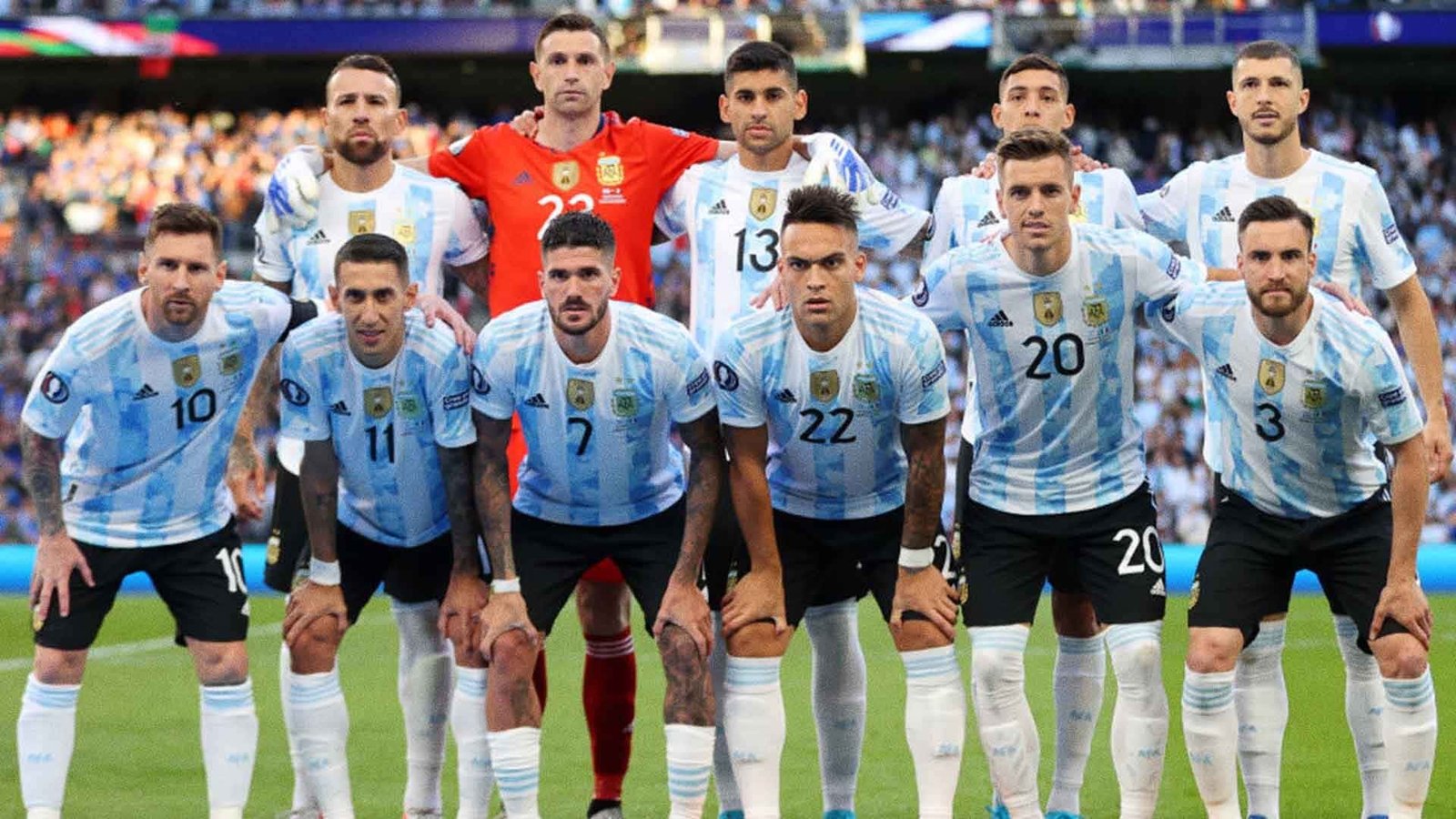
There are few sides in world football that hold as weighty a reputation as the Argentina national football team. Wearing their world famous sky-blue and white stripes, La Albiceleste have long represented passion, quality and unbelievable drive. And looking at how things are today with Argentina competing in the North America 2026 FIFA World Cup as champion they’re not just playing, they’re making history all over again match by match, goal by goal.
Argentina National Football Team 2026
| Category | Details |
| Team Name | Argentina National Football Team |
| Nickname | La Albiceleste (The White and Sky Blues) |
| Governing Body | Argentine Football Association |
| Confederation | CONMEBOL |
| Head Coach | Lionel Scaloni |
| Captain | Lionel Messi |
| FIFA Ranking | Top-ranked international team (2026) |
| Home Stadium | Estadio Más Monumental |
| FIFA World Cup Titles | 3 (1978, 1986, 2022) |
| Copa América Titles | 16 |
| Olympic Gold Medals | 2 (2004, 2008) |
| Team Colors | Sky Blue and White |
| Most Capped Player | Lionel Messi |
| All-Time Top Scorer | Lionel Messi |
| Current Goalkeeper | Emiliano Martínez |
| Key Defenders | Cristian Romero, Lisandro Martínez |
| Key Midfielders | Rodrigo De Paul, Enzo Fernández |
| Key Forwards | Lionel Messi, Julián Álvarez |
| Biggest Rival | Brazil National Football Team |
| Latest Major Trophy | Copa América 2024 |
Argentina National Football Team 2026 Squad
| No. | Player | Position | Club |
| 23 | Emiliano Martínez | Goalkeeper | Aston Villa |
| 12 | Gerónimo Rulli | Goalkeeper | Marseille |
| 1 | Juan Musso | Goalkeeper | Atlético Madrid |
| 13 | Cristian Romero | Defender | Tottenham Hotspur |
| 6 | Lisandro Martínez | Defender | Manchester United |
| 19 | Nicolás Otamendi | Defender | Benfica |
| 3 | Nicolás Tagliafico | Defender | Lyon |
| 4 | Gonzalo Montiel | Defender | River Plate |
| 26 | Nahuel Molina | Defender | Atlético Madrid |
| 25 | Facundo Medina | Defender | Marseille |
| 2 | Leonardo Balerdi | Defender | Marseille |
| 5 | Leandro Paredes | Midfielder | Boca Juniors |
| 7 | Rodrigo De Paul | Midfielder | Inter Miami |
| 8 | Enzo Fernández | Midfielder | Chelsea |
| 20 | Alexis Mac Allister | Midfielder | Liverpool |
| 14 | Exequiel Palacios | Midfielder | Bayer Leverkusen |
| 16 | Giovani Lo Celso | Midfielder | Real Betis |
| 18 | Valentín Barco | Midfielder | Strasbourg |
| 10 | Lionel Messi | Forward | Inter Miami |
| 9 | Julián Álvarez | Forward | Atlético Madrid |
| 22 | Lautaro Martínez | Forward | Inter Milan |
| 11 | Thiago Almada | Forward | Atlético Madrid |
| 15 | Nicolás González | Forward | Atlético Madrid |
| 17 | Giuliano Simeone | Forward | Atlético Madrid |
| 21 | Nico Paz | Forward | Como |
| 24 | José Manuel López | Forward | Palmeiras |
A Legacy Built on Trophies and Titans
Understanding what the Argentina national football team means now needs you to understand its foundation. Established under the auspices of Argentina’s governing body, the Argentine Football Association (AFA), founded in 1893, Argentina has been a FIFA member since 1912, and was one of four founding members of CONMEBOL in 1916. In all that time, they have emerged as one of the most storied football nations in the world.
How many World Cups have Argentina won, The crisp answer is three — in 1978, 1986 and, most recently at the memorable high against Qatar in 2022. The win over France in 2022, one of the strongest finals ever played, after a gap of 36 years brought national euphoria. It also made Argentina and Germany the only countries to win the FIFA World Cup on three occasions.
However, the World Cup tale from the beginning is only a part of the story. Brazil’s fine haul of 16 Copa América titles puts them comfortably atop the list of South American nations — but it is Argentina who have made football history with their world-cup winning success.
They last lifted the Copa América in 2024, making them consecutive champions of the continent. They are the only side to have ever won three Copa America titles in a row (1945-47) and have been within touching distance of glory ever since.
Outside of the continent, Argentina won the inaugural FIFA Confederations Cup in 1992 and also won the CONMEBOL–UEFA Cup of Champions in both 1993 and 2022 — another indication that La Albiceleste do not just play on the world stage — they rule it.
Lionel Scaloni: The Coach Who Changed Everything
Lionel Scaloni was named head coach of the Argentina national football team in 2018 to widespread scepticism. Of course, he was a rookie at the highest level of management and now Argentina had gone out early in the Russia World Cup. What happened next would be a remarkable managerial turnaround in sport.
With Scaloni at the helm, Argentina has maintained a 77% win rate in almost 100 international matches, averaging more than 2.4 points per game. His tactical identity for the squad was a massive departure from an almost sole reliance on star players to rely instead on a more structured collective approach through the lines together, focusing on defensive structure discipline and zonal defending with far less emphasis on individual brilliancy compared to previous systems used.
The results did the talking: Copa América 2021, World Cup 2022, Copa América 2024 A major treble history.
Another point that makes Scaloni’s success even remarkable is the way he managed the transition of players in the squad. He started to wean older players away, inject youth and create a culture where experience met spunk in his locker room. His tactics are adaptable, often using a back three, when necessary, high pressing in midfield and spaced-out fast play on the wings. Scaleni accounts for a sizable chunk of why the Argentina football team history and list of trophies have grown so vastly since 2021, if anyone was looking to know.
Also read this: Portugal National Football Team | India Cricket Team Schedule | FIFA World Cup 2026 Qualifiers
Lionel Messi: The Legend Writing His Final Chapter
Of course, no article about the Argentina national football team can go without mentioning Lionel Messi. The 39-year-old – whose birthday fell on June 24, 2026, both literally and virtually in the World Cup – is not just without a doubt the best player to wear a blue and white shirt but for most ever footballer.
Messi did the impossible again, and after all those years here he is at the 2026 FIFA World Cup. His first World Cup hat-trick came in Argentina’s opening group game against Algeria and was curtailed only by two further goals against Austria, taking him to a record 18 World Cup finals goals —the highest for either gender. A record that only a few years ago seemed beyond the realms of possibility at all, and yet here he is still doing it into an age when most pros similar to him have long since hung up their boots.
This story is up there with the most poignant in the world of sport, Messi’s odyssey with Argentina. And for years he was ridiculed for not delivering for the national team like he had done with FC Barcelona. It all changed in 2021 when he finally got his hands on a Copa América trophy and reached its zenith in 2022, lifting the World Cup title above his head in Qatar. And now, this tale has one last astonishing chapter to take as Messi shoots for a second World Cup back-to-back and the football world looks on.
The Argentina Squad 2026: Quality from Front to Back
While the Argentina RSVP football squad will be for you in 2026 is almost a perfect mix of experience and youthful dynamism. Goal: Emiliano Martínez (Aston Villa) — Winner of the World Cup, specialist in saving penalties and barking goalkeeper who used to be a meme but then you realised they’re actually one of the best shot-stoppers on planet earth.
Christian Romero (Tottenham Hotspur) and Lisandro Martínez (Manchester United) form one of the best central defensive pairings in international football at defence. Romero’s aggressive front-foot approach and Lisandro’s ability to read the game and remain calm at all times are a match made in heaven.
Rodrigo De Paul, the lop-sided midfielder with an unending engine, eye for a pass and steel to press, sets the tempo of play in midfield. Enzo Fernández can help with creativity and technical quality, same as Exéquiel Palacios (Bayer Leverkusen), who adds physicality and discipline.
In future years, he is Julián Álvarez a breakthrough World Cup star in November 2022 who remains one of football’s most tireless forwards, placing only more pressure on rivals with his near-telepathic off-the-ball movement and technical finishing edge likely to complement Inardo Messi better than any other forward race. Thiago Almada and Giuliano Simeone provide additional speed and ingenuity in wide areas, making Scaloni’s outfit multi-faceted when it comes to prising open opposition rearguards.
Argentina at the 2026 FIFA World Cup
Argentina headed into the 2026 FIFA World Cup in North America as overwhelming favourites to win a third title and are currently fulfilling that promise with everything going in their favour. They are top of Group J and have won all their matches so far — two wins, zero draws, zero losses — and qualified for the knockout stage.
In their opening match, they thrashed Algeria 3-0 at Kansas City, with Messi scoring his first World Cup hat-trick. Messi netted twice in that match to break that historic record for most World Cup goals, off the back of another dominant 2-0 win over Austria. Next is their final group encounter against Jordan, followed by the knockout stages.
Argentina lead Group J with the best goal differential in the group, and everything about this team screams hungry, disciplined and dialled-in for a run at being the first country since Brazil in 1958 and 1962 to repeat as world champion.
In fact, Argentina headed into this tournament ranked as the No. 1 nation in the world according to FIFA rankings a position they have held with uncanny regularity since 2022, and their showings so far have done little to suggest that will change for some time yet.
Argentina FIFA World Cup Performance
| FIFA World Cup Year | Host Country | Performance |
|---|---|---|
| 1930 | Uruguay | 🥈 Runners-up |
| 1934 | Italy | Round of 16 |
| 1938 | France | Did Not Participate |
| 1950 | Brazil | Did Not Participate |
| 1954 | Switzerland | Did Not Participate |
| 1958 | Sweden | Group Stage |
| 1962 | Chile | Group Stage |
| 1966 | England | Quarter-finals |
| 1970 | Mexico | Did Not Qualify |
| 1974 | West Germany | Second Group Stage |
| 1978 | Argentina | 🏆 Champions |
| 1982 | Spain | Second Group Stage |
| 1986 | Mexico | 🏆 Champions |
| 1990 | Italy | 🥈 Runners-up |
| 1994 | United States | Round of 16 |
| 1998 | France | Quarter-finals |
| 2002 | South Korea & Japan | Group Stage |
| 2006 | Germany | Quarter-finals |
| 2010 | South Africa | Quarter-finals |
| 2014 | Brazil | 🥈 Runners-up |
| 2018 | Russia | Round of 16 |
| 2022 | Qatar | 🏆 Champions |
| 2026 | Canada, Mexico & United States | Quarter-finals (Ongoing) |
Argentina FIFA World Cup Summary
| Record | Total |
|---|---|
| FIFA World Cup Appearances | 19 |
| Champions | 3 (1978, 1986, 2022) |
| Runners-up | 3 (1930, 1990, 2014) |
| Third Place | 0 |
| Fourth Place | 0 |
| Quarter-final Finishes | 4+ |
| Round of 16 Finishes | 3 |
| Group Stage Exits | 4 |
| Best Finish | Champions |
| First Appearance | 1930 |
| Most Recent Appearance | 2026 |
The Argentina vs Brazil Rivalry: The Superclásico de las Américas
No mention of the Argentina national team can be complete without their biggest rivalry – Argentina vs Brazil aka Superclásico de las Américas. Geography, politics, culture and decades of footballing confrontation make it one of the most fierce and fiercily supported contests in the game.
This rivalry peaked on July 10, 2021, when Argentina beat their Uber-rival Brazil in Rio de Janeiro just a stone’s throw from the Maracanã to take their 15 continental title. That triumph was poetic and, for Argentinians, incredibly heartwarming. They have been part of some of football’s greatest occasions together and when the two nations, on opposite sides of Europe, go toe to toe the whole continent watches.
Argentina have used their rich footballing history to breed many famous rivalries with England, Germany and Uruguay — in each case with landmark clashes that went beyond sport. The 1986 World Cup quarter-final against England (with Maradona’s ‘Hand of God’ goal and the best-ever individual goal ever probably) is one of the most cited games in football folklore.
The Home of Argentine Football
What is the Name of the Argentina National Football Team? Its main home is the Estadio Más Monumental in Buenos Aires, by far the largest stadium in South America at over 85,000 capacity. The simplest answer is: It is home to Club Atlético River Plate and the sheer size of it reflects the place football holds in Argentinian culture.
The team also plays other home matches at venues such as Estadio Único Madre de Ciudades and La Bombonera, the home of Boca Juniors. Every ground has its own vibe and a history of it’s own but all share an insatiable noise that comes from a country whose heartbeat beats in two halves for forty-five minutes at a time.
The Iconic Sky-Blue and White Jersey
Kits in World Football: Argentina’s sky blue and white striped jersey is one of the most recognisable kits in world football. Not Much Has Changed Since Official Use The shirt was worn in an official match for the first time in a game against Uruguay on September 13, 1908 and hasn’t changed much over a century later. The colours stand for the sky and from the clouds — a reference to Argentine national colors as well as an airborne spirit of independence.
Over the years, the jersey has embraced heartbreak and success alike: from the agony of 1990 and 2014 World Cup final defeats to overcoming celebration en route to 2021 and 2022 championships. However, today — as Messi wears the No. 10 shirt in what could be his swan song tournament — those light-blue stripes carry with them an emotional richness never before felt.
Argentina’s Record: The Most Decorated Side in the Americas
When asked who is the captain of the Argentina national team, the answer remains Lionel Messi — though that captaincy could transition in coming years. But what he leaves behind is a team with 23 official international titles, more than any other nation in the Americas.
Here is a quick summary of Argentina’s major honours:
- FIFA World Cup: 1978, 1986, 2022 (3 titles)
- Copa América: 16 titles, including 2021 and 2024
- FIFA Confederations Cup: 1992 (inaugural champions)
- CONMEBOL–UEFA Cup of Champions: 1993, 2022
- Olympic Gold Medal: 2004, 2008
The Argentina football team’s history and trophy list is matched by only a handful of nations globally, and no team in the Americas comes close to their level of sustained excellence.
Argentina National Football Team Records
| Record | Details |
|---|---|
| FIFA World Cup Titles | 3 (1978, 1986, 2022) |
| Copa América Titles | 16 |
| Finalissima Titles | 2 (1993, 2022) |
| Olympic Gold Medals | 2 (2004, 2008) |
| Most Capped Player | Lionel Messi (200+ appearances) |
| All-Time Top Scorer | Lionel Messi (115+ international goals) |
| Biggest Victory | Argentina 12–0 Ecuador (1942) |
| Biggest Defeat | Czechoslovakia 6–1 Argentina (1958 FIFA World Cup) |
| Longest Unbeaten Run | 36 matches (2019–2022) |
| Highest FIFA Ranking | 1st |
| Lowest FIFA Ranking | 24th (1996) |
| Most World Cup Matches Played | Lionel Messi |
| Most World Cup Goals | Lionel Messi (18)* |
| Most Copa América Appearances | Lionel Messi |
| Most Copa América Goals | Norberto Méndez & Lionel Messi (shared modern-era records vary by competition statistics) |
| Current Captain | Lionel Messi |
| Current Head Coach | Lionel Scaloni |
| Confederation | CONMEBOL |
| FIFA Membership | Since 1912 |
Argentina National Football Team Statistics (All-Time)
| Statistic | Record |
|---|---|
| FIFA World Cup Appearances | 19 |
| International Matches Played | 865+ |
| Wins | 509+ |
| Draws | 183+ |
| Losses | 173+ |
| Goals Scored | 1,750+ |
| Goals Conceded | 905+ |
| Win Percentage | 58.8% |
| FIFA World Cup Titles | 3 |
| Copa América Titles | 16 |
| Finalissima Titles | 2 |
| Olympic Gold Medals | 2 |
| Highest FIFA Ranking | 1st |
| Lowest FIFA Ranking | 24th |
| Current FIFA Ranking (2026) | 1st |
| Most Capped Player | Lionel Messi (200+ appearances) |
| All-Time Top Scorer | Lionel Messi (124 goals) |
| Current Head Coach | Lionel Scaloni |
| Current Captain | Lionel Messi |
| Confederation | CONMEBOL |
| Nickname | La Albiceleste (The White and Sky Blues) |
What Comes After Messi
The big question that haunts Argentine football is simple: What will happen when Messi leaves? That is a question to be answered in the near future, but there are reasons for encouragement. There are four more Enzo Fernández, Julián Álvarez, Thiago Almada and Valentín Barco constituting a golden generation bred on trophies who understand what it is to be winners.
Coach Scaloni has already shown great ingenuity in planning without specific players, and the AFA continues to develop world-class talent at the youth levels. The pipeline is well stocked, the culture is firmly in place and winning habits have taken root over the past five seasons.
Messi’s genius may define La Albiceleste in this era but the national team can transcend even one player. They always have been.
Argentina National Football Team Top Goal Scorers (All-Time)
| Rank | Player | Goals | Years Active |
|---|---|---|---|
| 1 | Lionel Messi | 124 | 2005–Present |
| 2 | Gabriel Batistuta | 52 | 1991–2002 |
| 3 | Sergio Agüero | 41 | 2006–2021 |
| 4 | Lautaro Martínez | 38 | 2018–Present |
| 5 | Hernán Crespo | 35 | 1995–2007 |
| 6 | Diego Maradona | 34 | 1977–1994 |
| 7 | Gonzalo Higuaín | 31 | 2009–2018 |
| 8 | Ángel Di María | 31 | 2008–2024 |
| 9 | Luis Artime | 24 | 1961–1967 |
| 10 | Daniel Passarella | 22 | 1976–1986 |
Conclusion
The Argentina national football team has reached the top of world football. With FIFA’s No. 1 ranked side, World Cup champions for the first time and back-to-back Copa América winners, they’ll go down as a generation of greatness led by arguably the greatest player to ever live while also coached by the man who lifted an entire nation’s fortunes and with perhaps no greater footballing love from a nation that burns as bright as anywhere else on this planet.
2026 FIFA World Cup and Argentina is chasing immortality again. Should they do it, they will be the first team to win back-to-back World Cups in 64years. And for La Albiceleste, it is not a hallucination. It is a mission.
FAQs
1. Who will be the captain of the Argentina National Football Team in 2026?
The captain of the Argentina National Football Team in 2026 is Lionel Messi. The legendary forward continues to lead La Albiceleste at the FIFA World Cup 2026.
2. How many FIFA World Cups has Argentina won?
Argentina National Football Team has won the FIFA World Cup three times: in 1978, 1986, and 2022.
3. Who is the head coach of the Argentina National Football Team in 2026?
The head coach of Argentina in 2026 is Lionel Scaloni, who guided the team to Copa América and FIFA World Cup success.
4. Who are the key players in Argentina’s 2026 squad?
Some of the key players include Lionel Messi, Julián Álvarez, Lautaro Martínez, Enzo Fernández, and Emiliano Martínez.
5. What is the home stadium of the Argentina National Football Team?
Argentina’s primary home venue is Estadio Más Monumental, the largest football stadium in South America.
6. What is Argentina’s nickname in international football?
The Argentina National Football Team is popularly known as La Albiceleste, which means “The White and Sky Blues,” referring to the team’s iconic jersey colors.