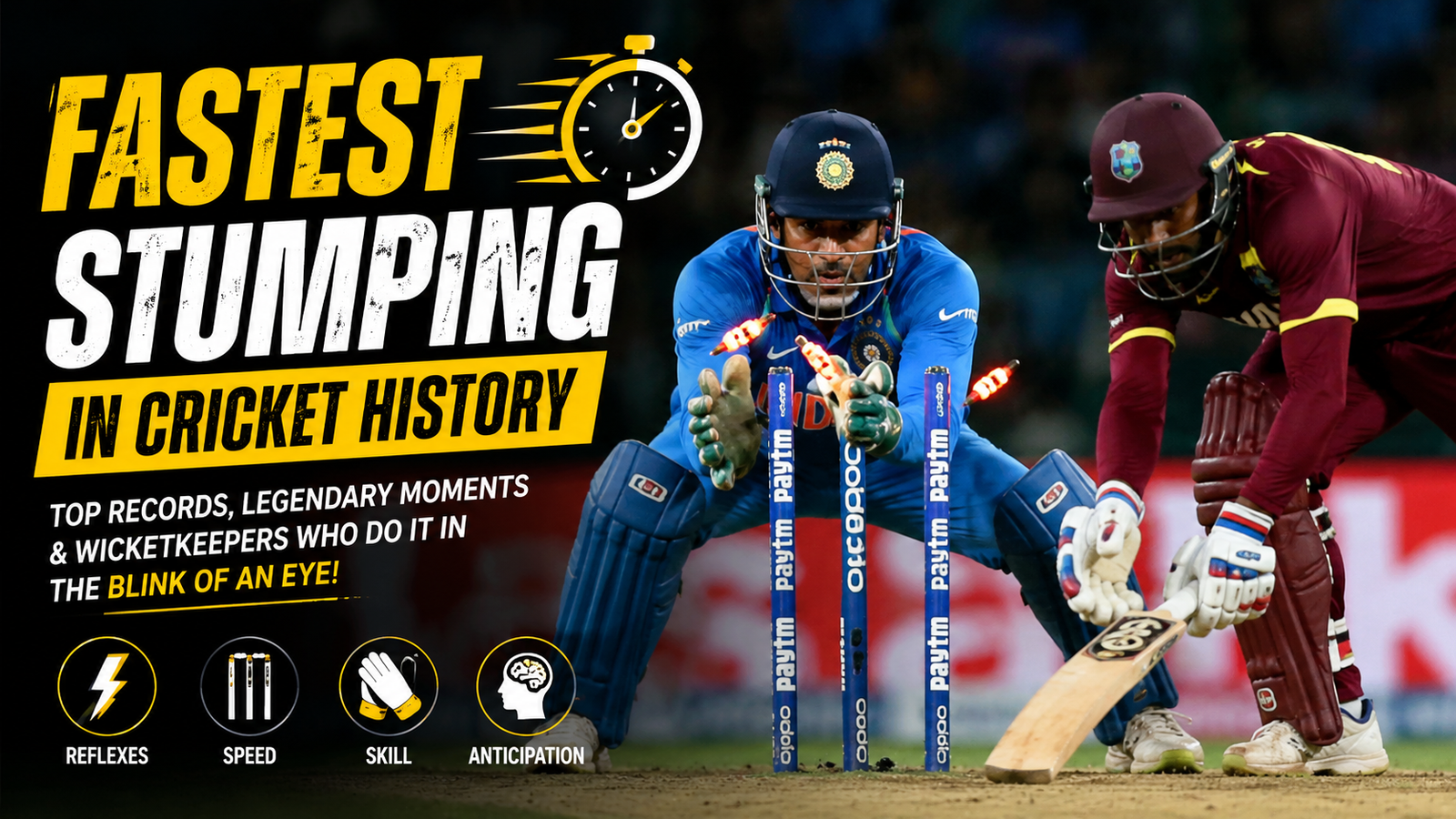
The fastest stumping in cricket history is one of the most impressive displays of wicketkeeping skill. A stumping can happen in the blink of an eye, but behind that moment are lightning-fast reflexes, sharp anticipation, excellent footwork, soft hands and the ability to read a batter’s movement before the ball even reaches the gloves.
Over the years, legendary wicketkeepers such as MS Dhoni, Adam Gilchrist, Kumar Sangakkara, Brendon McCullum and Jos Buttler have produced some remarkable stumpings across international cricket and T20 leagues. Among them, MS Dhoni is perhaps the name most closely associated with lightning-fast stumpings because of his famous no-backlift technique and incredibly efficient glove movement.
Some of Dhoni’s stumpings have been reported as taking only a fraction of a second from ball collection to the removal of the bails. His 2018 stumping of Keemo Paul is frequently mentioned when discussing the quickest stumpings in international cricket.
However, there is an important distinction between a widely reported fastest stumping and an officially recognized world record. The ICC does not maintain an official record for the fastest stumping based on reaction time. Timings published online are generally estimates derived from broadcast footage, frame-by-frame analysis and expert observations. Therefore, figures such as 0.08 or 0.10 seconds should be treated as unofficial estimates rather than confirmed ICC records.
In this guide, we explore the top fastest stumpings in cricket history, the wicketkeepers famous for lightning-fast glovework, MS Dhoni’s most notable stumpings, the difference between a stumping and a run-out, and the techniques and training drills that help wicketkeepers develop exceptional reaction speed.
Quick Facts Table: Fastest Stumping in Cricket
| Quick Fact | Details |
|---|---|
| Topic | Fastest Stumping in Cricket History |
| Most Associated Wicketkeeper | MS Dhoni |
| Famous Quick Stumping | MS Dhoni vs Keemo Paul |
| Year of Famous Stumping | 2018 |
| Reported Fastest Time | Around 0.08 seconds* |
| Format | ODI |
| Other Legendary Keepers | Adam Gilchrist, Kumar Sangakkara, Brendon McCullum, Jos Buttler |
| Common Stumping Formats | Test, ODI, T20I and IPL |
| Main Skill Required | Reflexes and anticipation |
| Most Common Bowling Type for Stumpings | Spin bowling |
| Official ICC Fastest-Stumping Record? | No |
| Timing Status | Unofficial estimate |
| How Timings Are Analyzed | Broadcast footage and frame-by-frame analysis |
Top 10 Fastest Stumpings in Cricket History
| Rank | Wicketkeeper | Country | Batter Stumped | Estimated Time | Format | Year |
|---|---|---|---|---|---|---|
| 1 | MS Dhoni | India | Keemo Paul | 0.08 sec* | ODI | 2018 |
| 2 | MS Dhoni | India | Mitchell Marsh | 0.09 sec* | T20I | 2012 |
| 3 | Ben Cox | England | Callum MacLeod | 0.10 sec* | T20 Blast | 2018 |
| 4 | MS Dhoni | India | Shubman Gill | 0.10 sec* | IPL | 2023 |
| 5 | Brendon McCullum | New Zealand | Ricky Ponting | 0.11 sec* | ODI (World Cup) | 2011 |
| 6 | MS Dhoni | India | Suryakumar Yadav | 0.12 sec* | IPL | 2025 |
| 7 | Kumar Sangakkara | Sri Lanka | Jimmy Maher | 0.13 sec* | ODI | 2003 |
| 8 | Kumar Sangakkara | Sri Lanka | Brian Lara | ~0.13 sec* | ODI (World Cup) | 2007 |
| 9 | Mark Boucher | South Africa | Marvan Atapattu | ~0.14 sec* | Test | 2006 |
| 10 | Adam Gilchrist | Australia | Craig McMillan | ~0.14–0.15 sec* | ODI | 2005 |
Disclaimer: The reaction times mentioned in this article are based on widely circulated media reports, broadcast frame-by-frame analysis, and cricket experts’ observations. The International Cricket Council (ICC) does not officially measure or recognize the fastest stumping based on reaction time. Therefore, all timings should be considered estimated and unofficial and are provided for informational purposes only.
MS Dhoni is widely regarded as the fastest wicketkeeper in cricket history due to his exceptional reflexes and lightning-fast stumpings. However, the ICC has never officially recognized or timed the fastest stumping record.
Understanding Stumping in Cricket
A stumping happens when:
- Batter comes out of the crease
- A ball is bowled (not a no-ball)
- The ball is collected cleanly by the wicketkeeper
- The stumps have been broken before the batter was back to his crease.
This is one of the reasons why questions like fastest stumping in history or stumping speed comparison on cricket are often asked.
Stumpings, in contrast to run-outs, rely wholly on reflex speed. The ball is all in one motion there is no fielder throwing it.
Also read this: Delhi Capitals vs Gujarat Titans Timeline | Lucknow Super Giants vs Gujarat Titans Match Scorecard | Chennai Super Kings vs Punjab Kings Timeline
Why Fast Stumping is One of the Hardest Skills
In ODI cricket, a fastest wicketkeeping stumping necessitates perfection in a million factors:
Reaction Window
After ball contact, the wicketkeeper has a mere 0.1 to 0.3 seconds to react!
Distance Factor
The batter is only a few feet away from the crease, so any micro-delay can easily be compensated for.
Spin vs Pace Difficulty
- Spinners create more stumping chances
- However, for spin you need to read the drift and bounce as well
Mental Anticipation
Good elite keepers can pre-wind before the ball gets to them based on batter footwork prediction.
This is why stumpings are incredibly rare dismissals compared to other forms of dismissals.
Top Fastest Stumpings
“Obviously, the ICC does not officially recognize a “fastest stumping time,” but cricket experts and broadcasters unanimously agree that, while they are in the mix as stumpings go, some dismissals happen so quickly they become instant stumpings.
And the same trend repeats with the fastest stumping in cricket history:
- MS Dhoni dominates most discussions
- Adam Gilchrist sets early-era benchmarks
- Modern T20 reflex standards are led by Jos Buttler
- Kumar Sangakkara shows technical perfection
But the fastest execution speed is best identified with Dhoni.
Also read this: Who Really Controls GT? | 1 to 100 Jersey Number in Cricket India | IPL Match Ticket Price
Why MS Dhoni is Known for Lightning Stumpings
And the fastest stumping by MS Dhoni is one of the most searched keywords in wicketkeeping history and with good reason.
Dhoni changed the way wicketkeeping was viewed, as he implemented his “no backlift” approach along with his fierce hand speed. He notches them up more often than not when the batter seems to have not even completed the shot.
Why Dhoni’s Stumpings Look Instant
- Minimal glove movement before collection
- Exceptional reading of batter footwork
- Lightning-fast bail removal technique
- Standing right up to the stumps even in limited overs cricket
Famous Dhoni Stumping Traits
- No visible wind-up motion
- Direct straight-line glove action
- Transfer from throughout the catch to during stumps
- Extremely low reaction delay
His woes at stumping are regarded as one of the fastest records in cricket world history by many analysts while comparing it to T20 and ODI formats.
Best Wicketkeepers with Fast Reflexes
It covers both Tests, ODIs and T20Is to register the fastest stumping in international cricket.
Elite Wicketkeepers Known for Fast Stumpings:
- MS Dhoni (India) – unrivaled reflex reliability
- Adam Gilchrist (Australia) — hard hitting acrobatic gloveman
- Kumar Sangakkara (SL) – Clean and Technique
- Jos Buttler (England) – modern day T20 pace keeper
- Quinton de Kock (South Africa) – sharp reader of the conditions
Of these, Dhoni is still the only player to do it across all three formats instantly.
Fastest Stumping in T20 Cricket
Wicketkeeping is a fast-paced reflex sport which has evolved into in T20 cricket.
Why T20 produces fastest stumpings:
- Batters step out aggressively
- Spinners use deception more often
- Limited overs increase risk-taking
- Keepers now stand up to stumps rather than back 17th Aug, 2023
This is an environment which provides the best conditions for the fastest stumping seconds in a cricket match.
Fastest Stumping in IPL and International Cricket
ODI records for the quickest stumping in IPL and international cricket
IPL has been, and in fact is a platform of stunning glove-work.
Key IPL Wicketkeepers:
- MS Dhoni (CSK) — The gold standard of quick stumpings
- Rishabh Pant – A fast improving reflex keeper
- Dinesh Karthik – quick hands in tight situations
- Jos Buttler – Any modern aggressive keeping(RR)
Dhoni features heavily in IPL and international cricket highlight reels every season as fans often look for fastest stumping moments.
How Wicketkeepers Train
| Step | Technique Element | Detailed Explanation | Key Skill Required |
| 1 | Pre-Delivery Reading | Wicketkeeper studies batter stance, foot movement, and intent even before the ball is bowled. | Game awareness |
| 2 | Anticipation Setup | Keeper adjusts position slightly based on pitch, spin, and batter behavior. | Predictive thinking |
| 3 | Balanced Stance | A low, stable crouch allows instant movement in any direction without delay. | Body control |
| 4 | Early Movement Trigger | Keeper starts micro-movement before ball reaches gloves based on batter stepping out. | Reflex timing |
| 5 | Clean Ball Collection | The ball must be collected without bobble or delay to avoid losing stumping chance. | Soft hands |
| 6 | Split-Second Glove Action | Immediate transfer from catch to stump-breaking motion in less than a blink. | Hand speed |
| 7 | Efficient Bail Removal | Quick flick or direct impact on stumps without unnecessary motion. | Precision control |
| 8 | Footwork Adjustment | Small lateral or forward step to align body with stumps instantly. | Agility |
| 9 | Eye-Hand Coordination | Continuous tracking of batter foot outside crease while handling ball. | Focus |
| 10 | Instant Appeal Timing | Appeal happens simultaneously with stumping to ensure umpire attention. | Reaction coordination |
Mechanics and cricket smarts will dissect the quickest wicketkeeping stumping ever in ODI cricket.
Pre-Delivery Prediction
Top keepers read:
- Batter stance
- Foot movement
- Bat swing trigger
Split-Second Hand Speed
- Top-class keepers do it in under 0.2 sec
Clean Ball Collection
No bobble or hitch; must be a clean catch.
Instant Bail Removal Technique
Modern keepers use:
- Single-finger flick
- Palm push method
- Direct stump impact
Body Positioning
Balanced Crouch Position: Get in the position to either blow past or outmaneuver whoever is coming at you.
Fastest Stumping Records in Cricket History
Although there is no official record with a stopwatch, many memorable dismissals were noted by experts:
Legendary Examples:
- MS Dhoni vs West Indies (ODI) — stumping second only to instant
- MS Dhoni v England – super-fast glovework to effect the dismissal
- Classic reflex stumping: Adam Gilchrist vs South Africa
- Jos Buttler vs Sri Lanka – missiles take out its mid in modern T20
These are among the most projected in conversations about quickest stumpings of all time in the realm of cricket.
Which Wicketkeeper Has the Fastest Stumping Record Ever
Analysts are still debating about the fastest wicketkeeper ever to stump a batsman.
Common Rankings:
- MS Dhoni – fastest-paced overall + best consistency
- Adam Gilchrist – raw athletic explosiveness
- Jos Buttler – Most modern speedy reflex keeper
- Kumar Sangakkara – technical perfection
- Quinton de Kock — sharp precise keeping
Dhoni has always been regarded as the best wicketkeeper for his speed and reading of the game.
Evolution of Fast Stumping in Cricket
Early Cricket Era:
- Slower pitches
- Less aggressive batting
- Fewer stumping opportunities
Modern Era:
- High-speed T20 cricket
- Power hitters stepping out frequently
- Advanced wicketkeeping gloves
- Faster training methods
Thus evolution did a heavier exploitation of fastest stumping in cricket history moments.
Training Methods for Fastest Stumping
It requires sharp reflexes, anticipation and perfection in stumping skills. In daily practice work, wicketkeepers are required to work on high-speed response drills, spin-ball and light based reflex systems. Footwork is practiced to continue not only balance in a low crouch position, but also so that you can move laterally at all times. Hand-eye coordination drills, like catching tennis balls and reaction balls improve glove speed and accuracy.
In keeping with a practice against the spinners in taking stumpings to find an emphasis on match simulations similar to decision-making. Mental training is just as important because he can read the batter’s intentions before the ball arrives, thereby cutting down his reaction time and paving the way for lightning-quick dismissals.
Factors That Make a Fast Stumping Possible
| Step | Training Method | Purpose | Benefit for Stumping Speed |
| 1 | Reaction Ball Drills | Improves unpredictable bounce handling | Faster glove reflexes |
| 2 | Spin Bowling Practice | Simulates real match stump chances | Better timing & anticipation |
| 3 | Light Reflex Training | Uses LED signals for reaction speed | Reduces response time |
| 4 | Tennis Ball Catching | Enhances hand-eye coordination | Sharp glove control |
| 5 | Low Crouch Stance Training | Builds stable wicketkeeping position | Quick directional movement |
| 6 | Footwork Ladder Drills | Improves agility and balance | Faster lateral movement |
| 7 | Shadow Wicketkeeping | Practicing without ball | Builds muscle memory |
| 8 | High-Speed Bowling Machine | Simulates fast deliveries | Improves reaction under pressure |
| 9 | Mental Visualization | Imagining stump scenarios | Better anticipation & decision-making |
| 10 | Stumping Simulation Drills | Real-time match practice | Match-ready execution speed |
Elite wicketkeepers follow structured training:
Reaction Training:
- Tennis ball drills
- Light-based reflex systems
Physical Training:
- Agility ladders
- Squat-and-explode exercises
Skill Training:
- Spin bowling simulation
- Close-range catching drills
Mental Training:
- Predictive reading of batsmen
- Situational awareness practice
These are best drills to achieve fastest wicketkeeping stumping in ODI cricket performance levels.
Fastest Stumpings by MS Dhoni (Top Moments)
Wicketkeepers operate under extreme pressure:
- Split-second decisions
- High crowd noise
- Match pressure situations
A great keeper maintains:
- Calm mind
- Sharp observation
- Instant reaction confidence
It is this mental fortitude that ensures average keepers are separated from those who have the ability to deliver the fastest ever stumping in international cricket.
Future Players Who Can Excel in Stumping
Wicketkeeping has a very bright future ahead with lots of young guns staking their claim for achieving the best stumping in cricket. Emerging trends in this 20-20 world of modern-day cricket, which requires razor-sharp reflexes combined with exceptional anticipatory skills and peak levels of fitness, are being absorbed within their DNA so quickly they hardly realise that the modern game has evolved.
Glovework is getting sharper – with Rishabh Pant (India), Sanju Samson (India), Jos Inglis (Australia) and Rahmanullah Gurbaz (Afghanistan) appearing more consistent behind the stumps. Some still play their way to the consistency required for elite-level fastest stumping in cricket but given a raw playing ground and most importantly the aggression, they will be a formidable non-existent contender.
These young stumping specialists are now set to break world fastest stump records in cricket over the next few years with advanced training methods, modern technology-backed reflex drills and exposure to high-pressure leagues like IPL.
Players with the Most Stumpings in International Cricket
| Player | Country | Key Stumping Skill | Ability Strength | Why They Stand Out |
| Rishabh Pant | India | Quick glove reflexes | Aggressive keeping style | Improves rapidly in T20 pressure situations |
| Sanju Samson | India | Clean catching & balance | Smooth wicketkeeping technique | Strong hand-eye coordination and calm mindset |
| Josh Inglis | Australia | Fast footwork behind stumps | High agility | Very quick reaction time in limited-overs cricket |
| Rahmanullah Gurbaz | Afghanistan | Sharp anticipation | Explosive energy | Reads batter movement early and reacts fast |
| Ishan Kishan | India | Close-range stumping speed | Quick hands | Excellent against spinners in IPL conditions |
| Heinrich Klaasen | South Africa | Spin reading ability | Strong positioning | Very effective in subcontinent conditions |
| Tom Banton | England | Reflex-based keeping | Athletic movement | Good adaptability in T20 format |
Fastest Stumping in Different Formats
Myth 1: It is only about hand speed
Reality: Reflex is out-gunned by anticipation.
Myth 2: Only spin bowlers can aid stumping
Truth: Deceptive pace bowling can generate stumping opportunities as well.
Myth 3: Stumpings are derived from good fortune
Reality: They are extremely high skill and can be reproduced by top class keepers.
Key Takeaways
- MS Dhoni is widely regarded as the fastest wicketkeeper in cricket history.
- The ICC does not officially recognize fastest stumping reaction times.
- Fast stumpings rely on reflexes, anticipation, and clean glove work.
- Most quick stumpings happen against spin bowlers.
- Modern wicketkeepers use advanced training to improve reaction speed.
- A split-second stumping can completely change the outcome of a match.
Conclusion
The fastest stumping in cricket history is not simply about having quick hands. It is a combination of anticipation, concentration, balance, footwork, clean ball collection and the ability to predict a batter’s movement within a fraction of a second.
MS Dhoni remains the wicketkeeper most strongly associated with lightning-fast stumpings. His trademark no-backlift technique, minimal glove movement and exceptional understanding of a batter’s footwork allowed him to remove the bails before many batters had time to react. His famous stumping of Keemo Paul in 2018 is frequently cited among the quickest stumpings seen in international cricket.
Other elite wicketkeepers, including Adam Gilchrist, Kumar Sangakkara, Brendon McCullum and Jos Buttler, have also demonstrated outstanding speed and precision behind the stumps. Modern T20 cricket has further increased the importance of rapid wicketkeeping as aggressive batting and attacking play create more opportunities for split-second stumpings.
At the same time, it is important not to confuse widely circulated timings with an official world record. The ICC does not officially recognize or maintain a fastest-stumping record based on reaction time. As a result, reported figures such as 0.08 or 0.10 seconds should be regarded as estimates based on video analysis rather than officially verified timings.
Ultimately, a lightning-fast stumping is one of cricket’s finest examples of anticipation meeting execution. As wicketkeepers continue to benefit from advanced reaction drills, improved equipment and high-intensity T20 cricket, even faster-looking stumpings may become possible in the future.
FAQs
1. What is the fastest stumping in cricket history and who achieved it?
The fastest stumping in cricket history is widely credited to MS Dhoni, who executed lightning-quick stumpings in international cricket with near-instant reflex action, often completing dismissals in a fraction of a second.
2. Who has the fastest stumping record by MS Dhoni in international cricket?
MS Dhoni has several ultra-fast stumpings in ODI and T20 cricket, with dismissals against players like Keemo Paul and Mitchell Marsh often cited among the quickest in cricket history.
3. How is the fastest stumping in cricket measured or analyzed?
Fastest stumping is usually analyzed using frame-by-frame video technology and reaction timing between ball collection and bail removal, as there is no official ICC timing record.
4. Which wicketkeeper has the fastest stumping record ever in world cricket?
MS Dhoni is most commonly regarded as having the fastest stumping record ever due to his unmatched reflexes, consistency, and anticipation skills behind the stumps.
5. What are the fastest stumping moments in IPL and international cricket history?
Some of the fastest stumping moments include MS Dhoni’s dismissals in IPL matches and international games where batters were stumped in almost instantaneous reactions after stepping out of the crease.
6. How do wicketkeepers train to achieve the fastest stumping in cricket?
Wicketkeepers train using reflex drills, spin bowling practice, reaction ball exercises, and agility workouts to improve hand speed, anticipation, and balance for quicker stumpings.
7. Is the fastest stumping in cricket officially recognized by the ICC?
No. The International Cricket Council (ICC) does not officially record or recognize the fastest stumping based on reaction time. Most reported timings are estimated through broadcast frame-by-frame analysis and expert observations.
8. Which wicketkeeper has the most stumpings in international cricket?
MS Dhoni holds the record for the most stumpings in international cricket. His exceptional reflexes and consistency across Tests, ODIs, and T20Is make him one of the greatest wicketkeepers of all time.
9. Why are most fast stumpings made against spin bowlers?
Spin bowlers often tempt batters to leave their crease while attempting attacking shots. This creates more stumping opportunities, allowing wicketkeepers to complete quick dismissals.
10. What skills are required to perform a lightning-fast stumping?
A fast stumping requires sharp reflexes, excellent hand-eye coordination, anticipation, soft hands, quick footwork, and the ability to read the batter’s movement before collecting the ball.
11. Who is famous for the fastest stumping in cricket?
MS Dhoni is the wicketkeeper most commonly associated with the fastest stumpings in cricket. His exceptional hand speed, anticipation and ability to remove the bails without a large glove movement made him famous for lightning-fast dismissals.
12. What is the fastest stumping time in cricket?
There is no officially recognized fastest stumping time because the ICC does not maintain an official reaction-time record for stumpings. Timings such as 0.08 or 0.10 seconds are generally unofficial estimates based on video or frame-by-frame analysis.
13. Was MS Dhoni’s stumping of Keemo Paul the fastest ever?
MS Dhoni’s stumping of Keemo Paul in 2018 is widely cited among the quickest stumpings in international cricket. However, it should not be described as an official world record because the ICC does not officially recognize a fastest stumping reaction time.
14. Why is MS Dhoni so quick at stumping?
Dhoni’s speed comes from a combination of anticipation, positioning, hand-eye coordination and efficient glove movement. His ability to read a batter’s footwork also allows him to begin the stumping motion extremely quickly.
15. Is stumping faster than a run-out?
A stumping can appear faster than many run-outs because the wicketkeeper usually receives the ball directly and can immediately break the stumps. A run-out often involves a throw from another fielder, although the actual speed varies depending on the situation.
16. Can a batsman be stumped off a no-ball?
No. A batter cannot normally be dismissed stumped from a no-ball. The laws of cricket provide specific restrictions on dismissals that can occur from a no-ball.
17. Which type of bowling creates the most stumping chances?
Spin bowling generally creates more stumping opportunities because batters are more likely to advance down the pitch against spinners. When the batter misses the ball and fails to regain the crease, the wicketkeeper can break the stumps quickly.
18. What makes a wicketkeeper good at stumping?
A good wicketkeeper needs fast reflexes, anticipation, excellent hand-eye coordination, balanced footwork, soft hands and the ability to read the batter’s intentions. Clean ball collection is equally important because even a small bobble can eliminate a stumping opportunity.
19. Do wicketkeepers practice stumping speed?
Yes. Wicketkeepers regularly use reaction-ball drills, tennis-ball catching, spin-bowling simulations, low-crouch exercises, footwork drills and match-simulation training to improve their speed and accuracy behind the stumps.
20. Who are some of the fastest wicketkeepers in cricket?
MS Dhoni, Adam Gilchrist, Kumar Sangakkara, Jos Buttler and Quinton de Kock are among the wicketkeepers frequently praised for their quick reflexes and efficient glove work.
21. Why do stumpings require anticipation?
A wicketkeeper has very little time to react once a batter leaves the crease. By reading the batter’s stance, foot movement and intention before the ball arrives, an experienced keeper can anticipate the movement and reduce the amount of time needed to complete the stumping.
22. Can a fast stumping change the result of a cricket match?
Absolutely. A quick stumping can dismiss a dangerous batter at a crucial moment, break a partnership or change the momentum of an innings. In T20 cricket, where every delivery can have a major impact, such dismissals can be particularly valuable.
23. What is the difference between a stumping and a run-out?
A stumping occurs when the wicketkeeper breaks the stumps while the batter is out of the crease and is not attempting a run. A run-out generally involves a batter being dismissed while attempting or completing a run, often through a fielder’s throw.
24. Is the fastest stumping officially measured with a stopwatch?
No. The ICC does not maintain an official stopwatch-based fastest-stumping record. Reported reaction times are generally calculated or estimated from broadcast footage and frame-by-frame analysis.
25. Can modern wicketkeepers break the fastest stumping records?
It is possible that future wicketkeepers will produce stumpings that appear even faster. Modern T20 cricket, improved wicketkeeping equipment and advanced reaction training continue to push the limits of glovework. However, without an official ICC timing system, it is difficult to establish a universally accepted fastest stumping record.