
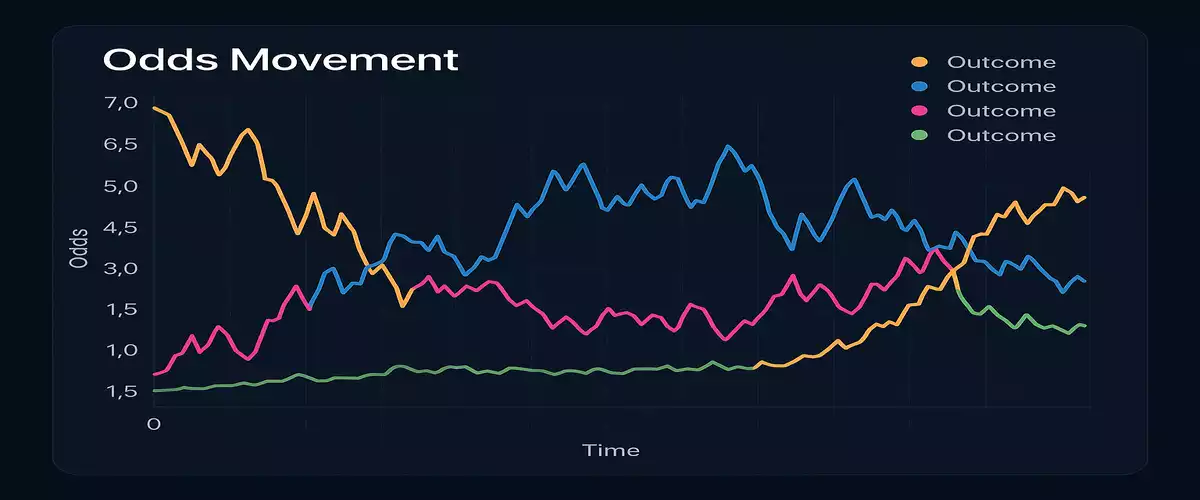
A polished virtual sports betting can display thousands of prices, but the fundamental mathematics is easier to understand than the surrounding interface. Odds describe a payment structure and imply a probability; they do not reveal the true chance of an event with certainty. They also often include the operator’s margin. Knowing these distinctions helps readers interpret numbers without mistaking a displayed price for an independently verified prediction.
Translating decimal odds
Decimal odds provide a straightforward starting point: dividing one by the quoted odds gives an implied probability before adjustments. A price of 2.00 corresponds to 50 percent, while 4.00 corresponds to 25 percent. Those figures do not establish what will actually happen; they express the probability implied by the quoted payout. In a two-outcome market, adding the unadjusted implied probabilities may produce a total above 100 percent, reflecting a margin. Comparing prices responsibly requires recognizing that a quote is not a pure statement about sporting likelihood.
Why the margin matters
Suppose the prices on opposite outcomes imply probabilities of 54 and 52 percent. Their sum is 106 percent, not 100. That excess is often called the overround. The simplest interpretation is that the set of quotes embeds a margin, though practical pricing can also reflect demand and risk management. Different events and market types may have different margins. A comparison that ignores this structure can reward the most dramatic-looking numbers rather than the clearest terms. Users should also distinguish quoted returns from actual net profit and confirm any applicable fees.
A good model can still lose repeatedly
Imagine an event genuinely has a 60 percent chance of occurring. That leaves a 40 percent chance it does not happen, which is hardly a negligible possibility. Multiple failures can occur in succession, and short runs do not reliably demonstrate whether an estimate was accurate. The same logic applies when using historical statistics to predict future matches. Injuries, changing conditions and tactical decisions are difficult to model perfectly. Treating probability as certainty creates an unreasonable expectation and often leads to financial decisions based on frustration rather than evidence.
Mathematical clarity does not create an income plan
Understanding odds can prevent common mistakes, but it cannot eliminate the possibility of financial harm. Budgeting for entertainment is different from attempting to earn regular income through uncertain outcomes. A person should consider whether participation is lawful in their location, read the transaction and settlement rules and set boundaries before committing funds. Promotions and bonuses must be examined alongside their restrictions. The central lesson is analytical humility: numbers can clarify what a price means without making the event predictable.
A numerical example of losing despite a strong favorite
Suppose a sporting outcome is assessed at a 70 percent probability. That sounds highly likely, yet in repeated comparable situations roughly three in ten would be expected to go the other way if the estimate were calibrated correctly. One unexpected loss does not disprove the original probability, and one success does not validate it. The difficulty is that real sports events are rarely identical repetitions. Injuries, selection decisions and changing conditions all affect the estimate. This makes recordkeeping and calibration important for anyone analyzing predictions professionally, but it also limits how much can be learned from a small sample. For consumers, the point is simpler: even a strong favourite is uncertain, and there is no amount of confidence that makes a potential financial loss disappear.
Understanding the limits of a price
A useful review of melbet app football betting odds or a similar digital service should explain terms with the same precision it uses to display prices. The clearest formula is only the beginning of understanding; assumptions, margins and the possibility of loss remain part of every decision.