
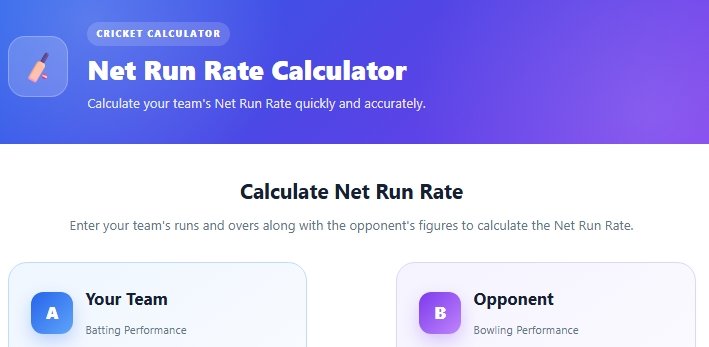
A Net Run Rate Calculator is a simple cricket tool used to calculate a team’s Net Run Rate (NRR) based on the runs scored, runs conceded, overs faced, and overs bowled. Net Run Rate is one of the most important statistics used in limited-overs cricket. It is commonly used in T20 leagues, ODI tournaments, the IPL, World Cups, and other league competitions to separate teams that have the same number of points. Instead of calculating NRR manually after every match, you can enter the required runs and overs into a calculator to get the result quickly. The basic Net Run Rate formula is:
NRR = (Total Runs Scored ÷ Total Overs Faced) − (Total Runs Conceded ÷ Total Overs Bowled)
Net Run Rate Calculator
Net Run Rate Calculator
Calculate your team’s Net Run Rate quickly and accurately.
Calculate Net Run Rate
Enter your team’s runs and overs along with the opponent’s figures to calculate the Net Run Rate.
Your Team
Batting PerformanceOpponent
Bowling PerformanceCalculation Breakdown
See how your Net Run Rate is calculated.
How Net Run Rate Is Calculated
Net Run Rate is the difference between a team’s average runs scored per over and its average runs conceded per over.
Note: Official tournament calculations may have special rules for all-out innings, rain-affected matches, abandoned games and other unusual situations.
To calculate your team's NRR, you need four main figures:
| Required Information | Meaning |
| Runs Scored | Total runs your team has scored |
| Overs Faced | Total overs faced by your team |
| Runs Conceded | Total runs scored by opponents |
| Overs Bowled | Total overs bowled by your team |
Enter these figures into a Net Run Rate Calculator and it can determine the team's current NRR.
Net Run Rate Formula
- Net Run Rate = Run Rate For − Run Rate Against
Where:
- Run Rate For = Total Runs Scored ÷ Total Overs Faced
- Run Rate Against = Total Runs Conceded ÷ Total Overs Bowled
- Quick Example
Suppose Team A scores 180 runs in 20 overs and then restricts Team B to 160 runs in 20 overs.
Team A's scoring rate:
- 180 ÷ 20 = 9.00
Team A's bowling rate:
- 160 ÷ 20 = 8.00
Therefore:
- NRR = 9.00 − 8.00 = +1.00
So Team A's Net Run Rate for that calculation is +1.00.
Also read this: IPL Teams 2026 | IPL Points Table 2026 | Series
How to Calculate Net Run Rate
Calculating NRR becomes easy once you understand the two parts of the formula.
Step 1: Calculate Runs Scored per Over
Take the total runs scored by your team and divide them by the total overs faced.
For example:
200 runs ÷ 20 overs = 10.00
This gives the team's run rate for.
Step 2: Calculate Runs Conceded per Over
Now divide the runs conceded by the total overs bowled.
For example:
170 runs ÷ 20 overs = 8.50
This gives the run rate against the team.
Step 3: Subtract the Two Rates
Now subtract the run rate against from the run rate for.
10.00 − 8.50 = +1.50
Therefore, the team's NRR is +1.50.
Net Run Rate Calculation Example
Let's take a complete example. Team B has played three matches.
| Match | Runs Scored | Overs Faced | Runs Conceded | Overs Bowled |
| Match 1 | 175 | 20 | 150 | 20 |
| Match 2 | 160 | 20 | 170 | 20 |
| Match 3 | 190 | 20 | 155 | 20 |
| Total | 525 | 60 | 475 | 60 |
Now calculate the overall scoring rate:
- 525 ÷ 60 = 8.75
Run rate against:
- 475 ÷ 60 = 7.92
Therefore:
- NRR = 8.75 − 7.92 = +0.83
Team B's approximate Net Run Rate is +0.83.
Why Is Net Run Rate Important in Cricket
Net Run Rate becomes particularly important when teams have the same number of points. For example, imagine the following league table:
| Team | Matches | Points | NRR |
| Team A | 7 | 10 | +0.850 |
| Team B | 7 | 10 | +0.420 |
| Team C | 7 | 8 | +0.900 |
Although Team C has a higher NRR, Team A and Team B have more points. If the competition uses NRR as the relevant tie-breaker, it can help determine the order among teams with equal points. This is why fans often search for an NRR calculator during the final stages of league tournaments.
Positive and Negative Net Run Rate
A team's NRR can be positive, negative, or zero.
Positive NRR
A positive NRR means the team's average scoring rate is higher than the rate at which it has conceded runs. For example:
Run Rate For = 9.20
Run Rate Against = 8.40
NRR = +0.80
Negative NRR
A negative NRR means the opposition's scoring rate has been higher. For example:
Run Rate For = 7.80
Run Rate Against = 8.50
NRR = -0.70
Zero NRR
If both rates are exactly the same:
Run Rate For = 8.00
Run Rate Against = 8.00
The NRR is:
0.00
T20 Net Run Rate Calculator
A T20 Net Run Rate Calculator follows the same basic mathematical principle.
In a standard 20-over match, a team's scoring rate can be calculated using:
- Runs scored ÷ overs faced
The opponent's rate is calculated using:
- Runs conceded ÷ overs bowled
The difference between these two figures gives the NRR.
For example:
Team score: 165/20
Opponent score: 145/20
Team run rate:
- 165 ÷ 20 = 8.25
Opponent run rate:
- 145 ÷ 20 = 7.25
NRR:
- 8.25 − 7.25 = +1.00
Can You Calculate NRR for Multiple Matches?
Yes. In a tournament, NRR is based on the relevant aggregate runs and overs rather than simply taking the average of each match's individual NRR. Suppose a team has:
- 500 total runs scored
- 60 overs faced
- 470 total runs conceded
- 60 overs bowled
Then:
- Run Rate For = 500 ÷ 60 = 8.33
- Run Rate Against = 470 ÷ 60 = 7.83
Therefore:
- NRR ≈ +0.50
This approach is more accurate than calculating separate NRR values for each match and simply averaging them.
Net Run Rate vs Run Rate
These two terms are related but not identical.
| Feature | Run Rate | Net Run Rate |
| Basic meaning | Runs scored per over | Difference between scoring and conceding rates |
| Formula | Runs ÷ Overs | Run Rate For − Run Rate Against |
| Uses opponent data | No | Yes |
| Used in league standings | Sometimes | Commonly used as a tie-breaker |
| Can be positive/negative | Usually expressed as a rate | Yes |
Run rate tells you how quickly a team scores. Net Run Rate goes one step further by comparing the team's scoring rate with its opponents' scoring rate.
How Much Does a Win Improve NRR?
There is no fixed amount by which a win improves NRR. The effect depends on:
- Runs scored
- Runs conceded
- Overs used
- Opponent's score
- Number of matches already played
- Total runs and overs accumulated before the match
A big win can have a larger impact than a narrow win because it can significantly improve the team's aggregate scoring and conceding rates. Similarly, a heavy defeat can reduce NRR considerably.
Can a Team Qualify With a Negative NRR?
Yes, depending on the tournament standings and qualification rules. NRR is generally one factor in determining the order of teams when the relevant teams are tied on points. Therefore, a team with a negative NRR may still qualify if its points position is sufficient and the competition rules permit it. Likewise, having a positive NRR does not automatically guarantee qualification. Always check the official points table and competition rules.
Net Run Rate and Qualification Scenarios
During the final matches of a tournament, fans often use NRR calculations to understand different qualification possibilities.
For example:
- Team A needs a win to qualify.
- Team B needs a win plus an improvement in NRR.
- Team C needs another team's loss.
- Two teams are tied on points and NRR becomes important.
A Net Run Rate Qualification Calculator can help estimate how a particular score might change the NRR. However, qualification depends on the complete standings and the tournament's official tie-breaking rules, not NRR alone.
Net Run Rate Calculator: Quick Formula
You can remember the basic formula as:
- NRR = (Runs Scored ÷ Overs Faced) − (Runs Conceded ÷ Overs Bowled)
- NRR = (Total Runs Scored ÷ Total Relevant Overs Faced) − (Total Runs Conceded ÷ Total Relevant Overs Bowled)
The word “relevant” matters because official competition regulations can specify how particular match situations are treated.
Final Thoughts
A Net Run Rate Calculator makes it much easier to calculate NRR without performing multiple calculations manually. You only need the relevant runs and overs to work out the basic scoring rate, conceding rate, and final NRR. For simple matches, the calculation is straightforward. Tournament qualification scenarios can be more complicated because official rules may apply to all-out innings, rain-affected games, revised targets, abandoned matches, and other unusual situations. If you are following an IPL, T20, ODI, or other limited-overs tournament, combining the NRR calculation with the official points table gives you a clearer picture of the standings.
FAQs
1.What is a Net Run Rate Calculator?
A Net Run Rate Calculator is a cricket calculation tool that determines a team's NRR using runs scored, runs conceded, and the relevant overs used.
2.What is the formula for Net Run Rate?
NRR = (Runs Scored ÷ Overs Faced) − (Runs Conceded ÷ Overs Bowled)
3.How do I calculate NRR after one match?
Calculate your team's runs per over, calculate the opponent's runs per over, and subtract the opponent's rate from your team's rate.
4.Is Net Run Rate calculated from all matches?
For tournament standings, NRR is generally calculated from aggregate relevant runs and overs across the applicable matches rather than by averaging individual match NRR values.
5.What does a positive NRR mean?
A positive NRR means the team's scoring rate is higher than its rate of conceding runs over the relevant calculations.
6.What does a negative NRR mean?
A negative NRR means the team's rate of conceding runs is higher than its scoring rate.