Football is often described as a young player’s game, but a growing number of veteran stars are proving that age does not necessarily mean the end of a professional career. While many players retire in their early or mid-30s, some continue playing competitive football well into their late 30s, 40s and, in exceptional cases, even beyond 50.
The list of the oldest football players 2026 is particularly interesting because it includes players from very different levels of the sport. Some are still competing in Europe’s biggest leagues, while others are extending their careers in South America, Asia, smaller European leagues or lower divisions.
Among the most recognizable veteran names in 2026 are Manuel Neuer, Cristiano Ronaldo, Luka Modrić, Edin Džeko, Lionel Messi, Luis Suárez, James Milner and Fábio. At the same time, players such as Kazuyoshi Miura continue to demonstrate extraordinary longevity.
It is important to define what “oldest football player” means. A player who is 60 and competing in amateur football cannot automatically be compared with a 40-year-old playing in the Bundesliga or Champions League. For that reason, this article separates the broader list of active players from the oldest footballers competing at the highest levels.
Oldest Football Players 2026 – Quick Overview
The following table highlights some of the most notable veteran footballers who remain active in 2026. Ages can change during the season as players celebrate their birthdays.
| Rank | Player | Age in 2026 | Position | Current Club | Nationality |
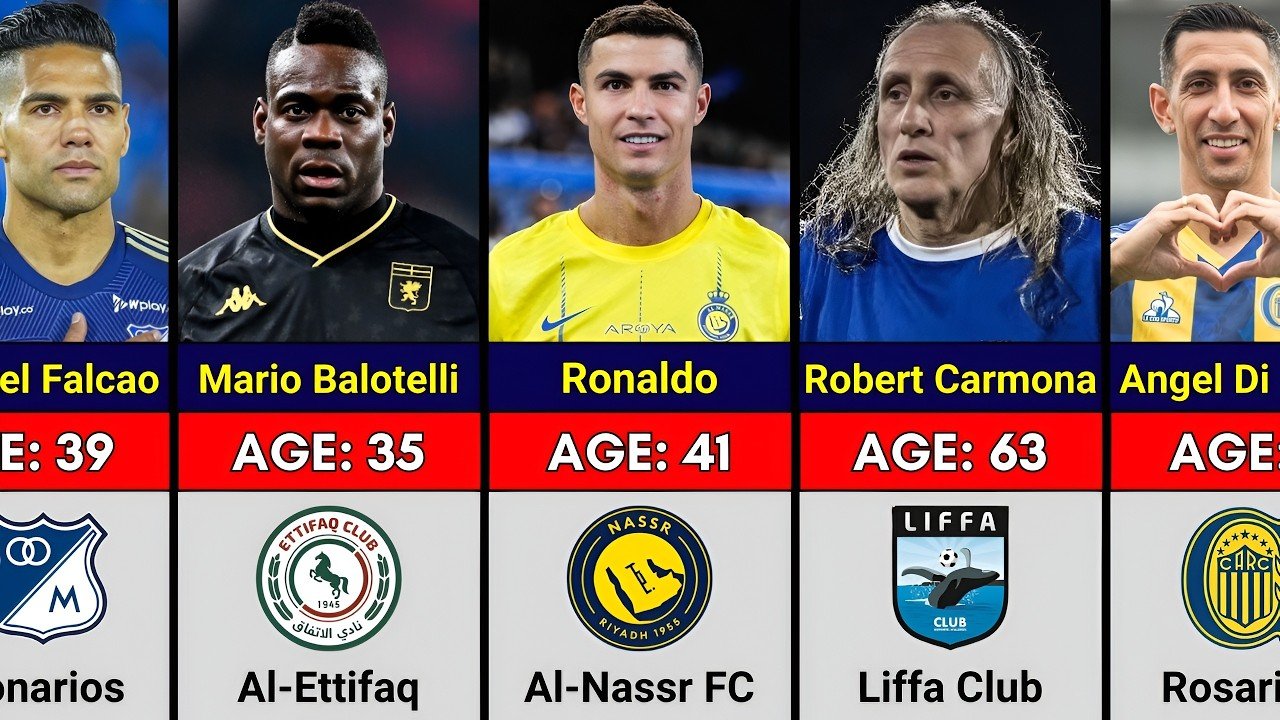
| 1 | Robert Carmona | 64 | Midfielder/Forward | Liffa Club | Uruguay |
| 2 | Mykola Lykhovydov | 60 | Forward | FC Real Pharma Odesa | Ukraine |
| 3 | Kazuyoshi Miura | 59 | Forward | Fukushima United | Japan |
| 4 | Georgi Petkov | 50 | Goalkeeper | Slavia Sofia | Bulgaria |
| 5 | Dragan Jolović | 50 | — | FK Alfa Modriča | Bosnia & Herzegovina |
| 6 | Fábio | 45 | Goalkeeper | Fluminense | Brazil |
| 7 | Nenê | 45 | Midfielder | Botafogo-PB | Brazil |
| 8 | Cristiano Ronaldo | 41 | Forward | Al-Nassr | Portugal |
| 9 | Manuel Neuer | 40 | Goalkeeper | Bayern Munich | Germany |
| 10 | Edin Džeko | 40 | Forward | Schalke 04 | Bosnia & Herzegovina |
The broader 2026 list includes players competing at different competitive levels. A July 2026 ranking also listed Robert Carmona, Mykola Lykhovydov, Kazuyoshi Miura, Georgi Petkov and Dragan Jolović among the oldest active players.
For readers interested specifically in elite-level football, the picture is different. Players such as Cristiano Ronaldo, Manuel Neuer, Edin Džeko, Fábio and other 40-plus veterans are much more relevant comparisons.
Also read this: Shortest Football Players 2026 | Football Players Born in 2007 | Football Players Born in 2008
Who Is the Oldest Football Player in 2026?
There is no single answer unless the level of competition is specified.
If amateur football is included, Robert Carmona of Uruguay is one of the most frequently cited names at the top of 2026 longevity lists. A July 2026 ranking listed him at 64 years old while playing for Liffa Club in Uruguay’s Liga Metropolitana Amateur.
The situation changes considerably when the definition is restricted to professional football.
Kazuyoshi Miura, commonly known as “King Kazu,” remains one of the most remarkable examples of professional football longevity. Born in 1967, the Japanese forward turned 59 in February 2026. A 2026 report noted that he extended his loan with Fukushima United until June 2027, keeping his professional career going into its 42nd season.
At the highest levels of European football, the list is dominated by players in their late 30s and early 40s. Manuel Neuer, for example, remains with Bayern Munich at 40 and renewed his contract for another season.
This distinction is essential when discussing the oldest football players 2026 because “oldest active player” and “oldest elite footballer” are not necessarily the same thing.
Top 10 Oldest Football Players in 2026
1. Robert Carmona
Age: 64
Country: Uruguay
Position: Midfielder/Forward
Level: Amateur football
Robert Carmona represents one of the most extraordinary longevity stories in football.
At an age when most former professionals have been retired for decades, Carmona has continued playing organized football. His inclusion in 2026 lists shows just how broad the definition of an active footballer can become when amateur competition is included.
His case should therefore be viewed separately from the likes of Cristiano Ronaldo or Manuel Neuer. Carmona is not competing in a major European top division, but his longevity is still remarkable.
His story demonstrates that football does not necessarily have to end when a player leaves the professional game. For some footballers, the sport remains a lifelong activity.
2. Mykola Lykhovydov
Age: 60
Country: Ukraine
Club: FC Real Pharma Odesa
Position: Forward
Mykola Lykhovydov is another unusual example of football longevity.
At around 60 years old, his continued involvement in organized football places him among the oldest active footballers in the world. His appearance on 2026 longevity lists is especially notable because he has continued to be associated with organized competitive football rather than simply playing recreational matches.
Like Carmona, however, his career should not be directly compared with players competing in the UEFA Champions League or Europe’s top five leagues.
His inclusion provides an important perspective: football has several different competitive levels, and players can continue participating long after the conventional retirement age.
3. Kazuyoshi Miura
Age: 59
Country: Japan
Position: Forward
Club: Fukushima United
Few footballers in history have challenged the concept of retirement as consistently as Kazuyoshi Miura.
Known around the world as “King Kazu,” Miura has built a professional career stretching across several decades. His career began in the 1980s, yet he remains active in 2026.
A 2026 report stated that Miura’s loan with Fukushima United was extended through June 2027, allowing him to continue a professional career that had reached its 42nd season.
Miura’s longevity is remarkable not simply because of his age but because of the length of time he has remained connected to professional football.
His career has included football in Japan, Brazil, Italy and other environments. He also became one of the most recognizable Japanese footballers of his generation.
Miura’s continued career is an example of how experience, fitness, professionalism and adaptation can extend a footballer’s playing life far beyond the conventional retirement age.
4. Georgi Petkov
Age: 50
Country: Bulgaria
Position: Goalkeeper
Club: Slavia Sofia
Goalkeepers are frequently represented among football’s oldest players, and Georgi Petkov is an excellent example.
Petkov’s career demonstrates one of the advantages goalkeepers can have when it comes to longevity. Unlike outfield players, goalkeepers generally do not spend an entire match making repeated high-speed runs across large areas of the pitch.
Their game relies heavily on positioning, anticipation, communication, concentration and technique.
A 2026 ranking listed Petkov at 50 while playing for Slavia Sofia in Bulgaria’s top division.
His continued presence at that age makes him one of the most interesting veteran goalkeepers in world football.
5. Dragan Jolović
Age: 50
Country: Bosnia & Herzegovina
Club: FK Alfa Modriča
Dragan Jolović is another veteran whose career demonstrates how long football careers can become outside Europe’s biggest leagues.
His inclusion in 2026 lists at approximately 50 years old highlights the importance of distinguishing between top-flight football and the broader professional football ecosystem.
Players in smaller leagues and lower divisions may be able to continue playing because the physical and competitive demands can differ from those of Europe’s elite competitions.
6. Fábio
Age: 45
Country: Brazil
Position: Goalkeeper
Club: Fluminense
Brazilian goalkeeper Fábio is one of the strongest examples of a genuinely high-level footballer maintaining an extraordinary career into his 40s.
Fábio has enjoyed a particularly long career in Brazilian football and remains associated with Fluminense in 2026.
His longevity is even more impressive because he has competed at a very high level rather than simply remaining active in recreational or lower-level football.
In July 2026, Brazilian outlet ge highlighted Fábio among the footballers over 40 who remained active, noting his record appearances in the Copa Libertadores.
His career illustrates why goalkeeper is often considered one of the best positions for football longevity.
7. Nenê
Age: 45
Country: Brazil
Position: Midfielder
Club: Botafogo-PB
Nenê provides an important counterexample to the idea that only goalkeepers can play into their 40s.
The Brazilian midfielder continued playing professionally at an age when most outfield players have already retired. A July 2026 report described Nenê as approaching his 45th birthday while continuing to produce goals and assists for Botafogo-PB.
Midfielders face significant physical demands because they often cover large areas of the pitch. Yet players with exceptional technical ability can sometimes compensate for reduced pace through positioning, passing, vision and decision-making.
Nenê’s career is therefore an excellent example of how football intelligence can become increasingly important as a player ages.
8. Cristiano Ronaldo
Age: 41
Country: Portugal
Position: Forward
Club: Al-Nassr
Cristiano Ronaldo is arguably the most famous name on any list of the oldest football players 2026.
Born in February 1985, Ronaldo turned 41 in 2026 but continued playing professional football at the highest level.
His career has already included Sporting CP, Manchester United, Real Madrid, Juventus and Al-Nassr, as well as an extraordinary international career with Portugal.
Ronaldo’s longevity is particularly remarkable because he has remained an attacking player. Forwards generally face considerable physical demands, including sprinting, acceleration and repeated high-intensity actions.
His continued international career also demonstrates his importance to Portugal. According to 11v11’s 2026 Portugal records, Ronaldo made his final appearance in the listed 2026 season at 41 years and 150 days against Spain on July 6, 2026.
Ronaldo’s longevity has been supported by professional conditioning, recovery, nutrition and a highly disciplined approach to physical preparation.
9. Manuel Neuer
Age: 40
Country: Germany
Position: Goalkeeper
Club: Bayern Munich
Manuel Neuer remains one of the greatest examples of goalkeeper longevity in modern football.
At 40, Neuer continues to play for Bayern Munich and remains involved at the highest level of European football. In September 2026, reports noted that Neuer had renewed his contract for another year and was targeting another Champions League title.
Neuer’s career has been unusual because he helped redefine the goalkeeper position.
His ability with the ball at his feet, willingness to leave the penalty area and quality of distribution made him one of the most influential modern “sweeper-keepers.”
At 40, experience is particularly valuable for a goalkeeper. Anticipation can reduce the need for explosive movement, while positioning and reading the game can compensate for some physical decline.
10. Edin Džeko
Age: 40
Country: Bosnia & Herzegovina
Position: Forward
Club: Schalke 04
Edin Džeko is another veteran attacker who remains active at 40.
The Bosnian striker has built an exceptional career across several European leagues and has consistently been recognized for his movement, finishing ability, physical presence and intelligent positioning.
A 2026 active-player ranking listed Džeko at 40 with Schalke 04.
Džeko’s career also demonstrates how an experienced striker can adapt. A veteran forward does not necessarily need to rely on the same explosive running style that characterized his younger years.
Instead, positioning, movement inside the penalty area, link-up play and anticipation can become increasingly important.
Oldest Active Football Players in 2026
The definition of an active football player matters greatly.
An active footballer may be:
- Playing regularly in a major league
- Registered with a professional club
- Playing in a lower professional division
- Competing in semi-professional football
- Playing organized amateur football
Therefore, rankings can produce very different results.
| Player | Age | Position | Club | Competition Level |
| Robert Carmona | 64 | Midfielder/Forward | Liffa Club | Amateur |
| Mykola Lykhovydov | 60 | Forward | FC Real Pharma Odesa | Lower-level professional |
| Kazuyoshi Miura | 59 | Forward | Fukushima United | Professional |
| Georgi Petkov | 50 | Goalkeeper | Slavia Sofia | Top division |
| Fábio | 45 | Goalkeeper | Fluminense | Top-level |
| Nenê | 45 | Midfielder | Botafogo-PB | Professional |
| Cristiano Ronaldo | 41 | Forward | Al-Nassr | Elite professional |
| Manuel Neuer | 40 | Goalkeeper | Bayern Munich | Elite professional |
| Edin Džeko | 40 | Forward | Schalke 04 | Professional |
The table shows why an article about the oldest football players should always explain its methodology.
Oldest Goalkeepers in Football 2026
Goalkeepers frequently appear near the top of longevity rankings.
There are several reasons.
A goalkeeper does not need to constantly sprint from one end of the pitch to the other. Although the position requires explosive reactions, much of the role depends on positioning and anticipation.
Experienced goalkeepers can also use their understanding of the game to place themselves correctly before an opponent gets a chance to shoot.
Some of the most notable veteran goalkeepers in 2026 include:
| Goalkeeper | Approx. Age | Club | Country |
| Georgi Petkov | 50 | Slavia Sofia | Bulgaria |
| Fábio | 45 | Fluminense | Brazil |
| Manuel Neuer | 40 | Bayern Munich | Germany |
| Fernando Muslera | 40 | Estudiantes | Uruguay |
| Vozinha | 40 | Colo-Colo | Cape Verde |
A July 2026 report on veteran players also highlighted Fábio, while international names such as Neuer and Fernando Muslera remained active at around 40.
Oldest Defenders in Football 2026
Defenders can also enjoy long careers because experience and positioning are extremely valuable.
A defender does not always need to win a race against a younger forward. Good positioning can prevent the race from happening in the first place.
Veteran defenders often compensate for declining speed through:
- Reading the game
- Anticipating passes
- Positioning
- Tackling technique
- Communication
- Leadership
- Set-piece knowledge
Notable veteran defenders in 2026 include players such as David Luiz and Nicolás Otamendi.
A 2026 active-footballer ranking listed David Luiz at 39 with Pafos FC and Nicolás Otamendi at 38 with River Plate.
Oldest Midfielders in Football 2026
Midfielders face one of the most demanding physical workloads in football, yet technically gifted players can continue well beyond the typical retirement age.
One of the most notable examples in 2026 is Luka Modrić.
Modrić remained active at 40 and continued competing at a major European club after renewing his contract with AC Milan. Brazilian outlet ge included Modrić among the notable footballers over 40 who remained active in 2026.
Experienced midfielders can remain effective because their game often evolves.
Instead of covering every metre at maximum speed, an older midfielder can:
- Move intelligently
- Pass earlier
- Control the tempo
- Avoid unnecessary challenges
- Use positioning
- Read developing attacks
- Rely on technical ability
| Veteran Midfielder | Approx. Age in 2026 | Key Strength |
| Luka Modrić | 40 | Passing and game intelligence |
| Nenê | 45 | Creativity and experience |
| James Milner | 40 | Versatility and experience |
Oldest Forwards and Strikers in Football 2026
Attacking players usually face significant physical demands, which makes longevity among veteran forwards especially impressive.
Cristiano Ronaldo, Edin Džeko, Lionel Messi and Luis Suárez demonstrate several different ways attackers can adapt as they age.
Ronaldo has continued to score through movement, finishing and positioning.
Džeko’s game has increasingly emphasized intelligent movement and penalty-box positioning.
Messi has gradually reduced some of the unnecessary running associated with his younger years while becoming even more influential as a creator.
Luis Suárez has relied heavily on anticipation, finishing and movement around the penalty area.
A 2026 active-player ranking listed Messi and Suárez at 39, alongside Džeko at 40.
Oldest Football Players by League in 2026
Age distribution varies considerably from league to league.
| League/Region | Examples of Veteran Players |
| Premier League | James Milner, Tom Heaton, Séamus Coleman |
| Bundesliga | Manuel Neuer, Edin Džeko |
| Serie A | Veteran players in their late 30s |
| La Liga | Veteran players in their late 30s |
| MLS | Lionel Messi, Luis Suárez |
| Brazil | Fábio, Nenê |
| Japan | Kazuyoshi Miura |
| Bulgaria | Georgi Petkov |
| Portugal | Cristiano Ronaldo |
The exact ranking can change depending on whether the measurement is based on the player’s age at the start of the season, current age, or age on the date of an appearance.
Oldest Premier League Players 2026
The Premier League provides one of the clearest examples of how rare extreme football longevity is at the highest level.
James Milner made Premier League history in January 2026 when he appeared for Brighton against Manchester City shortly after his 40th birthday. The Premier League reported that he became only the fifth outfield player to appear in the competition at age 40 or older.
The five outfield players to have made Premier League appearances after turning 40 were listed as:
| Player | Club | Appearances After Turning 40 |
| Teddy Sheringham | Portsmouth | 24 |
| Gordon Strachan | Coventry City | 6 |
| Ryan Giggs | Manchester United | 6 |
| Kevin Phillips | Crystal Palace | 4 |
| James Milner | Brighton | 1* |
*The Premier League’s January 2026 report reflected Milner’s first appearance after turning 40 at that point in the season.
Milner’s 2026 season therefore deserves special attention.
Historical Premier League records also show that goalkeepers have reached even older ages. John Burridge holds the record for the oldest Premier League appearance at 43 years and 162 days, according to the Premier League’s historical records.
Oldest Football Players in Europe 2026
European football remains the ultimate test for veteran players because the top leagues combine intense schedules, tactical demands and elite competition.
In 2026, some of the most notable veterans competing in Europe include:
- Manuel Neuer
- Edin Džeko
- Luka Modrić
- David Luiz
- Nicolás Otamendi
- James Milner
Neuer’s continued presence at Bayern Munich is particularly significant because he remains at one of Europe’s biggest clubs at 40.
Modrić also demonstrates that an outfield player can remain competitive at elite European level at 40.
This challenges the old assumption that most footballers must retire before reaching 35.
Oldest Football Players Over 40 in 2026
Players over 40 are still rare at the highest level, but they are no longer completely unheard of.
| Player | Age in 2026 | Position | Club |
| Robert Carmona | 64 | Midfielder/Forward | Liffa Club |
| Mykola Lykhovydov | 60 | Forward | FC Real Pharma Odesa |
| Kazuyoshi Miura | 59 | Forward | Fukushima United |
| Georgi Petkov | 50 | Goalkeeper | Slavia Sofia |
| Fábio | 45 | Goalkeeper | Fluminense |
| Nenê | 45 | Midfielder | Botafogo-PB |
| Cristiano Ronaldo | 41 | Forward | Al-Nassr |
| Manuel Neuer | 40 | Goalkeeper | Bayern Munich |
| Edin Džeko | 40 | Forward | Schalke 04 |
| Luka Modrić | 40 | Midfielder | AC Milan |
The important point is that these players are not all competing at the same level. The first several names demonstrate exceptional football longevity, while Ronaldo, Neuer, Džeko and Modrić are notable because they have remained relevant at much higher levels of the sport.
Football Players Over 35 Still Playing in 2026
The 35-year-old mark is increasingly becoming less definitive in modern football.
Players can remain competitive beyond 35 because clubs now have access to:
- Better injury prevention
- Sports science
- Advanced recovery
- Nutrition programs
- GPS tracking
- Training-load management
- Physiotherapy
- Individual conditioning
Modern football also allows players to specialize.
A veteran defender can concentrate on positioning and leadership. A midfielder can reduce unnecessary running. A striker can focus on movement and finishing. A goalkeeper can rely heavily on anticipation and positioning.
This means a player’s role can evolve as their physical abilities change.
How Do Football Players Stay Active for So Long?
Improved Sports Science
- Modern football clubs understand much more about athlete recovery than previous generations did.
- Players can receive individualized training programs based on workload, injury history and physical condition.
- Recovery is no longer simply about resting between matches. Clubs use physiotherapy, mobility work, strength training and carefully managed workloads to keep players available.
Nutrition and Diet
- Nutrition also plays a major role.
- Professional players generally have access to individualized meal plans designed around their training and match schedules.
- Adequate protein, carbohydrates, hydration and micronutrients can support recovery and performance.
- Older players may need to pay even greater attention to nutrition because recovery can become more difficult with age.
Strength and Conditioning
- Strength training is another important component.
- Older footballers need to maintain muscle strength, joint stability and mobility while avoiding excessive training loads.
- The objective is not simply to become stronger. It is to remain strong enough to perform while minimizing injury risk.
Tactical Adaptation
Perhaps the most underrated factor is tactical intelligence.
A 40-year-old player does not need to play exactly like a 20-year-old.
Veterans can conserve energy by:
- Choosing better positions
- Anticipating passes
- Making earlier decisions
- Avoiding unnecessary sprints
- Controlling the tempo
- Using experience to read opponents
This is one reason technically gifted midfielders and intelligent defenders can maintain long careers.
Mental Experience
Football is also a mental game.
Veteran players have usually experienced:
- Pressure situations
- Major finals
- International tournaments
- Dressing-room conflicts
- Tactical changes
- Difficult defeats
- High-pressure matches
That experience can be extremely valuable.
A younger player may have more physical energy, but an older player may recognize a situation before it fully develops.
Oldest Football Players vs Youngest Football Players
Football’s modern landscape contains an interesting combination of extremely young players and highly experienced veterans.
| Category | Oldest Players | Youngest Players |
| Typical age | 35+ | Teenagers |
| Main advantage | Experience | Athletic development |
| Key strength | Decision-making | Speed and energy |
| Career stage | Veteran | Emerging |
| Development focus | Longevity | Improvement |
| Tactical value | Game reading | Adaptability |
The coexistence of these two groups is one of the most interesting aspects of modern football.
Young players bring energy, speed and unpredictability. Older players provide experience, leadership and tactical understanding.
A successful team often needs both.
Oldest Football Players of All Time
The phrase “oldest football player ever” requires caution.
There are players who have competed in amateur football into their 50s and 60s. There are also professional players who have maintained careers into their 40s.
These categories should not be treated as identical.
For example, Robert Carmona’s reported age of 64 places him far above most professional players, but he competes in amateur football. Kazuyoshi Miura, on the other hand, has maintained a professional career into his late 50s.
This makes Miura’s case particularly extraordinary.
When comparing historical records, researchers should consider:
- Professional status
- Competitive level
- Official registration
- Number of appearances
- League level
- Whether the player was actually active
- Age on the date of the appearance
Without these criteria, “oldest footballer” lists can easily mix very different categories.
Oldest Football Player to Play at the Highest Level
Playing football at 40 is one thing. Playing at 40 for one of the world’s biggest clubs is something entirely different. Manuel Neuer is one of the clearest modern examples.
At 40, he remains with Bayern Munich and is still targeting Champions League success. James Milner is another important example. His appearance for Brighton after turning 40 placed him among a very small group of outfield players to play Premier League football at that age.
Cristiano Ronaldo provides another example of elite longevity because he remains a major professional and international football figure at 41. These examples demonstrate that longevity is not simply about continuing to play. It is also about the level at which a player can continue performing.
Oldest Players to Represent Their National Teams
- International football is another difficult environment for veteran players.
- National teams generally prioritize players who can maintain high intensity, especially during major tournaments.
- Cristiano Ronaldo’s continued international career is therefore exceptional.
- Portugal’s 2026 records show Ronaldo appearing against Spain on July 6, 2026, at 41 years and 150 days.
- International longevity is different from club longevity because national-team players do not necessarily have the same weekly training and recovery environment as club players.
- A player may remain active for a club but no longer receive international selection.
Why Goalkeepers Often Have Longer Football Careers
Goalkeepers are disproportionately represented among the oldest footballers. The reasons are relatively straightforward. A goalkeeper’s role is physically different from that of an outfield player. They spend large portions of a match in a limited area and rely heavily on anticipation.
This does not mean goalkeeping is easy. Goalkeepers need:
- Explosive reactions
- Agility
- Coordination
- Strength
- Positioning
- Communication
- Concentration
- Distribution
However, some aspects of goalkeeping can age differently from sprinting ability.
A veteran goalkeeper can use years of experience to anticipate where the ball is likely to go.
That is why players such as Georgi Petkov, Fábio and Manuel Neuer can continue competing at advanced ages.
Does Age Affect Football Performance?
Yes, but the effect is not identical for every player.
Speed
Acceleration and sprint speed can decline with age.
This can be particularly important for wingers and forwards who rely on explosive movement.
Stamina
Older players may need more recovery between high-intensity efforts.
However, intelligent positioning can reduce unnecessary running.
Recovery
Recovery generally becomes more challenging as players age.
This is why modern clubs carefully manage training loads for veteran players.
Strength
Maintaining strength becomes increasingly important.
Well-designed strength and conditioning programs can help players preserve physical performance.
Reaction Time
Goalkeepers may be particularly affected by changes in reaction speed.
However, anticipation and positioning can help compensate.
Tactical Intelligence
This is one area where veteran players can have an advantage.
Years of experience allow players to recognize patterns that younger players may not yet understand.
Experience
Experience cannot be purchased or developed overnight.
A veteran who has played hundreds of high-level matches may possess an understanding that is extremely valuable during difficult games.
Oldest Football Players 2026 by Age Group
| Age Group | Description | Common Positions |
| 35–37 | Established veterans | All positions |
| 38–39 | Exceptional senior players | GK/DEF/MID/FWD |
| 40–44 | Extremely rare at elite level | GK/DEF/MID/FWD |
| 45–49 | Exceptional longevity | GK/MID/FWD |
| 50+ | Rare cases, often outside elite football | Various |
| 60+ | Extremely unusual | Amateur/lower levels |
The key takeaway is that the competitive level becomes increasingly important as age increases.
A 36-year-old Premier League starter and a 60-year-old amateur footballer are both technically active players, but they represent very different forms of longevity.
Why Are Football Careers Getting Longer?
Several factors have contributed to the increased longevity of professional players.
- First, players now understand their bodies better.
- Second, clubs can monitor workloads in real time.
- Third, nutrition has become much more sophisticated.
- Fourth, medical teams can identify injury risks earlier.
- Fifth, tactical systems can be adapted around experienced players.
- Finally, footballers themselves are increasingly professional about life away from the pitch.
- Sleep, recovery, nutrition and conditioning can all influence how long an athlete remains competitive.
What Makes a Football Career Exceptional?
Longevity alone does not necessarily mean a player had a great career.
A truly exceptional football career combines:
- Longevity
- Consistency
- Major trophies
- International success
- High-level performances
- Adaptability
- Professionalism
This is why players such as Cristiano Ronaldo, Manuel Neuer and Luka Modrić remain particularly interesting.
They have not simply survived into old age. They have remained relevant at extremely high levels.
Final Thoughts on the Oldest Football Players 2026
The oldest football players 2026 list shows just how dramatically football careers can differ.
At one end are extraordinary cases such as Robert Carmona and Mykola Lykhovydov, who remain connected to organized football at exceptionally advanced ages. Kazuyoshi Miura stands out even further because his career has continued professionally into his late 50s.
At the highest levels, the picture becomes even more impressive in a different way.
Cristiano Ronaldo remains an international star at 41. Manuel Neuer continues at Bayern Munich at 40. Fábio and Nenê have continued their professional careers into their mid-40s. James Milner reached 40 while still appearing in the Premier League, while Luka Modrić has continued competing in elite European football at the same age.
These players prove that there is no single formula for football longevity.
Goalkeepers can rely on anticipation and positioning. Midfielders can adapt through passing and game intelligence. Defenders can compensate for declining speed with experience and positioning. Forwards can focus increasingly on movement, finishing and efficiency.
Modern sports science has also changed what is possible. Better nutrition, recovery, injury prevention, conditioning and workload management have helped extend careers that might once have ended much earlier.
The most important lesson is that age alone does not determine a footballer’s value.
Physical decline is inevitable, but football intelligence, technical quality, professionalism and tactical adaptation can allow exceptional players to remain competitive for many additional years.
The list should also be updated throughout 2026 because player ages, club registrations, transfers and retirement decisions can change during the season.
For football fans, that makes the veteran generation one of the most fascinating parts of the modern game.
FAQs
Q1. Who is the oldest football player in 2026?
The answer depends on how “football player” is defined. If amateur football is included, Robert Carmona is among the oldest at 64. In professional football, Kazuyoshi Miura is one of the most extraordinary active veterans at 59.
Q2. Who is the oldest active soccer player in 2026?
Kazuyoshi Miura is one of the oldest active professional soccer players in 2026. He turned 59 in February and continued his professional career with Fukushima United.
Q3. Are there football players over 40 still playing in 2026?
Yes. Cristiano Ronaldo, Manuel Neuer, Fábio, Nenê and several other players remain active at 40 or older.
Q4. Who is the oldest goalkeeper still playing?
Georgi Petkov is among the oldest active goalkeepers listed in 2026, at around 50. Fábio and Manuel Neuer are other notable veteran goalkeepers.
Q5. Who is the oldest football player in Europe?
The answer depends on the level and definition used. Georgi Petkov is among Europe’s most notable veteran players, while elite European football includes players such as Manuel Neuer and Edin Džeko at around 40.
Q6. Who is the oldest Premier League player in 2026?
James Milner became one of the oldest outfield players to appear in the Premier League when he played for Brighton after turning 40 in January 2026.
Q7. What age do most football players retire?
There is no universal retirement age. Many professional outfield players retire during their 30s, while goalkeepers can often continue longer. Individual fitness, injuries, club opportunities and playing level all influence retirement.
Q8. Can football players play professionally after 40?
Yes. Although it is rare, several players continue playing professionally after 40. The examples of Miura, Fábio, Ronaldo and Neuer demonstrate that professional football after 40 is possible.
Q9. Which position has the oldest football players?
Goalkeeper is one of the positions most commonly associated with exceptional longevity. The position relies heavily on positioning, anticipation, communication and experience.
Q10. Who has had one of the longest football careers?
Kazuyoshi Miura is one of the most famous examples. His professional career has stretched across more than four decades, with his career continuing in 2026.