
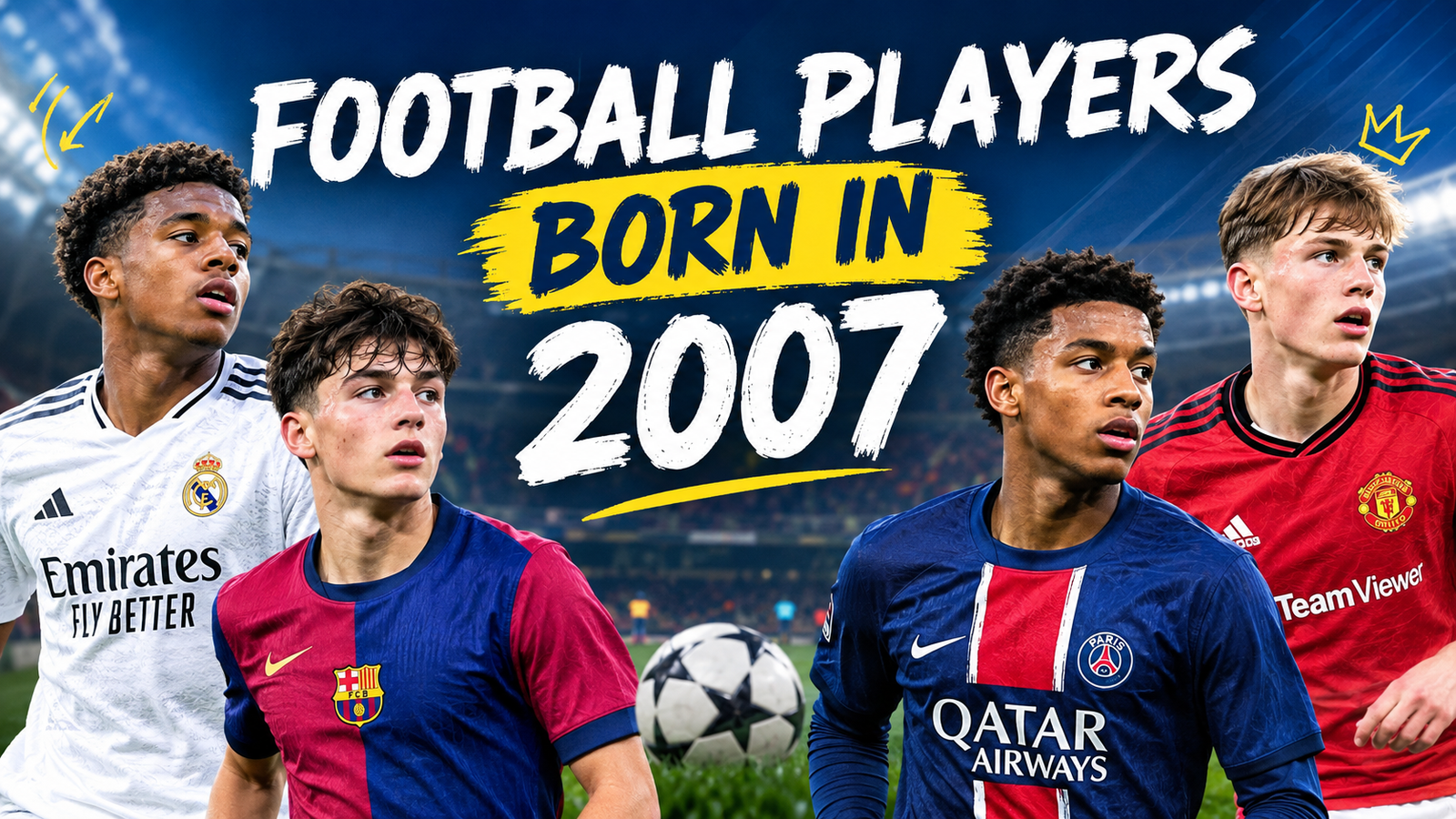
The generation of football players born in 2007 has become one of the most exciting age groups in modern football. These players are now reaching the stage where academy football is being replaced by senior professional football, and several have already made a major impact at the highest level.
What makes the 2007-born generation particularly interesting is the number of players who have reached senior football at an unusually young age. Some have become regulars for major European clubs, while others have already represented their senior national teams.
Lamine Yamal and Pau Cubarsí at Barcelona are two of the clearest examples. Both were born in 2007 and have already established themselves at club and international level. Barcelona’s official profile lists Cubarsí’s birth date as January 22, 2007, while the club has described his strengths as his ball progression, leadership and defensive ability.
The same birth year also includes players such as Franco Mastantuono, Geovany Quenda, Rodrigo Mora, Konstantinos Karetsas, Ethan Nwaneri and Marc Bernal. A broader football database currently lists dozens of notable footballers born in 2007 across different positions and countries.
This article looks at the most notable footballers born in 2007, their clubs, positions, nationalities, development, international experience and why they are considered important young talents.
Note: Player ages, clubs and statistics can change during a season. The information in this article is intended as a September 2026 snapshot, while career statistics should be checked against current club or competition records before publication updates.
Quick Facts About Football Players Born in 2007
| Category | Details |
| Birth Year | 2007 |
| Approximate Age in 2026 | 18–19 |
| Generation | Emerging senior professionals |
| Common Positions | Forward, midfielder, defender, goalkeeper |
| Major Development Path | Academy → youth football → senior football |
| Major Competitions | Domestic leagues, UEFA competitions and international football |
| Notable Names | Lamine Yamal, Pau Cubarsí, Franco Mastantuono, Geovany Quenda, Ethan Nwaneri |
Because birthdays are spread throughout the year, not every player born in 2007 has the same age at a particular point in the season. A player born in January will turn 19 earlier than someone born late in the year.
List of Football Players Born in 2007
There are many professional and academy-level players born in 2007. The list below focuses on notable names who have attracted attention through senior football, major academies, international football or performances in important competitions.
Main List of Notable 2007-Born Football Players
| Player | Date of Birth | Nationality | Position | Club/Team |
| Lamine Yamal | 13 July 2007 | Spain | Winger | Barcelona |
| Pau Cubarsí | 22 January 2007 | Spain | Centre-back | Barcelona |
| Franco Mastantuono | 14 August 2007 | Argentina | Attacking player | Real Madrid |
| Geovany Quenda | 30 April 2007 | Portugal | Forward/Winger | Sporting CP |
| Rodrigo Mora | 5 May 2007 | Portugal | Attacking midfielder/Winger | Porto |
| Ethan Nwaneri | 21 March 2007 | England | Midfielder/Winger | Arsenal/Marseille |
| Marc Bernal | 26 May 2007 | Spain | Defensive midfielder | Barcelona |
| Konstantinos Karetsas | 19 November 2007 | Greece | Attacking midfielder | Genk |
| Kendry Páez | 4 May 2007 | Ecuador | Attacking midfielder | Chelsea |
| Chris Rigg | 18 June 2007 | England | Midfielder | Sunderland |
| Ayyoub Bouaddi | 2 October 2007 | France | Midfielder | Lille |
| Francesco Camarda | 10 March 2008 | Italy | Forward | — |
| Trey Nyoni | 30 June 2008 | England | Midfielder | Liverpool |
| Marc Guiu | 4 January 2006 | Spain | Forward | Chelsea |
| Franco Mastantuono | 14 August 2007 | Argentina | Attacking player | Real Madrid |
| Charalampos Kostoulas | 30 May 2007 | Greece | Forward | Brighton |
| Gabriel Carvalho | 17 August 2007 | Brazil | Attacking midfielder | Al Qadsiah |
| Luka Vušković | 24 February 2007 | Croatia | Centre-back | Tottenham |
| Rodrigo Mora | 5 May 2007 | Portugal | Attacking midfielder | Porto |
| Mikey Moore | 11 August 2007 | England | Winger | Tottenham |
Editorial note: The table is intended to highlight notable players from the 2007 birth year rather than represent every professional footballer born during that year. Player registrations and loan arrangements can change.
Also read this: Football Players Born in 2008 | Football Players Contract Expiry 2026 | Football Players Without Club 2026
Top Football Players Born in 2007
1. Lamine Yamal
Lamine Yamal is arguably the most recognizable name among football players born in 2007.
Born on 13 July 2007, the Spanish winger developed through Barcelona’s famous La Masia academy before making his senior debut. He has become one of the most important young players in world football and has already accumulated substantial club and international experience.
Yamal’s position is primarily on the right wing, where he combines close control, acceleration, creativity and an ability to create chances from difficult situations.
His rise has been remarkably fast. Barcelona’s first-team environment gave him the opportunity to play alongside established stars, while his performances for Spain have turned him into a global football name.
Lamine Yamal Profile
| Category | Details |
| Full Name | Lamine Yamal Nasraoui Ebana |
| Date of Birth | 13 July 2007 |
| Nationality | Spanish |
| Position | Right winger |
| Club | Barcelona |
| Academy | La Masia |
| Strongest Attributes | Dribbling, creativity, passing, chance creation |
His importance to the 2007 generation is difficult to overstate. Instead of being viewed simply as an academy prospect, Yamal has already reached the level where expectations surround him as an established elite player.
2. Pau Cubarsí
Pau Cubarsí represents the defensive side of the 2007 generation.
Born on 22 January 2007, the Spanish centre-back came through Barcelona’s academy after joining La Masia from Girona in 2018. Barcelona’s official profile describes him as a central defender with strong leadership, ball-playing ability and defensive aggression.
Cubarsí quickly progressed through Barcelona’s youth system and made his official first-team debut in the Copa del Rey in January 2024. He subsequently became an important part of the first-team squad.
Pau Cubarsí Profile
| Category | Details |
| Date of Birth | 22 January 2007 |
| Nationality | Spain |
| Position | Centre-back |
| Club | Barcelona |
| Height | 183 cm |
| Academy | Barcelona |
| Key Strengths | Passing, positioning, defensive reading |
Barcelona’s official player information records two La Liga titles, two Spanish Super Cups and a Copa del Rey among his club honours.
Cubarsí demonstrates that the 2007 generation is not limited to attacking players. His development shows that young defenders can also make the jump into elite senior football early.
3. Franco Mastantuono
Franco Mastantuono is one of the leading Argentine names from the 2007 birth year.
Born on 14 August 2007, Mastantuono developed at River Plate before moving to Real Madrid. The Spanish club describes him as one of the most promising young players in football and notes that he joined Real Madrid after his development at River Plate.
Mastantuono is an attacking player known for his technical quality, passing vision and ability to operate between midfield and attack.
His rise in Argentina was especially impressive because he broke several age-related records at River Plate. Real Madrid’s official announcement noted that he became the youngest player to make his debut for Argentina in an official match.
Franco Mastantuono Profile
| Category | Details |
| Date of Birth | 14 August 2007 |
| Nationality | Argentina |
| Position | Attacking player |
| Current Club | Real Madrid |
| Former Club | River Plate |
| Strengths | Passing, creativity, technique, ball control |
His transfer to Real Madrid places him among the most closely watched 2007-born footballers in Europe.
4. Geovany Quenda
Geovany Quenda is another major name from the 2007 generation.
Born on 30 April 2007, Quenda developed through Sporting CP’s academy after previously spending time with Benfica and SF Damaiense. Sporting’s official profile lists him as a forward and records his birth date and Portuguese nationality.
Quenda became notable for his early integration into Sporting’s senior environment. His development demonstrates the effectiveness of Portuguese clubs in identifying and developing young players.
Geovany Quenda Profile
| Category | Details |
| Date of Birth | 30 April 2007 |
| Nationality | Portugal |
| Position | Forward/Winger |
| Club | Sporting CP |
| Academy | Sporting CP |
| Previous Academy | Benfica |
| Strengths | Speed, attacking movement, versatility |
Sporting’s profile also records his contribution to the club’s 2024/25 Portuguese league and cup successes.
5. Rodrigo Mora
Rodrigo Mora is one of Portugal’s most interesting attacking players from the 2007 birth year.
Born on 5 May 2007, Mora developed at Porto and progressed through the club’s youth structure before reaching senior football. He primarily plays as an attacking midfielder or winger.
His technical ability, movement and creativity have made him an important young prospect.
Rodrigo Mora Profile
| Category | Details |
| Date of Birth | 5 May 2007 |
| Nationality | Portugal |
| Position | Attacking midfielder/Winger |
| Club | Porto |
| Academy | Porto |
| Strengths | Dribbling, creativity, attacking movement |
Mora’s progression is another example of the strong Portuguese development pathway that has produced several players from this age group.
6. Ethan Nwaneri
Ethan Nwaneri is one of England’s best-known footballers born in 2007.
Born on 21 March 2007, Nwaneri came through Arsenal’s academy and made his Premier League debut at only 15 years and 181 days old, becoming the youngest player to appear in the competition at the time.
He can play as an attacking midfielder or winger and is known for his technical ability, close control and attacking instincts.
Nwaneri’s early Premier League appearance immediately placed him among the most closely watched young English footballers.
As of 2026, he has also gained international experience through England’s youth pathway, including the U21 level.
7. Marc Bernal
Marc Bernal provides another example of Barcelona’s strength in producing players from the 2007 generation.
Born on 26 May 2007, Bernal is a defensive or positional midfielder who developed at La Masia. Barcelona describes him as a player who provides balance, composure, tactical intelligence and defensive security.
Marc Bernal Profile
| Category | Details |
| Date of Birth | 26 May 2007 |
| Nationality | Spain |
| Position | Defensive/positional midfielder |
| Club | Barcelona |
| Height | 193 cm |
| Academy | La Masia |
| Strengths | Positioning, passing, physical presence, tactical awareness |
Bernal’s profile is particularly interesting because he offers a different style from the more attack-focused players in this generation.
8. Konstantinos Karetsas
Konstantinos Karetsas is a Belgian-born Greek international who plays for Genk.
Born on 19 November 2007, he operates mainly as an attacking midfielder or forward. Genk’s official profile lists his date of birth as November 19, 2007 and his contract through June 2029.
Karetsas is another example of how the 2007 generation is already developing outside Europe’s traditional biggest clubs.
Best Football Players Born in 2007
Ranking young players is difficult because football development is not linear. A player with fewer senior appearances may have greater long-term potential, while another may already have a larger body of work.
For that reason, the following ranking should be viewed as a current prominence and development ranking, not a prediction of future careers.
| Rank | Player | Position | Nationality | Club | Key Strength |
| 1 | Lamine Yamal | Winger | Spain | Barcelona | Creativity |
| 2 | Pau Cubarsí | Centre-back | Spain | Barcelona | Ball-playing defence |
| 3 | Franco Mastantuono | Attacking player | Argentina | Real Madrid | Vision |
| 4 | Geovany Quenda | Winger/Forward | Portugal | Sporting CP | Direct attacking |
| 5 | Rodrigo Mora | Attacking midfielder | Portugal | Porto | Technique |
| 6 | Ethan Nwaneri | Midfielder/Winger | England | Arsenal/Marseille | Creativity |
| 7 | Marc Bernal | Defensive midfielder | Spain | Barcelona | Tactical intelligence |
| 8 | Konstantinos Karetsas | Attacking midfielder | Greece | Genk | Ball control |
The most important factors when assessing these players include senior appearances, quality of opposition, international exposure, tactical maturity, technical ability and consistency.
Football Players Born in 2007 by Position
The 2007 generation contains players across almost every position. However, attacking midfielders and forwards receive particularly high media attention because goals, assists and highlights are easier for casual fans to notice.
Forwards and Wingers Born in 2007
Some notable attacking players include:
- Lamine Yamal
- Geovany Quenda
- Rodrigo Mora
- Franco Mastantuono
- Ethan Nwaneri
- Konstantinos Karetsas
- Charalampos Kostoulas
- Gabriel Carvalho
These players generally attract attention because of dribbling, speed, chance creation, finishing and one-on-one ability.
Midfielders Born in 2007
Important midfield prospects include:
- Marc Bernal
- Ethan Nwaneri
- Konstantinos Karetsas
- Chris Rigg
- Ayyoub Bouaddi
- Rodrigo Mora
Midfield development can take longer than attacking development because young players must learn positional responsibility, defensive structure and decision-making.
Defenders Born in 2007
Pau Cubarsí is the standout example, while other defenders from this generation include Luka Vušković and several academy prospects across Europe.
Young centre-backs often require additional physical and tactical development before becoming consistent senior starters.
Goalkeepers Born in 2007
Goalkeepers generally develop later than outfield players. There are nevertheless several promising goalkeepers from the 2007 birth year playing in European youth and professional systems.
Position-Based Table
| Player | Position | Club | Nationality | Playing Style |
| Lamine Yamal | Winger | Barcelona | Spain | Creative and direct |
| Pau Cubarsí | Centre-back | Barcelona | Spain | Ball-playing defender |
| Franco Mastantuono | Attacking midfielder | Real Madrid | Argentina | Creative playmaker |
| Geovany Quenda | Winger/Forward | Sporting CP | Portugal | Direct attacker |
| Rodrigo Mora | Attacking midfielder | Porto | Portugal | Technical creator |
| Marc Bernal | Defensive midfielder | Barcelona | Spain | Positional midfielder |
| Ethan Nwaneri | Midfielder/Winger | Arsenal/Marseille | England | Creative attacker |
| Karetsas | Attacking midfielder | Genk | Greece | Technical creator |
Footballers Born in 2007 by Country
The 2007 generation is international rather than concentrated in one country.
Spanish Footballers Born in 2007
Spain has one of the strongest groups of highly visible 2007-born players.
The most prominent names include:
- Lamine Yamal
- Pau Cubarsí
- Marc Bernal
Barcelona has played an important role in this group. The club itself has highlighted the 2007 generation of Yamal, Cubarsí and Bernal as an important part of its first-team development.
Portuguese Footballers Born in 2007
Portugal also has an impressive group of young players.
Notable names include:
- Geovany Quenda
- Rodrigo Mora
- João Simões
- other academy prospects
Portuguese clubs such as Sporting CP and Porto have established reputations for giving young players opportunities.
English Footballers Born in 2007
England’s 2007 group includes:
- Ethan Nwaneri
- Chris Rigg
- Trey Nyoni
- Kaye Furo
- other academy players
The Premier League’s player database specifically lists 2007-born players such as Nwaneri, George Hemmings, Kaye Furo and Zadok Yohanna among players associated with Premier League clubs.
Argentine Footballers Born in 2007
Argentina’s most prominent name from this group is Franco Mastantuono.
His development at River Plate and subsequent move to Real Madrid demonstrate the pathway from South American academy football to European elite football. Real Madrid’s official announcement also highlighted his early Argentina international record.
French Footballers Born in 2007
France has a large youth-development system, with players from this birth year progressing through Ligue 1 academies and national youth teams.
Ayyoub Bouaddi is among the notable French midfield prospects from this generation.
Greek Footballers Born in 2007
Konstantinos Karetsas is the standout name. Although born in Belgium, he represents Greece internationally and plays his club football with Genk.
Other Nationalities
The generation also includes notable players from:
- Brazil
- Ecuador
- Croatia
- Germany
- Italy
- Belgium
- Norway
- Denmark
- Japan
- Nigeria
- South Africa
Country-Based Overview
| Country | Notable 2007-Born Players |
| Spain | Lamine Yamal, Pau Cubarsí, Marc Bernal |
| Portugal | Geovany Quenda, Rodrigo Mora |
| England | Ethan Nwaneri, Chris Rigg |
| Argentina | Franco Mastantuono |
| Greece | Konstantinos Karetsas |
| France | Ayyoub Bouaddi |
| Croatia | Luka Vušković |
| Ecuador | Kendry Páez |
| Brazil | Gabriel Carvalho |
| Belgium | Several academy prospects |
Football Players Born in 2007 by Club
Some clubs have been particularly successful at developing players from this birth year.
Barcelona
Barcelona is arguably the clearest example.
The club has multiple important 2007-born players, including:
- Lamine Yamal
- Pau Cubarsí
- Marc Bernal
The Barcelona academy pathway has allowed these players to progress from youth football into one of Europe’s most demanding first-team environments.
Real Madrid
Real Madrid’s 2007-born group includes Franco Mastantuono, who joined the club after his development at River Plate. The club officially announced his arrival in 2025.
Sporting CP
Sporting CP has developed Geovany Quenda through its academy system. Sporting’s official profile records his progression from youth football into the senior setup and his role in the club’s 2024/25 domestic success.
Porto
Porto is another important development centre for this generation, with Rodrigo Mora among the most notable names.
Arsenal
Arsenal’s academy produced Ethan Nwaneri, who became famous after his record-breaking Premier League debut.
Club-Based Table
| Club | Notable 2007-Born Player | Position |
| Barcelona | Lamine Yamal | Winger |
| Barcelona | Pau Cubarsí | Centre-back |
| Barcelona | Marc Bernal | Midfielder |
| Real Madrid | Franco Mastantuono | Attacking player |
| Sporting CP | Geovany Quenda | Forward/Winger |
| Porto | Rodrigo Mora | Attacking midfielder |
| Arsenal | Ethan Nwaneri | Midfielder/Winger |
| Genk | Konstantinos Karetsas | Attacking midfielder |
Famous Footballers Born in 2007
Not every player born in 2007 has the same level of recognition. Fame generally comes from a combination of senior appearances, international football, major competitions and performances for well-known clubs.
Lamine Yamal
Yamal has achieved global recognition through Barcelona and Spain.
Pau Cubarsí
Cubarsí has become one of the most closely watched young defenders in European football.
Franco Mastantuono
His River Plate development, Argentina debut and move to Real Madrid have made him one of the most talked-about players from this birth year.
Ethan Nwaneri
Nwaneri’s record-breaking Premier League debut at 15 made him an early headline-maker among English footballers.
Geovany Quenda
Quenda’s development at Sporting CP and early senior football have put him firmly on the list of young Portuguese talents.
Football Wonderkids Born in 2007
The term wonderkid is commonly used to describe a young footballer who demonstrates unusually high potential or has already achieved an impressive level of senior football.
However, being labelled a wonderkid does not guarantee a successful career.
Footballers develop at different speeds. Injuries, coaching, playing opportunities, tactical changes, competition for places and personal development can all influence a player’s career.
Top 2007-Born Wonderkids
| Player | Age in 2026 | Club | Position | Nationality | Why They Stand Out |
| Lamine Yamal | 19 | Barcelona | Winger | Spain | Elite creativity and experience |
| Pau Cubarsí | 19 | Barcelona | Centre-back | Spain | Defensive maturity |
| Franco Mastantuono | 19 | Real Madrid | Attacking player | Argentina | Vision and technical quality |
| Geovany Quenda | 19 | Sporting CP | Forward | Portugal | Pace and versatility |
| Rodrigo Mora | 19 | Porto | Attacking midfielder | Portugal | Creativity and technique |
| Ethan Nwaneri | 19 | Arsenal/Marseille | Midfielder/Winger | England | Early senior experience |
| Marc Bernal | 19 | Barcelona | Midfielder | Spain | Tactical intelligence |
| Konstantinos Karetsas | 18/19 | Genk | Attacking midfielder | Greece | Creativity and ball control |
Youngest Footballers Born in 2007 to Make a Senior Debut
A senior debut is different from an academy or youth-team appearance.
A player can progress through several stages:
- Academy football
- Youth-team football
- Reserve-team football
- Senior professional debut
- Top-flight debut
- European competition debut
- Senior international debut
Ethan Nwaneri is a particularly strong example. He made his Premier League debut at 15 years and 181 days, an age that made him the youngest player to appear in the competition at that time.
Early Senior-Debut Examples
| Player | Birth Year | Club Pathway | Notable Milestone |
| Ethan Nwaneri | 2007 | Arsenal | Premier League debut at 15 |
| Lamine Yamal | 2007 | Barcelona | Early senior breakthrough |
| Pau Cubarsí | 2007 | Barcelona | First-team breakthrough at 16 |
| Geovany Quenda | 2007 | Sporting CP | Early senior involvement |
| Franco Mastantuono | 2007 | River Plate | Early senior and Argentina breakthrough |
| Rodrigo Mora | 2007 | Porto | Early first-team development |
Football Players Born in 2007 Playing in Europe
Premier League
England’s top division has featured several players from the 2007 birth year. Ethan Nwaneri is the most prominent example.
The Premier League maintains a birth-year player list that includes Nwaneri and other 2007-born players associated with its clubs.
La Liga
La Liga has been an important stage for the 2007 generation, particularly through Barcelona.
Lamine Yamal and Pau Cubarsí have already moved far beyond the traditional academy-prospect stage.
Bundesliga
Germany has a strong tradition of developing young footballers, and several players born in 2007 have progressed through Bundesliga academies.
Serie A
Italian clubs continue to develop young players from this generation, although goalkeepers and defenders often require longer development periods.
Ligue 1
France’s top division is another important environment for teenage and young professional players.
Portuguese League
Portugal is particularly notable because Sporting CP and Porto have historically provided young players with senior opportunities.
International Footballers Born in 2007
International experience is another useful way to compare young footballers.
There is an important difference between youth and senior international football.
A player might represent:
- U15
- U16
- U17
- U18
- U19
- U20
- U21
- Senior national team
International Experience
| Player | Country | International Pathway |
| Lamine Yamal | Spain | Youth and senior football |
| Pau Cubarsí | Spain | Youth and senior football |
| Franco Mastantuono | Argentina | Youth and senior football |
| Ethan Nwaneri | England | Youth international pathway |
| Geovany Quenda | Portugal | Youth international pathway |
| Rodrigo Mora | Portugal | Youth international pathway |
| Konstantinos Karetsas | Greece | Youth and senior football |
Franco Mastantuono is particularly notable because Real Madrid’s official announcement highlighted that he became Argentina’s youngest player to appear in an official senior international match.
Football Players Born in 2007: Stats Comparison
Statistics should always be treated carefully when comparing young footballers.
A winger may be judged on goals and assists, while a centre-back may be evaluated through defensive actions, passing and positioning. A defensive midfielder can have a major influence without producing large attacking numbers.
For that reason, a useful comparison should include position and playing role rather than only goals.
| Player | Position | Club | Main Statistical Focus |
| Lamine Yamal | Winger | Barcelona | Goals, assists, chances created |
| Pau Cubarsí | Centre-back | Barcelona | Minutes, passing, defensive actions |
| Franco Mastantuono | Attacking player | Real Madrid | Goals, assists, chances created |
| Geovany Quenda | Winger/Forward | Sporting CP | Goals, assists, progressive actions |
| Rodrigo Mora | Attacking midfielder | Porto | Goals, assists, chance creation |
| Ethan Nwaneri | Midfielder/Winger | Arsenal/Marseille | Goals, assists, minutes |
| Marc Bernal | Defensive midfielder | Barcelona | Passing, recoveries, minutes |
| Karetsas | Attacking midfielder | Genk | Goals, assists, chance creation |
For a live version of this article, the table should be updated at the end of each season rather than relying on one fixed career-stat snapshot.
Most Promising Football Players Born in 2007
Predicting which teenagers will become global superstars is difficult.
A better approach is to assess current evidence.
Senior Experience
Players who regularly compete against senior professionals have already demonstrated that they can handle a higher level of football.
Technical Ability
Ball control, passing, dribbling and finishing provide the foundation for long-term development.
Tactical Intelligence
Modern football requires players to understand pressing, positioning, defensive transitions and build-up structures.
Physical Development
Strength, speed, endurance and injury resilience become increasingly important as players move into senior football.
International Exposure
Playing international football gives young players experience against different tactical styles and opponents.
Consistency
One spectacular match is less important than maintaining a high level over an entire season.
Why the 2007-Born Generation Is Important
The rise of footballers born in 2007 is part of a broader change in professional football.
Increased Academy Opportunities
Top clubs are investing heavily in youth development. The best academy players are increasingly being given first-team opportunities instead of spending years waiting for a senior breakthrough.
Earlier Professional Debuts
Players are technically and tactically prepared earlier than previous generations.
Ethan Nwaneri’s Premier League debut is an extreme example of how young a modern professional footballer can be.
Better Scouting
Clubs now use extensive scouting networks and performance data to identify young players.
Data-Driven Recruitment
Modern clubs monitor:
- Ball progression
- Expected goals
- Expected assists
- Pressing
- Passing
- Defensive actions
- Physical output
- Playing time
Financial Incentives
Developing a young player internally can be financially valuable. A successful academy graduate can become an important first-team player or generate a significant transfer fee.
Global Youth Competitions
International youth tournaments and continental competitions allow scouts and fans to discover players much earlier.
2007-Born Footballers vs Other Young Generations
Birth-year comparisons are useful because they provide context for a player’s development.
| Birth Year | Approx. Age in 2026 | General Development Stage |
| 2005 | 20–21 | Young professionals |
| 2006 | 19–20 | Young professionals |
| 2007 | 18–19 | Emerging senior professionals |
| 2008 | 17–18 | Teenage professionals/prospects |
| 2009 | 16–17 | Youth prospects |
The difference of one year can be significant at youth level. An 18-year-old may have considerably more senior experience than a 17-year-old, even though the age gap is small.
This is why comparisons should consider playing time and development stage rather than age alone.
How to Identify a Future Football Star
Being a talented youth player is only the beginning. Several indicators can help identify whether a player is progressing well.
Senior Minutes
Regular first-team minutes are one of the strongest indicators that a club trusts a young player.
Goal Contributions
For attackers, goals and assists provide an obvious measure of output.
Technical Quality
First touch, passing, ball carrying and dribbling remain important regardless of position.
Tactical Intelligence
A player must understand where to move, when to press and how to contribute without the ball.
Physical Development
Players need to adapt to the speed and physical demands of senior football.
Consistency
A promising player needs to perform repeatedly rather than only in isolated matches.
Quality of Opposition
A player performing well against strong professional teams is generally gaining more valuable experience than one playing exclusively against weak opposition.
Academy Environment
Good coaching and an appropriate development pathway can significantly influence a player’s progression.
Final Verdict
The football players born in 2007 represent one of the most interesting young generations in the sport.
What makes this group stand out is not simply the number of talented teenagers. It is the speed at which several players have progressed into senior football.
Lamine Yamal has become a global star with Barcelona and Spain. Pau Cubarsí has emerged as an important young defender. Franco Mastantuono has moved from River Plate to Real Madrid, while Geovany Quenda and Rodrigo Mora have developed through Portugal’s strong youth systems. Ethan Nwaneri provides another outstanding example of an early Premier League breakthrough.
Behind these headline names is a much larger group of young footballers developing across Europe and beyond.
The important point is that potential is not the same as achievement. A player being described as a wonderkid does not guarantee a successful career. The strongest prospects still need consistent playing time, good coaching, physical development, tactical education and the ability to handle the pressure of professional football.
As the 2007-born generation moves deeper into senior football, the next few seasons should reveal which of these young players can make the transition from promising prospect to established international star.
For fans searching for footballers born in 2007, this generation is certainly one worth following closely.
FAQs
Q1. Who are the best football players born in 2007?
Some of the most prominent football players born in 2007 include Lamine Yamal, Pau Cubarsí, Franco Mastantuono, Geovany Quenda, Rodrigo Mora, Ethan Nwaneri, Marc Bernal and Konstantinos Karetsas.
Q2. How old are football players born in 2007?
Footballers born in 2007 are generally 18 or 19 years old during 2026, depending on their birthday.
For example, Pau Cubarsí was born on January 22, 2007, while Konstantinos Karetsas was born on November 19, 2007.
Q3. Who is the most famous footballer born in 2007?
Lamine Yamal is arguably the most globally recognized footballer from the 2007 birth year because of his performances for Barcelona and Spain.
Q4. Are there professional footballers born in 2007?
Yes. Numerous footballers born in 2007 have already played professional football. Some have progressed into major European leagues and senior international football.
Q5. Which clubs have the best 2007-born football talents?
Barcelona, Real Madrid, Sporting CP, Porto, Arsenal and Genk are among the clubs associated with notable players from the 2007 generation.
Q6. Who are the best 2007-born football wonderkids?
Lamine Yamal, Pau Cubarsí, Franco Mastantuono, Geovany Quenda, Rodrigo Mora, Ethan Nwaneri and Marc Bernal are among the most prominent names.
Q7. Which footballers born in 2007 play in the Premier League?
Ethan Nwaneri is one of the best-known examples. The Premier League also maintains a birth-year list containing other players born in 2007.
Q8. Which footballers born in 2007 have played international football?
Several have progressed through youth and senior international football. Lamine Yamal, Pau Cubarsí and Franco Mastantuono are notable examples of players who have reached senior international football.
Q9. What position do most football players born in 2007 play?
There is no single position that defines the entire generation. However, many of the most visible players are attackers or attacking midfielders. The group also includes elite defensive and positional midfield prospects such as Cubarsí and Bernal.
Q10. Will 2007-born footballers become the next generation of football stars?
Some almost certainly have the potential to become major stars, but predicting long-term careers is difficult. Injuries, form, coaching, competition and tactical development can all change a player’s trajectory.