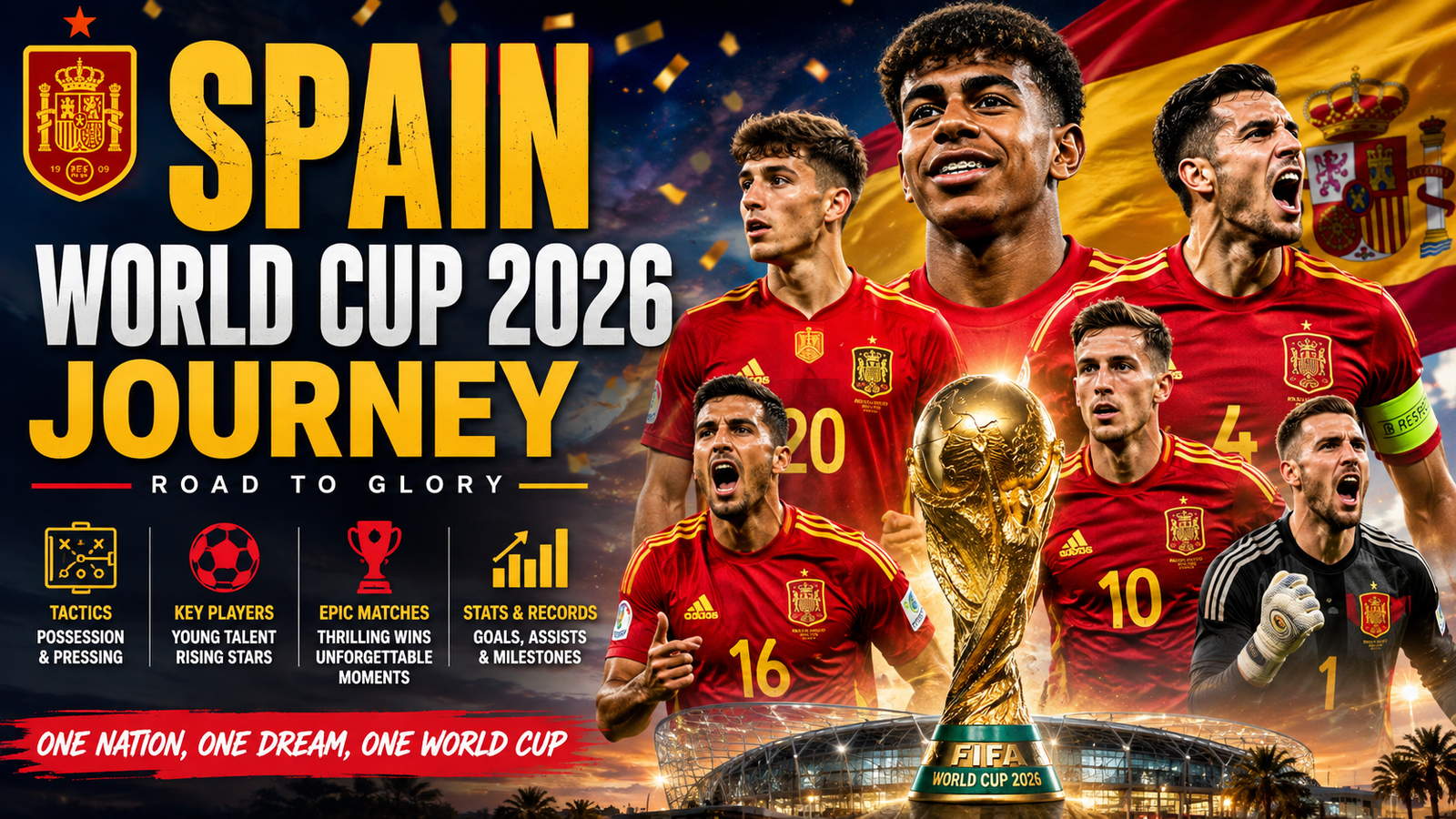
For the first time since Xavi, Iniesta and Casillas hoisted the trophy in Johannesburg 16 years ago, Spain are world champions. Spain World Cup 2026 Journey: From an anxious goalless draw against tournament newcomers Cape Verde in their opening game, the journey ended 38 days later with the most heartbreaking of finishes for Argentina as substitute Ferran Torres put one final launch past Emiliano Martínez after extra time in New Jersey to leave Messi’s fairytale send-off a dream unfulfilled
Spain, in terms of goals per campaign, have not had a more spectacular World Cup to boast but perhaps their most complete one. Luis de la Fuente’s side kept their eight-match tournament campaign to a single goal conceded an all-time record for any team to ever win the trophy on its way past co-favorites Portugal, Belgium, France and Argentina in turn-out through 2023.
It was ironic, almost, that Spain’s journey to the 2026 World Cup was so regimented under Enrique — built on stifling defensive organization, midfield control through captain Rodri and a conveyor belt of reliable match-winners called from the bench with Mikel Merino and Ferran Torres both finding late winners at key moments in the knockout stages.
There was Lamine Yamal emerging as a teenage star on the biggest stage, Pau Cubarsí marshalling a back line that made almost no mistakes, and the golden generation already crowned champions of Europe when they confirmed their preeminence as the best footballing nation. This is how Spain went from a shaky opening draw with nothing to show for their efforts, to the edge of becoming two-time world champions.
Spain World Cup 2026 Journey at a Glance
| Category | Detail |
| Tournament | FIFA World Cup 2026 (USA, Mexico, Canada) |
| Head Coach | Luis de la Fuente |
| Captain | Rodri |
| Final Position | Champions (Winners) |
| Matches Played | 8 |
| Record | 7 Wins, 1 Draw, 0 Losses |
| Goals Scored | 14 |
| Goals Conceded | 1 |
| Top Scorer | Mikel Oyarzabal |
| Best Player | Rodri (Golden Ball winner) |
| Clean Sheets | 7 of 8 matches |
Spain’s World Cup 2026 journey stands out for how rarely they were troubled defensively. Belgium’s Charles De Ketelaere was the only player from any nation to find the net against La Roja across the entire tournament — every other opponent, including Portugal, France, and Argentina, was held scoreless.
Spain’s World Cup 2026 Squad
This is Luis de la Fuente’s 26–man squad, announced on May 25, 2026 and memorable as Spain World Cup XI without a single Real Madrid player in its history – a sign of the club’s tortured domestic campaign. Rodri, who captained Manchester City.
Goalkeepers: Unai Simón (Athletic Club), David Raya (Arsenal), Joan García (Barcelona)
Defenders: Marc Cucurella (Chelsea), Alejandro Grimaldo (Bayer Leverkusen), Pau Cubarsí (Barcelona), Aymeric Laporte (Athletic Club), Marc Pubill (Atlético Madrid), Eric García (Barcelona), Marcos Llorente (Atlético Madrid), Pedro Porro (Tottenham Hotspur)
Midfielders: Pedri (Barcelona), Fabián Ruiz (Paris Saint-Germain), Martín Zubimendi (Arsenal), Gavi (Barcelona), Rodri(Manchester City)Álex Baena(Atlético Madrid)Mikel Merino(Arsenal)
Forwards: 12 Mikel Oyarzabal (Real Sociedad) 11 Dani Olmo (Barcelona) 7 Nico Williams (Athletic Club) 5 Yeremy Pino (Crystal Palace) 10 Ferran Torres (Barcelona) Borja Iglesias (Celta Vigo) Víctor Muñoz 3 Osasuna Lamine Yamal diumumkan
The squad contained 26 players, eight of them representing Barcelona alone and seven more with Premier League clubs — overwhelmingly a La Liga and Barcelona core around whom that footballing continuity played throughout the Spain World Cup 2026 journey.
Also read this: World Cup 2026 Fair Play Award | Pau Cubarsi World Cup 2026 | Shivam Dube Father Name
Spain’s Group Stage Campaign
Placed in Group H with Cape Verde, Saudi Arabia and Uruguay, Spain set up as European champions and one of the most likely winners of the World Cup — but their campaign in Brazil started nothing like anyone back home had predicted.
Spain vs Cape Verde
Spain became frustrated with a 0–0 draw in the opening match of Group D on June 15 in Atlanta. So that meant the Cape Verde were on their toes, with the islanders packing a near full-strength side and appearing in their first-ever World Cup.
A City defender lined up against them formed like a brick wall without much fuss. Spain controlled possession and territory but couldn’t break down a “watertight wall of blue jerseys,” as one report put it, and the result kicked off much soul-searching at home about whether this Spain side was simply too blunt to go all the way.
The key performers: Cape Verde’s back three and keeper were the headline act, taking centre stage in a game that saw Spain create but not score many opportunities.
Full-Time: Spain 0 Cape Verde 0
Spain vs Saudi Arabia
His side hit back even more emphatically six days later, on June 21 in Atlanta. And with Yamal scoring his first ever World Cup goal, Mikel Oyarzabal scored a brace to keep the result well beyond reach. Spain then scored four goals without reply, a response to any doubts on the back of the opener and now one step away from qualification.
Top performers: Lamine Yamal (first-ever World Cup goal), Mikel Oyarzabal (2 goals)
Full-time: Spain 4-0 Saudi Arabia
Spain vs Uruguay
Spain were already close to securing qualification, with a draw in Guadalajara on June 26 against Uruguay enough to top the group. Instead it ended up being a scrappy, low-quality affair but Spain emerged 1-0 victors thanks to Álex Baena’s goal just before half-time that finally secured top spot in Group H.
Key players: Álex Baena (match-winning goal)
Final score: Uruguay 0-1 Spain
Spain Group Stage Standings
Spain finished top of Group H with seven points from a win, a draw, and a further win, scoring five goals and conceding none across the three group games. That result meant a first-place finish and a spot in the new 32-team knockout bracket, avoiding the group runners-up path and setting up a Round of 32 meeting with Austria.
- Points earned: 7 (2W, 1D)
- Goals scored and conceded: 5 scored, 0 conceded
- Position in Group H: 1st
- Qualification: Advanced to Round of 32 as group winners
Spain’s Road Through the Knockout Stage
Spain had to win five knockout matches in a row to claim the trophy thanks to the introduction of a Round of 32 round, one more than any other World Cup winner has ever needed to overcome. Every last one of them had been cleared.
Round of 32
Spain easily negotiated the knockout stage of their tournament, the only concern coming ahead of a 3-0 win over Austria in Los Angeles on July 2 that soothed any hesitancy from the group phase itself with a clear statement to come early for what lay next.
- Opponent: Austria
- Match Highlights: England v AustriaWe controlled the match brilliantly and never allowed ‘the Stars” from going into the contest.
- Scoreline: Spain 3-0 Austria
Round of 16
Their Round of 16 meeting with Portugal, in Dallas on July 6, became one of the most sensational matches not just of the tournament but also perhaps the last significant match in Cristiano Ronaldo’s illustrious World Cup career. Spain wasted their best chance of a dull first half when Mikel Oyarzabal saw a shot dragged wide when clean through and Diogo Costa kept Portugal in it with some top saves. Portugal’s Nuno Mendes rattled the crossbar and into held at even Stevens deep in the second half. In stoppage time it was the substitutes who had to kill the game: Ferran Torres squared for fellow sub Mikel Merino, who finished coolly before sending Spain through and Ronaldo home.
- Highlights: Costa prevents Yamal and Baena with double save; Mendes hits the crossbar; Merino’s last minute winner
- Tactical- West European possession play in a Froma that was ultimately broken by an obstruction from one more substitute.
- Match result: Portugal 0-1 Spain
Quarter-final
Spain’s third round, hostile quarter-final in Los Angeles on July 10 against Belgium was the match that came closest to producing an upset of all their tournament games. They led through Fabián Ruiz’s goal in the 30th minute but Charles De Ketelaere levelled 11 minutes later, that being the only goal Spain conceded throughout the entire tournament.
Belgium, without their captain Youri Tielemans who suffered an injury beforehand and later lost goalkeeper Thibault Courtois, pressed for a winner but found one with Spain: Merino set up from the bench, tucking home after Lammens parried a Pau Cubarsí effort just moments after being introduced to net for the second straight match.
- The key moments: De Ketelaere’s equaliser, and Lammens miscue that gave Merino the winner
- Fabián Ruiz (Goal), Mikel Merino (bench-to-hero winner back to back rounds)
- Final score: Spain 2-1 Belgium
Semi-final
The July 14 semi-final in Dallas saw Spain face down the French side who many had labelled as the most attacking threat of the tournament in a line up spear-headed by an impressive Kylian Mbappé and Ousmane Dembélé. Described as a defensive masterclass of Fernando Hierro’s, Spain hardly allowed France to have any real openings on goal the whole game.
Spain advanced to their first World Cup final since winning it in 2010 thanks to Mikel Oyarzabal’s penalty in the 22nd minute and Pedro Porro’s header, the defender’s first international goal at senior level, 20 minutes from time for a convincing 2-0 semi-final win..
- Top talking points: Gaps in French defence exposed despite phenomenal attacking talent on show
- The two goals to settle the match: Oyarzabal’s penalty in the 22nd minute and Porro’s header in the 58th.minute
- Final score: France 0-2 Spain
FIFA World Cup 2026 Final
- Opponent: Argentina (reigning champions)
- Location: East Rutherford, New Jersey, MetLife Stadium — July 19, 2026
Spain were up against the defending champions, Lionel Messi’s Argentina, in what was touted as a contest billed as between the world’s top two ranked teams and Europe’s reigning champions and South America’s. Even though the scoreline remained level for well over 100 minutes, it developed into one of the most lopsided finals in recent memory.
Spain took control from the first whistle as Argentina’s Emiliano Martínez set a World Cup final record number of saves to keep his team in it while the Spaniards piled up 20 consecutive attempts and nine of their first ten corners.
In contrast, Argentina did not have a single shot on target in 90 minutes, an alarming statistic given the individual quality at Scaloni’s disposal. Argentina’s Enzo Fernández was sent off late in normal time for a second yellow and red card for a challenge on Pau Cubarsí, leaving the South Americans with ten men for the closing stages and all of extra time.
It finally came in the 104th minute of extra time. At the far post, Nico Williams nodded down a Pedro Porro cross before substitute Ferran Torres on for Mikel Oyarzabal since the 62nd minute volleyed into the roof of the net from close range in the 106th minute. It was the first goal of the tournament for Torres, and it turned out to be all anyone needed.
- Goals and assists: Ferran Torres (goal, 106′), assisted by Nico Williams’ flick-on from a Pedro Porro cross
- Full match stats: Spain had dominance in possession, shots and territory for virtually the whole match; Argentina played out a hugely disappointing second half with 10 men after Enzo Fernández was red carded; The Albiceleste managed only two attempts (0.2 expected goals) to Spain’s 20 shots and 1.94 expected goals
- That trophy-winning moment: Torres’s strike 106 minutes in, triggering wild celebrations along the Spanish bench and giving them a 1-0 extra-time win
Final score: Spain 1-0 Argentina (after extra time)
That victory brought Spain their second world title, having previously lifted the trophy for the first time in South Africa in 2010 while denying Messi his chance of back-to-back medals as it was widely assumed would be the last World Cup appearance of the Argentinian superstar’s career.
Spain’s Best Players of the Tournament
Rodri — The best player of the tournament, with all but one game (final aside) played as Spain’s midfield general, controlling games from deep as he set the tempo that continuously worked in conjunction with an almost perfect defensive record throughout.
Lamine Yamal — Scored against Saudi Arabia in his first WC as a teen and dribbled fear into defenders all tourney, played pivotal role in final’s winning move.
Pedri — The Barcelona playmaker was involved in the possession game to orchestrate play from midfield alongside Rodri over Spain World Cup 2026 campaign.
Nico Williams — The Athletic Club wide man set up Ferrand Torres’ winner in the final, after a tournament of penetrating, high-intensity wings play.
Dani Olmo — A creative hub both for the group and knockout stages, influential during build-up play throughout the tournament.
Pau Cubarsí (Spain) — A linchpin of the defence which only conceded one goal in eight matches at 19, he was also fouled for the red card that swung a tense Spanish final win.
Unai Simón – Out-and-out No.1 throughout, whose defence in front of him did much of the legwork, but was a solid reassuring presence each and every match Spain played.
Spain’s Tactical Masterclass
Luis de la Fuente was relentless with his method, as he had been throughout Spain World Cup 2026 journey: pragmatic and possession-based; a fundamental control of midfield built on what is now (the world will always find the right name for things, even in hindsight) Rodri-Pedri double pivots playing around a front three that rotated from Yamal to Williams to Olmo and Oyarzabal, laborious if you want against stiffer opposition that defended as blocks.
The ball is mine: In all of their matches — beginning with the group stage against Cape Verde and Saudi Arabia through to the final, when Spain led 20-2 in shots to Argentina — La Roja dominated possession.
Defensive organisation: The hallmark of Spain’s campaign was defensive solidity—seven clean sheets from eight matches and just one goal conceded in the entire tournament, a record for any World Cup winning team.
Pressing system: Spain’s high press won them the ball time and again, transferable in dangerous zones (notably for Pedri to get his chance or for Dani Olmo’s role in the winner against Portugal).
Attacking transitions: You were trained through opportunities, generally in fast combinations: Williams created a profit flick to Torres in the final, Ruiz and Merino were transformed Against Belgium rebounds.
Squad rotation and bench impact: This was perhaps the single biggest tactical story of the tournament, as De la Fuente repeatedly turned to his subs…. Spain’s most decisive players off the bench — Mikel Merino (two winning goals against Portugal and Belgium) along with Ferran Torres in the final, all three of Spain’s major goals came from substitutes.
Spain World Cup 2026 Match Results
| Stage | Opponent | Result | Score |
| Group Stage | Cape Verde | Draw | 0-0 |
| Group Stage | Saudi Arabia | Win | 4-0 |
| Group Stage | Uruguay | Win | 1-0 |
| Round of 32 | Austria | Win | 3-0 |
| Round of 16 | Portugal | Win | 1-0 |
| Quarter-final | Belgium | Win | 2-1 |
| Semi-final | France | Win | 2-0 |
| Final | Argentina | Win (aet) | 1-0 |
Spain World Cup 2026 Statistics
- Total matches: 8
- Wins: 7 (1 draw, 0 losses)
- Goals scored: 14
- Goals conceded: 1
- Clean sheets: 7
- Top scorer: Mikel Oyarzabal
- Notable contributors: Mikel Merino (two knockout-stage winning goals from the bench), Ferran Torres (World Cup-winning goal), Lamine Yamal, Álex Baena, Fabián Ruiz, Pedro Porro
- Unbeaten run: Spain extended their unbeaten streak to 38 matches (29 wins, 9 draws) by the end of the tournament — the longest such run by any European national team in history, surpassing Italy’s 37-match streak from 2018-2021
Key Moments That Defined Spain’s Journey
Spain’s Best goal of the tournament: Ferran Torres’ Extra-time winner in final- A First time finish off Nico Williams’s flick-on to win the World Cup.
Biggest comeback/resilience: Bouncing back from the agony of a goalless opening against Cape Verde to remain unbeaten through to lifting the trophy.
Best moment as an individual: Mikel Merino, who has made a habit of coming off the bench and scoring a winning goal within minutes (in two consecutive knockout rounds against Portugal and Belgium).
Breakthrough star: Lamine Yamal, a teenager playing his first World Cup, opened the scoring in the 4-0 win over Saudi Arabia and was directly involved in the championship-winning move of the final.
Moment of tactical change: De la Fuente’s introduced subs who made an impact — all three of Spain’s most decisive goals came from his bench in the tournament as Merino and Torres proved excellent strikers.
Record-breaking achievement: Spain conceded just one goal across the entire tournament, the fewest ever by a World Cup-winning team in a single edition.
Spain’s Biggest Strengths
- Teenage attacking talent: Lamine Yamal and Pau Cubarsí both play leading roles over the course of the campaign
- Midfield supremacy: Rodri and Pedri provided Spain with control in virtually every game they played
- Stat of the tournament: One goal conceded in eight matches defensive stability
- The depth of the squad: The two most significant goals scored by Spain in the knockout stage were netted by substitutes Mikel Merino and Ferran Torres
- Tactical flexibility: How easily De la Fuente was able to grind out results against Uruguay, Portugal and Argentina compared to Spain grinding out comfortable in a more expansive fashion vs Saudi Arabia and a good Austria side
Spain’s Challenges During the Tournament
- Tough opponents: Spain faced Portugal, Belgium, France, and Argentina in the knockout stage — arguably the toughest possible run to the title
- Slow start: The opening 0-0 draw with Cape Verde raised early questions about Spain’s cutting edge in front of goal
- Pressure in knockout matches: Four of Spain’s five knockout games were won by a single goal or through extra time, underlining how tight the margins were despite their dominance
- Finishing efficiency: Spain often generated far more chances and expected goals than they converted, relying on moments of individual quality or late substitute impact to break down stubborn defences
Spain World Cup 2026 Records
- Team record: Fewest goals conceded (1) by any World Cup-winning team in a single tournament
- Team record: Longest unbeaten run by a European national team in history (38 matches, 29 wins, 9 draws), surpassing Italy’s previous 37-match record
- Historic milestone: Spain’s second World Cup title, joining a select group of nations to win the tournament more than once, 16 years after their maiden triumph in 2010
- Individual milestone: Rodri named the tournament’s Best Player (Golden Ball) while captaining the side to the title
- Individual milestone: Pedro Porro scored his first-ever international goal in the semi-final against France
What Spain’s World Cup 2026 Success Means for the Future
This Spain side spearheaded by Lamine Yamal, Pau Cubarsí and Pedri looks made for the next decade of world football. The combination of a core fronted by Barcelona players, seasoned winners like Rodri and impact substitutes such as Merino and Torres provides Spain with something they may be able to take into UEFA Euro 2028 and beyond.
Already winners of Euro 2024 before subsequently claiming the World Cup in 2026, this generation now lays a valid claim to be ranked as among the best ever to represent their country and with an ongoing unbeaten run, future tournament appearances offer only heightened expectation.
Conclusion
Spain World Cup 2026 Journey: A team that hardly ever panicked, relied on its bench when it needed to and built an entire World Cup around preventing goals rather than just scoring more than the other guy. From the nervy draw with Cape Verde, to Mikel Merino’s back-to-back knockout winners, Pedro Porro’s maiden international goal and Ferran Torres’s extra-time strike in the final, this was a campaign characterized by composed pressure play and a squad deep enough to continue digging up new heroes.
Sixteen years on from the moment Vicente del Bosque’s side first hoisted that trophy up in the Berlin sky, Luis de la Fuente has handed Spain their second World Cup — and with a burgeoning young, hungry core yet to arrive, this chapter of Spanish football may be barely begun.
FAQs
1. How did Spain perform in the FIFA World Cup 2026?
Spain won the tournament, going unbeaten across all eight matches (seven wins, one draw), conceding just a single goal, and beating Argentina 1-0 after extra time in the final.
2. Who was Spain’s top scorer in the 2026 World Cup?
Mikel Oyarzabal was Spain’s top scorer, contributing goals including a brace against Saudi Arabia and a penalty in the semi-final win over France.
3. Which teams did Spain defeat during their World Cup 2026 journey?
Spain defeated Saudi Arabia, Uruguay, Austria, Portugal, Belgium, France, and Argentina, drawing only with Cape Verde in the group stage.
4. Who was Spain’s best player at the FIFA World Cup 2026?
Captain Rodri was named the tournament’s Best Player, winning the Golden Ball while marshalling Spain’s midfield throughout the campaign.
5. Who coached Spain during the 2026 FIFA World Cup?
Luis de la Fuente coached Spain to the title, having previously led the team to UEFA Euro 2024 glory.
6. What was Spain’s biggest win in the 2026 World Cup?
Spain’s biggest win was their 4-0 group-stage victory over Saudi Arabia, featuring Lamine Yamal’s first World Cup goal and a Mikel Oyarzabal brace.
7. How many goals did Spain score in the FIFA World Cup 2026?
Spain scored 14 goals across eight matches while conceding only one.
8. Did Spain win the FIFA World Cup 2026?
Yes. Spain won the FIFA World Cup 2026, beating Argentina 1-0 after extra time in the final on July 19, 2026, at MetLife Stadium in New Jersey, for their second World Cup title after 2010.