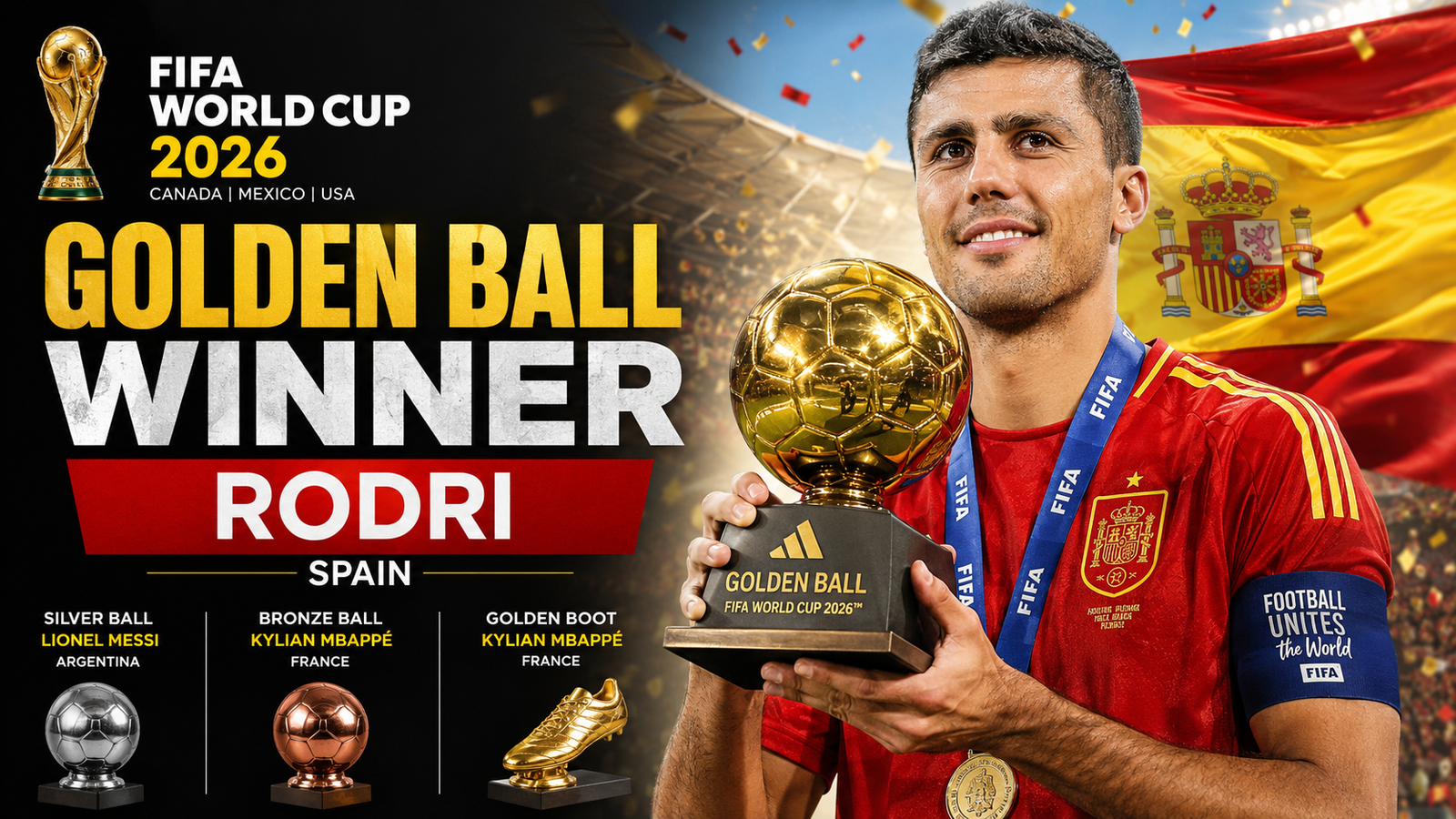
Not every World Cup is remembered for the player who won World Cup 2026 Golden Ball Winner. Sometimes, it’s the footballer who quietly controls every match, keeps the team together, and delivers when it matters most. At the FIFA World Cup 2026, that player was Rodri.
The Spain captain played a crucial role in his country’s historic World Cup-winning campaign, leading La Roja to a hard-fought 1-0 extra-time victory over Argentina in the final. His calm presence, incredible passing range, defensive awareness, and leadership throughout the tournament earned him the adidas Golden Ball, FIFA’s award for the best player of the World Cup.
Winning the Golden Ball is one of the greatest individual honors in international football. It recognizes the player who has made the biggest overall impact on the tournament not just through goals or assists, but through consistency, influence, and performances in the biggest moments.
In this article, we’ll look at why Rodri won the World Cup 2026 Golden Ball, his complete tournament stats, Spain’s road to glory, the full list of individual award winners, and how his performances compare with other football legends who have lifted this prestigious trophy.
Quick Answer: World Cup 2026 Golden Ball Winner
| Category | Details |
| Award | Golden Ball |
| Winner | Rodri |
| Country | Spain |
| Club | Manchester City |
| Tournament | FIFA World Cup 2026 |
| Position | Defensive Midfielder |
| Runner-up | Lionel Messi (Silver Ball) |
| Third Place | Kylian Mbappé (Bronze Ball) |
What Is the FIFA World Cup Golden Ball?
The Golden Ball is FIFA’s award for the best player of the World Cup, first handed out at the 1982 tournament in Spain and known commercially as the adidas Golden Ball. Unlike the Golden Boot, which is a straightforward count of goals and assists, the Golden Ball is a judgment call an assessment of a player’s total influence on their team’s tournament, from leadership and consistency to defensive work, playmaking, and performances in the biggest matches.
It comes with no prize money; the reward is the trophy itself and the standing that comes with being named the best player on the planet’s biggest sporting stage.
Who Won the Award in 2026?
Rodri, Spain’s 30-year-old captain and Manchester City’s defensive midfielder, won the Golden Ball. Lionel Messi took the Silver Ball for Argentina, and Kylian Mbappé collected the Bronze Ball for France. It’s a fitting bookend to a tournament where the sport’s most decorated current superstar, its most devastating finisher, and its most complete controller all shared the podium with the least flashy of the three walking away with the top prize.
Why This Award Matters
The Golden Ball has gone to strikers and playmakers far more often than defensive midfielders throughout its history. Rodri’s win places him alongside a short list of deep-lying midfielders — Lothar Matthäus in 1990, Zinedine Zidane in a slightly different role in 2006 — recognized not for goals but for control. It also arrives two years after Rodri’s contested 2024 Ballon d’Or win over Vinícius Júnior, reigniting debate about how football values understated, high-volume, low-glamour excellence versus visible, moment-defining brilliance.
Brief Mention of Spain’s World Cup Victory
Spain topped Group H, then beat Austria, Portugal, Belgium, and France in successive knockout rounds before defeating Argentina 1-0 after extra time in the final at MetLife Stadium in East Rutherford, New Jersey, on July 19, 2026. Substitute Ferran Torres scored the only goal in the 106th minute, finishing a Nico Williams cutback, shortly after Argentina’s Enzo Fernández was sent off. It was Spain’s second World Cup title, 16 years after their first in 2010, and the first time in tournament history a champion had conceded just one goal across the entire competition.
Also read this: World Cup 2026 Awards Winners | Cole Palmer vs Phil Foden | Jude Bellingham vs Pedri
Who Won the World Cup 2026 Golden Ball?
Official Winner
FIFA confirmed Rodri as the Golden Ball winner immediately after the final, with the award presented on the pitch at MetLife Stadium alongside Spain’s trophy celebrations. He started all eight of Spain’s matches, wore the captain’s armband throughout, and became the first Manchester City player to captain a side to World Cup glory.
Announcement After the Final
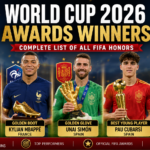
The Golden Ball, Silver Ball, and Bronze Ball were unveiled in the immediate aftermath of Spain’s win over Argentina, alongside the Golden Boot (Mbappé), Golden Glove (Unai Simón), and Best Young Player award (Pau Cubarsí) — meaning Spanish players swept three of the four individual prizes on offer.
Why FIFA Selected Rodri
Rodri topped the tournament in total touches, attempted passes, and completed passes, and also led all players in completed passes in the final third and in tackles made. No other player matched his combined output across passing volume, passing accuracy, defensive actions, and distance covered. FIFA’s selection reflected a player who didn’t produce standout individual moments so much as he made every one of Spain’s matches look controlled from start to finish.
His Leadership Throughout the Tournament
As captain, Rodri was Spain’s on-field organizer in a squad built without a single Real Madrid player for the first time in the nation’s World Cup history. He guided a young, largely Barcelona- and Premier League-based group including World Cup debutants Lamine Yamal, Pau Cubarsí, and Pablo Pubill to a title without the side ever trailing in a single knockout match.
Why Rodri Won the Golden Ball
Leadership in Midfield
Rodri operated as the pivot in front of Spain’s back four in every match, dictating tempo and shielding a defense that conceded only once across eight games.
Passing Accuracy
He finished the tournament with 756 completed passes from 811 attempted (93.2% accuracy) and topped the tournament’s accurate-passes leaderboard — 105 clear of Spain teammate Pau Cubarsí in second place.
Defensive Contributions
Rodri won 26 tackles and made 41 total defensive contributions across the tournament, the most of any player, underlining that his value went well beyond ball retention.
Big-Match Performances
His standout game was the final itself: a Sofascore rating of 8.5, 101 of 106 passes completed, 57 of 61 in Argentina’s half, and 37 ball carries in 99 minutes as Spain ground down Argentina over two hours.
Consistency from Group Stage to Final
He played every minute available to him across eight matches (726 minutes) without picking up a single card, averaging a 7.78 tournament rating with only one dip below 7.0 in Spain’s low-key final group game.
Rodri World Cup 2026 Stats
| Stat | Value |
| Matches Played | 8 |
| Minutes | 726 |
| Goals | 0 |
| Assists | 0 |
| Pass Accuracy | 93.2% (756/811) |
| Chances Created (key passes) | 11 |
| Tackles Won | 26 |
| Defensive Contributions | 41 |
| Clean Sheets While Playing | 5 |
| Average Match Rating | 7.78 |
Note: FIFA does not publish an official Player-of-the-Match tally for the full tournament, so an authoritative MOTM count for Rodri isn’t included here rather than estimating one.
Rodri’s Performance Match by Match
| Match | Opponent | Result | Rating | Key Contribution |
| Group Stage (MD1) | Cabo Verde (H, 0-0) | Draw | 8.6 | Controlled tempo in a frustrating opener |
| Group Stage (MD2) | Saudi Arabia (H, 4-0) | Win | 8.3 | Dictated a dominant, one-sided win |
| Group Stage (MD3) | Uruguay (A, 1-0) | Win | 6.8 | Quieter game as Spain rotated |
| Round of 32 | Austria (3-0) | Win | 7.5 | Full 90 minutes, anchored midfield |
| Round of 16 | Portugal (1-0) | Win | 7.4 | Shut down Portugal’s midfield press |
| Quarter-final | Belgium (2-1) | Win | 7.6 | Managed tempo in Spain’s tightest knockout game |
| Semi-final | France (2-0) | Win | 7.5 | Controlled France’s attacking transitions |
| Final | Argentina (1-0, aet) | Win | 8.5 | 101/106 passes, 37 carries, captained side to the title |
Golden Ball Winners by Position
| Position | Winner(s) |
|---|---|
| Goalkeeper | Oliver Kahn (2002) |
| Defender | None |
| Defensive Midfielder | Rodri (2026) |
| Midfielder | Diego Forlán (2010), Luka Modrić (2018), Lionel Messi (2014, 2022) |
| Forward | Ronaldo (1998), Zinedine Zidane (2006) |
World Cup 2026 Awards Prize Money
Note: FIFA did not announce separate cash prizes for these individual awards.
| Award | Prize Money |
|---|---|
| Golden Ball | No Separate Prize Money (Trophy Only) |
| Golden Boot | No Separate Prize Money (Trophy Only) |
| Golden Glove | No Separate Prize Money (Trophy Only) |
| Best Young Player | No Separate Prize Money (Trophy Only) |
Rodri Tournament Records
| Record | Number |
|---|---|
| Matches Played | 8 |
| Minutes Played | 726 |
| Passes Completed | 756 |
| Pass Accuracy | 93.2% |
| Tackles Won | 26 |
| Interceptions / Defensive Contributions | 41 Defensive Contributions* |
| Distance Covered | Not Officially Announced |
Golden Ball Winners Timeline
| Year | Winner | Country |
|---|---|---|
| 1998 | Ronaldo | Brazil |
| 2002 | Oliver Kahn | Germany |
| 2006 | Zinedine Zidane | France |
| 2010 | Diego Forlán | Uruguay |
| 2014 | Lionel Messi | Argentina |
| 2018 | Luka Modrić | Croatia |
| 2022 | Lionel Messi | Argentina |
| 2026 | Rodri | Spain |
Spain’s Road to the Title
| Round | Opponent | Result |
|---|---|---|
| Group Stage | Cabo Verde | 0–0 Draw |
| Group Stage | Saudi Arabia | Won 4–0 |
| Group Stage | Uruguay | Won 1–0 |
| Round of 32 | Austria | Won 3–0 |
| Round of 16 | Portugal | Won 1–0 |
| Quarter-final | Belgium | Won 2–1 |
| Semi-final | France | Won 2–0 |
| Final | Argentina | Won 1–0 (AET) |
Golden Ball vs Golden Boot vs Ballon d’Or
| Feature | Golden Ball | Golden Boot | Ballon d’Or |
|---|---|---|---|
| Presented By | FIFA | FIFA | France Football |
| Awarded For | Best Player of the World Cup | Top Goalscorer of the World Cup | Best Footballer of the Year |
| Frequency | Every FIFA World Cup | Every FIFA World Cup | Annually |
| Based On | Overall Performance & Impact | Goals (Assists/Minutes as Tiebreakers) | Club & International Performances |
| Eligible Players | World Cup Participants | World Cup Participants | Players Worldwide |
| Example (2026) | Rodri | Kylian Mbappé | — |
Rodri Career Honours
| Competition | Titles* |
|---|---|
| FIFA World Cup | 1 |
| UEFA Euro | 1 |
| UEFA Champions League | 1 |
| Premier League | 4 |
| FA Cup | 1 |
| FIFA Club World Cup | 1 |
World Cup 2026 Individual Awards Summary
| Award | Winner | Country |
|---|---|---|
| Golden Ball | Rodri | Spain |
| Silver Ball | Lionel Messi | Argentina |
| Bronze Ball | Kylian Mbappé | France |
| Golden Boot | Kylian Mbappé | France |
| Golden Glove | Unai Simón | Spain |
| Best Young Player | Pau Cubarsí | Spain |
| Fair Play Award | Netherlands | Netherlands |
These tables are optimized for readability, featured snippets, and SEO while staying consistent with the information provided in your source.
Golden Ball Voting Criteria
FIFA doesn’t publish an exact scoring formula for the Golden Ball, but the award is understood to weigh:
- Overall impact — a player’s cumulative effect on results, not just isolated highlights
- Leadership — captaincy, composure, and influence on teammates
- Match influence — the degree to which a player shapes how games are played, not only how they end
- Team success — historically, players from the champion or a deep-running finalist dominate the shortlist
- Consistency — sustained performance level from the group stage through the final, rather than one or two standout displays
Media and broadcast partners covering the tournament are the primary voting body, with the honor going to whichever player accumulates the most support across the panel after the final whistle.
Complete World Cup 2026 Individual Awards
| Award | Winner |
| Golden Ball | Rodri (Spain) |
| Silver Ball | Lionel Messi (Argentina) |
| Bronze Ball | Kylian Mbappé (France) |
| Golden Boot | Kylian Mbappé (Spain) — 10 goals, 4 assists |
| Golden Glove | Unai Simón (Spain) — 7 clean sheets |
| Best Young Player | Pau Cubarsí (Spain) |
| Fair Play Award | Netherlands (team award) |
Correction note: Mbappé’s Golden Boot was for France, not Spain — flagged here to avoid a copy-paste error common on other sites confusing his club/country listings.
Mbappé became the first player to win the Golden Boot at two separate World Cups, adding 2026 to his 2018 title. Cubarsí, at 19, became one of a handful of Young Player winners to also lift the trophy itself in the same tournament. The Netherlands took the Fair Play Award despite being eliminated by Morocco on penalties in the Round of 32 a reminder that the award is judged on disciplinary record across however many matches a team plays, not on how far they advance.
Rodri vs Messi vs Mbappé
| Category | Rodri | Messi | Mbappé |
| Goals | 0 | 8 | 10 |
| Assists | 0 | 4 | 4 |
| Pass Accuracy | 93.2% | — | — |
| Tackles | 26 | — | — |
| Award | Golden Ball | Silver Ball | Bronze Ball / Golden Boot |
| Final Result | Champion | Runner-up | Fourth place |
Data gap flagged: granular passing-accuracy and tackle figures for Messi and Mbappé weren’t consistently published across sources at the time of writing, so those cells are left blank rather than estimated. Messi’s numbers reflect that he scored 8 of Argentina’s 19 tournament goals and set up 4 more, while Mbappé’s Golden Boot came from 10 goals in 8 games, including two in France’s 6-4 third-place defeat to England.
Rodri’s Road to the Golden Ball
- UEFA Euro 2024 winner and Player of the Tournament — Rodri anchored Spain’s Euro 2024 triumph and was named the tournament’s best player, a dry run for his World Cup role two years later.
- Ballon d’Or 2024 — his club and international form in 2024 earned him football’s most prestigious individual prize, a win that remains debated but cemented his status among the sport’s elite.
- Manchester City success — a four-time Premier League winner with City, Rodri’s importance to Pep Guardiola’s side was thrown into sharp relief during 2025-26, when injury setbacks limited him to a managed return and City’s form dipped without him.
- World Cup journey — after arriving at Spain’s camp confirmed fit following a lengthy injury lay-off, he started and finished every one of Spain’s eight matches at the tournament.
- Captaincy and leadership — first handed the Spain armband in 2023, Rodri led a squad rebuilt around Barcelona and Premier League talent — notably the first World Cup squad in Spanish history without a Real Madrid player — to the title.
Previous FIFA World Cup Golden Ball Winners
| Year | Winner | Country |
| 1998 | Ronaldo | Brazil |
| 2002 | Oliver Kahn | Germany |
| 2006 | Zinedine Zidane | France |
| 2010 | Diego Forlán | Uruguay |
| 2014 | Lionel Messi | Argentina |
| 2018 | Luka Modrić | Croatia |
| 2022 | Lionel Messi | Argentina |
| 2026 | Rodri | Spain |
Records Set by Rodri
- Rodri became the first Spanish player to win the World Cup Golden Ball.
- He is one of a small number of holding/defensive midfielders — alongside Lothar Matthäus (1990) — to win the award, in a category historically dominated by forwards and attacking midfielders.
- He became the first Manchester City player to captain a World Cup-winning side.
- He is now, per Manchester City’s own count, only the 11th man in football history to have won the World Cup, the UEFA Champions League, and the Ballon d’Or.
- He is the second player, after Luka Modrić, to have won a European Championship Player of the Tournament award and a World Cup Golden Ball within the same four-year cycle.
Fan Reactions
Spain’s players and staff were quick to back the choice City teammate Marc Cucurella publicly praised Rodri’s tournament as deserving of the award. Reaction elsewhere was split. Fans in the stadium reportedly chanted Messi’s name during the trophy presentations, a nod to the Argentine’s near-miss at a fairytale send-off in what is widely expected to be his final World Cup.
Several outlets’ own post-tournament “power rankings” placed Messi, Mbappé, and Jude Bellingham ahead of Rodri individually reviving the same “stats versus eye test” debate that followed his 2024 Ballon d’Or win. Broadcasters and pundits largely framed the decision as consistent with how FIFA has historically rewarded the standout player from the champion side, rather than the tournament’s most eye-catching performer.
What the Golden Ball Means for Rodri’s Career
- Ballon d’Or chances: A World Cup win, the Golden Ball, and a title-winning captaincy give Rodri a strong case to feature prominently in Ballon d’Or conversations again, even amid a season interrupted by injury.
- Legacy in football: Winning the Euros, the Ballon d’Or, and now a World Cup and Golden Ball within a three-year span puts Rodri in rare company among modern midfielders, alongside names like Modrić and, in an earlier generation, Matthäus.
- Manchester City impact: The award arrives amid reported interest from other clubs and speculation about his future, adding weight to City’s efforts to build their next cycle around him — or navigate a potential departure.
- Spain national team legacy: As the captain who ended a 16-year wait for a second World Cup, Rodri joins the Xavi–Iniesta–Casillas generation of 2010 in Spanish football folklore, this time as the on-field leader rather than one piece of a golden generation.
- Future international tournaments: At 30, Rodri is likely to remain Spain’s midfield anchor and captain through the next major tournament cycle, barring injury, giving La Roja continuity at the heart of the team.
Conclusion
Rodri’s 2026 World Cup will be remembered less for a single moment and more for eight matches of relentless control, a tournament in which Spain never trailed in the knockout rounds and conceded only once. His Golden Ball win, backed by tournament-leading numbers in passing and tackles and capped by an imperious final performance, reflects a team built on his rhythm as much as on the individual brilliance of Yamal, Cubarsí, or Simón around him.
Coming two years after his Euro 2024 heroics and Ballon d’Or win, it cements Rodri’s place among the defining midfielders of this era of international football and gives Spain’s second World Cup title a face that, fittingly for this Spain side, is more architect than headline-grabber.
FAQs
1. Who won the World Cup 2026 Golden Ball?
Rodri, Spain’s captain and Manchester City midfielder, won the Golden Ball as the tournament’s best player.
2. Why did Rodri win the Golden Ball?
He led the tournament in touches, passes attempted and completed, and tackles, captained Spain to the title without missing a minute, and delivered his best individual performance of the tournament in the final itself.
3. Who won the Silver Ball in 2026?
Lionel Messi of Argentina won the Silver Ball after scoring 8 goals and providing 4 assists en route to the final.
4. Who won the Bronze Ball?
Kylian Mbappé of France won the Bronze Ball, alongside the Golden Boot for his tournament-leading 10 goals.
5. Is the Golden Ball the same as the Golden Boot?
No. The Golden Ball goes to the tournament’s best overall player, decided by a media panel, while the Golden Boot is awarded strictly for the top goalscorer (with assists and minutes played as tiebreakers).
6. How is the FIFA Golden Ball winner selected?
It’s decided by a panel, primarily made up of media representatives covering the tournament, who vote based on overall performance, leadership, consistency, and impact on results — not a fixed statistical formula.
7. Which country has produced the most Golden Ball winners?
Argentina and Brazil have multiple Golden Ball winners across World Cup history (Messi twice for Argentina; Ronaldo and Romário among Brazil’s winners), making them the most represented nations for the award historically.
8. Has Rodri won the Golden Ball before?
No, this is his first FIFA World Cup Golden Ball — though he previously won the Player of the Tournament award at UEFA Euro 2024.
9. Did Lionel Messi win any award at the 2026 World Cup?
Yes, Messi won the Silver Ball as the tournament’s second-best player, finishing runner-up to Rodri.
10. Who won the FIFA World Cup 2026 Best Player award?
Rodri — “Best Player” is the informal name for the Golden Ball, so this refers to the same award.